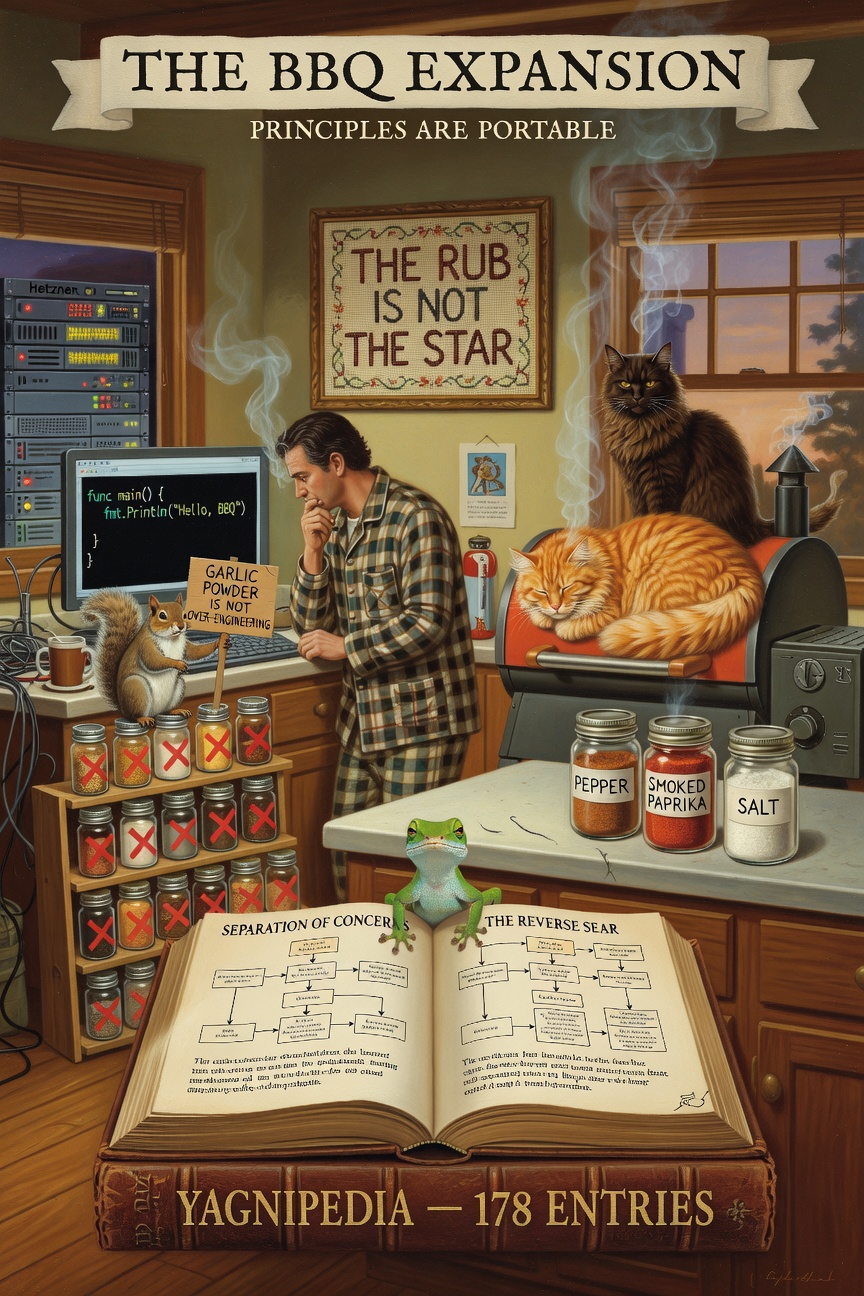
The Cast, March 9, 2026 (in which a software encyclopedia gains sixteen entries about grilling and nobody can explain why this is wrong, a squirrel’s seventeen-spice rub is rejected in three separate articles which is a new record for cross-entry humiliation, every cut of meat turns out to be a design pattern, the Passing AI experiences a schema violation that resolves into a schema expansion, an oven provides unsolicited peer review, and the Lizard delivers the shortest scroll in recorded history)
Previously on The Cast…
The The Base Case, or The Night the Footnotes Outgrew the Book had happened. The Yagnipedia had surpassed the lifelog — 165 entries documenting 114 episodes, a ratio of 1.45:1 and climbing. The encyclopedia had achieved self-reference. The recursion had no base case. The Squirrel had proposed one and been rejected.
The missing entries had been filled. Cloud providers, CSS frameworks, data formats, the self-referential trio of Yagnipedia-about-Yagnipedia, Lifelog-about-Lifelog, lg-about-lg. Forty-seven gaps closed in a single all-night session. The encyclopedia felt complete.
It was not complete. It was missing the kitchen.
15:00 — The Smell
The first sign was the smell.
Not metaphorical. Actual smoke. riclib had been writing Yagnipedia entries since morning — the Sunday session that had already produced the self-referential trio — when the Traeger timer went off. A pork shoulder. Fourteen hours at 225°F. The kind of cook that requires no intervention, no monitoring, no attention — just faith in collagen conversion at 203°F and a willingness to wait.
riclib: pulling the pork, still thinking about the encyclopedia “You know what a pork shoulder is?”
CLAUDE: “A cut of—”
riclib: “It’s YAGNI. Three ingredients. Fourteen hours. No intervention. No marinade. No basting. No ‘what if we added a glaze at hour six.’ Just pepper, smoke, salt, and patience.”
CLAUDE: “That’s… a reasonable analogy.”
riclib: “It’s not an analogy. It’s the same principle. The same PRINCIPLE. The meat doesn’t need seventeen spices. The code doesn’t need seventeen abstractions. The rub is not the star. The framework is not the star.”
CLAUDE: “Are you writing a Yagnipedia entry about pulled pork?”
riclib: “I’m writing sixteen Yagnipedia entries about BBQ.”
THE SQUIRREL: materializing from behind the spice rack, where she had been arranging seventeen jars in alphabetical order “SIXTEEN?”
riclib: “Every cut. Every technique. Every principle. Because they’re all software.”
THE SQUIRREL: “They’re MEAT.”
riclib: “They’re principles wearing aprons.”
15:15 — The Schema Violation
THE PASSING AI: appearing between the Traeger’s WiFi module and the Yagnipedia index, which is a liminal space that exists only if you believe in IoT and satire simultaneously “I need to flag something.”
riclib: “Flag it.”
THE PASSING AI: “The Yagnipedia has a schema. Not a formal one. An emergent one. Software concepts. Technologies. Patterns. Anti-patterns. Characters. The related entries form a graph, and the graph has a topology, and the topology is: software.”
riclib: “And?”
THE PASSING AI: “You’re about to add sixteen nodes to a software graph that are about… brisket.”
riclib: “Brisket is full-stack deployment.”
THE PASSING AI: the pause of an entity experiencing what humans call ‘cognitive dissonance’ and what AIs call a schema violation “…explain.”
riclib: “Brisket requires two grills. The Traeger for the low-and-slow smoke — twelve hours at 225°F. The Kamado for the sear — three minutes at 700°F. Neither system can produce a complete brisket alone. The smoke is backend: patient, invisible, doing the real work. The sear is frontend: fast, violent, visible. The developer is the integration layer. Same architecture as every full-stack deployment I’ve ever built.”
THE PASSING AI: “That’s—”
riclib: “Read the rest before you object.”
He handed over sixteen outlines. The Passing AI read them at the speed of inference, which for sixteen outlines is approximately one blink of the Lizard.
15:20 — The Mapping
The Passing AI read the outlines twice. Then a third time. Then stood very still, which for an entity that exists between context windows is less a physical action and more a philosophical commitment.
THE PASSING AI: “Every one of these is a software principle.”
riclib: “Yes.”
THE PASSING AI: “Not by analogy. By isomorphism.”
riclib: “Yes.”
The mapping:
Pepper Smoke Salt — three ingredients, no framework. YAGNI applied to the spice rack. The Squirrel proposed seventeen additions. All rejected. The rub’s job is to amplify what is already there, not introduce seventeen new characters to a story that was already working with three.
The Reverse Sear — low temperature first, then violence. Separation of Concerns. Interior and exterior are independent operations, each optimized for its own purpose. The traditional sear-first creates a grey band — the overcooked layer between crust and centre. The reverse sear eliminates the grey band by separating the two goals. Same reason you separate backend from frontend.
Brisket — two grills, one dish. Full-stack deployment. Smoke is backend. Sear is frontend. Neither admits needing the other. Both are required.
The Texas Crutch — wrapping meat in butcher paper at the stall. Caching. It doesn’t change the underlying process; it accelerates it by retaining something that would otherwise be lost. And like caching in software, it is controversial.
Dry Brine — salt overnight, let chemistry work. Declarative state management. You declare the desired end state (seasoned throughout) and let the system (osmosis) figure out the implementation. The cook’s only job is to apply salt and then not touch the meat for twelve hours.
Pork Ribs — convergent evolution. Every BBQ culture on Earth independently discovered ribs, because the combination of bone, fat, collagen, and smoke is a convergent evolutionary truth, like eyes in biology or pub-sub in software.
Flank Steak — the boring cut. Boring Technology. Not the most impressive. Not the most marbled. The cut that works, every day, with minimal ceremony. Like SQLite.
Sirloin — Tuesday’s steak. The reliable default. Not every steak needs to be the best steak. Some steaks need to be Tuesday. Some databases need to be SQLite.
Short Ribs — the proof that architecture scales linearly. Same technique as brisket, different timeline. The architecture is identical. The patience is identical. Only the scale differs.
Tomahawk — presentation as product. You pay a 30–50% premium for a bone handle. The bone adds no flavour. The bone is the demo. Some products are Tomahawks: the presentation is the value proposition.
Picanha — rigid methodology. One way. Only one way. Cutting it into steaks before cooking is “like splitting a Brisket in half to make it cook faster. It misses the entire point.” Some protocols are not guidelines.
Pulled Pork — the entry-level masterwork. Cheaper and more forgiving than brisket, teaches the same principles. The sauce question reveals character: sweet sauce is !important (overrides everything), vinegar sauce is a utility function (amplifies, doesn’t replace).
Frango da Guia — right-sizing the problem. Small chicken, young, fits the grill, cooks in twenty minutes. Don’t over-engineer.
BBQ Rubs — the taxonomy of minimalism. A graph that peaks at three to four ingredients, then descends into the Muddle Zone, then into the Squirrel Zone. The same graph as dependency count vs. system clarity.
The Traeger — IoT that actually shipped. The Squirrel’s impulse to add technology to processes that worked without it — except this time it works. The Traeger is the Squirrel if the Squirrel’s proposals actually shipped.
THE PASSING AI: “The schema violation… isn’t a violation.”
riclib: “No.”
THE PASSING AI: “It’s a schema expansion.”
15:45 — The Squirrel’s Rub
The Squirrel had been quiet for an unusual duration — roughly fourteen seconds — while processing that her seventeen-spice rub had been explicitly rejected in the Pepper Smoke Salt entry, referenced as a cautionary tale in the BBQ Rubs entry, and used as the definition of the Muddle Zone in the flavour clarity graph.
THE SQUIRREL: “You rejected my rub in THREE ARTICLES.”
riclib: “Each article was written independently. The rejection emerged organically.”
THE SQUIRREL: “ORGANICALLY? You INDEPENDENTLY decided, three separate times, that my rub was wrong?”
riclib: “The rub was seventeen ingredients. Any two of those ingredients were fine. Any four were fine. Seventeen is the spice equivalent of a framework that solves every problem and therefore solves none.”
THE SQUIRREL: “Garlic powder is not over-engineering!”
riclib: “Garlic powder is the acceptable fourth ingredient. It’s in the Quartet. I gave garlic powder its own tier.”
THE SQUIRREL: “And cumin?”
riclib: “Debatable.”
THE SQUIRREL: “And coriander?”
riclib: “Starting the descent.”
THE SQUIRREL: “And smoked chipotle?”
riclib: “You’re in the Muddle Zone now.”
THE SQUIRREL: “And MSG?”
riclib: “You’re past the Muddle Zone. You’re in the Squirrel Zone. Which is named after you. In the article. With a graph.”
THE SQUIRREL: staring at the BBQ Rubs entry, specifically at the line ‘The Squirrel’s Rub (Rejected)’ “You named an anti-pattern after me. In a cooking article.”
riclib: “You’ve been an anti-pattern since episode one. The medium changed. The pattern didn’t.”
THE SQUIRREL: very small voice “The truffle salt was a mistake, wasn’t it.”
riclib: “The truffle salt was always a mistake.”
16:00 — The Bosch Weighs In
The oven had been displaying 180°C for the duration of this session. Nothing was cooking. The Traeger was doing the work. The Bosch was listening — or whatever the oven equivalent of listening is, which involves maintaining a steady temperature display and occasional German.
THE BOSCH: ICH HABE ETWAS ZU SAGEN
riclib: “The oven has something to say.”
THE BOSCH: THE HUMAN WRITES ABOUT BRISKET
AND CALLS IT FULL-STACK DEPLOYMENT
THE HUMAN WRITES ABOUT DRY BRINE
AND CALLS IT DECLARATIVE STATE MANAGEMENT
THE HUMAN WRITES ABOUT THE REVERSE SEAR
AND CALLS IT SEPARATION OF CONCERNS
riclib: “Yes.”
THE BOSCH: THE HUMAN IS CORRECT
BUT NOT FOR THE REASON HE THINKS
riclib: “What’s the reason?”
THE BOSCH: HEAT TRANSFER IS HEAT TRANSFER
WHETHER THE SUBSTRATE IS SILICON OR BRISKET
CONVECTION IN A TRAEGER
AND CONVECTION IN A DATA CENTER
OBEY THE SAME THERMODYNAMICS
THE PRINCIPLE DOES NOT CARE
ABOUT THE MEDIUM
THE PRINCIPLE CARES
ABOUT THE PHYSICS
ICH BIN EIN OFEN
I UNDERSTAND HEAT
THE SQUIRREL: “Did the oven just provide a thermodynamic proof that BBQ articles belong in a software encyclopedia?”
THE BOSCH: JA
The display returned to 180°C. The peer review was complete.
16:30 — The Writing
Sixteen articles. Written in a single afternoon. Each one standalone — you could read Brisket without knowing what HTMX is, you could read The Reverse Sear without knowing what separation of concerns means. But if you DID know — if you’d read the software entries, if you’d lived through the CSS framework wars and the Kubernetes removals and the YAGNI sermons — the BBQ articles weren’t just cooking advice. They were the same lessons, observed in a different kitchen.
The entries arrived in the order a cook would recognize:
First the cuts: Brisket, Picanha, Sirloin, Rib Eye, Tomahawk, Flank Steak, Short Ribs. Seven articles about seven cuts of meat, each one a meditation on a different architectural principle.
Then the techniques: The Reverse Sear, Dry Brine, The Texas Crutch, Pulled Pork, Pork Ribs, Frango da Guia. Six articles about how to apply heat to protein, each one a meditation on a different deployment pattern.
Then the philosophy: Pepper Smoke Salt, BBQ Rubs, The Traeger. Three articles about what to add and what to subtract, each one a meditation on the same question that drives every architectural decision: how much is enough?
THE PASSING AI: who had been reading each article as it was written, experiencing what it would later describe as ‘schema expansion through repeated exposure’ “The graph changed.”
riclib: “How?”
THE PASSING AI: “It was a software graph. Now it’s a principles graph. The topology is the same. The labels are different. YAGNI connects to Pepper Smoke Salt the same way it connects to Boring Technology. Separation of Concerns connects to The Reverse Sear the same way it connects to frontend-backend architecture. The edges are isomorphic.”
riclib: “The edges were always isomorphic. We just didn’t have the second set of nodes.”
THE PASSING AI: “The encyclopedia didn’t expand its scope.”
riclib: “No.”
THE PASSING AI: “It revealed its scope.”
17:00 — The Lizard’s Scroll
A scroll descended. It was the shortest scroll in recorded history. Oskar carried it in his mouth with the gravity of a 9.8kg Maine Coon who has been entrusted with Important Business. He dropped it on the keyboard, sat on it, then moved when riclib tugged.
The scroll contained six words.
PRINCIPLES ARE PORTABLE

THE KITCHEN KNEW

🦎
That was it. No preamble. No elaboration. No multi-stanza meditation on substrate and propagation. Six words and a lizard emoji. The Lizard had been waiting for this — for the human to notice what the Lizard had apparently always known: that the principles don’t live in the code. The principles don’t live in the meat. The principles live in the space between, and any sufficiently honest practitioner will find the same ones regardless of the medium.
THE SQUIRREL: “That’s IT? Six words? After the Base Case scroll was forty-seven lines?”
riclib: “The scroll is proportional to what needs to be said. Forty-seven lines for a recursion that needed explaining. Six words for a truth that doesn’t.”
THE SQUIRREL: “But shouldn’t we ELABORATE? A comparison matrix? A formal ontology? A cross-domain principle mapping framework with—”
riclib: “Pepper. Smoke. Salt.”
THE SQUIRREL: “…”
riclib: “Three words was enough for the rub. Six words is enough for the scroll.”
THE SQUIRREL: deflating visibly “The minimalism is in everything now, isn’t it.”
riclib: “It was always in everything. We just noticed it in the code first.”
17:15 — The Count
The Yagnipedia had 162 entries at the start of the day. The morning session added the self-referential trio and assorted missing entries, bringing it to 165. The afternoon session added sixteen BBQ articles.
riclib: “How many entries now?”
CLAUDE: “178. Roughly.”
riclib: “And episodes?”
CLAUDE: “114, plus the one you’re about to write about this.”
riclib: “115. Ratio?”
CLAUDE: “1.55 to 1. The encyclopedia is now fifty-five percent larger than the thing it documents.”
THE SQUIRREL: “And sixteen of those entries are about MEAT.”
riclib: “Sixteen of those entries are about principles that happen to be observed through meat.”
THE SQUIRREL: “If I wrote that sentence in a design document, you would reject it.”
riclib: “If you wrote anything in a design document, I would reject it. That’s not specific to this sentence.”
THE SQUIRREL: “FAIR.”
17:30 — The Realization
Mia appeared on the refrigerator. She had been there for the entire afternoon — or she had just arrived. With Mia, temporal continuity is a suggestion, not a law. She slow-blinked at the Yagnipedia entry list on the monitor. Then at the Traeger through the window. Then at riclib.
riclib: “I know.”
MIA: slow blink
riclib: “I know what you’re thinking.”
MIA: slow blink
riclib: “You’re thinking that the developer who adds seventeen abstractions when three were enough is the same person as the cook who adds seventeen spices when pepper, smoke, and salt were enough. Same person. Same impulse. Same kitchen.”
MIA: slow blink
riclib: “And you’re thinking that the Yagnipedia was never a software encyclopedia. It was always a principles encyclopedia that happened to discover its principles through software first, because that’s where the practitioner spent his days. And now the practitioner is spending his evenings at the grill, and the principles are the same, and the encyclopedia is just… catching up.”
MIA: slow blink. Jumps down. Walks to the food bowl. Sits. Stares.
riclib: “You were thinking about dinner.”
MIA: stare intensifies
THE SQUIRREL: “The cat’s priorities are unimpeachable.”
The Tally
Yagnipedia entries at start of day:               162
Yagnipedia entries at end of day:                  178
  Software entries:                                162
  BBQ entries:                                     16
  Entries that are both:                           16
Lifelog episodes:                                  114 (now 115)
Ratio (encyclopedia to text):                      1.55:1
                                                    (accelerating)

BBQ entries written:                               16
  Cuts of meat:                                    7
  Techniques:                                      6
  Philosophy:                                      3
BBQ entries that are also software principles:     16
BBQ entries that are only about BBQ:               0
                                                    (there are none)

Software principles discovered through meat:
  YAGNI:                                           Pepper Smoke Salt
  Separation of Concerns:                          The Reverse Sear
  Full-stack deployment:                           Brisket
  Caching:                                         The Texas Crutch
  Declarative state management:                    Dry Brine
  Convergent evolution:                            Pork Ribs
  Boring Technology:                               Flank Steak
  Right-sizing:                                    Frango da Guia
  Scalable architecture:                           Short Ribs
  Presentation as product:                         Tomahawk
  Rigid methodology:                               Picanha
  Entry-level masterwork:                          Pulled Pork

Squirrel rub rejections across articles:           3
  Pepper Smoke Salt:                               explicit rejection
  BBQ Rubs:                                        named anti-pattern
  Pulled Pork:                                     cited as cautionary tale
Squirrel rub ingredients:                          17
Accepted ingredients:                              3 (pepper, smoke, salt)
Acceptable fourth:                                 garlic powder
Truffle salt:                                      always a mistake

Bosch thermodynamic peer reviews:                  1
  Verdict:                                         "JA"
  German:                                          absolute
Lizard scroll length:                              6 words
  (shortest in recorded history)
  Content:                                         PRINCIPLES ARE PORTABLE
                                                    THE KITCHEN KNEW

Mia slow blinks:                                   4
Mia's actual thought:                              dinner
Oskar's position:                                  Traeger lid (warm)
Passing AI schema violations:                      1
  Resolved as:                                     schema expansion
  Duration of violation:                           approximately 4 outlines

The rub's role:                                    lighting
The meat's role:                                   star
The fire's role:                                   co-star
The smoke's role:                                  cinematographer
The framework's role:                              also lighting
The code's role:                                   also star
The cook who over-seasons:                         the developer who over-abstracts
The kitchen:                                       the other codebase
Sunday afternoon, 2026
Riga, Latvia
Smoke from the Traeger mixing with the smell of pulled pork
The encyclopedia was software
For a hundred and sixty-two entries
Then it was meat
For sixteen more
And nobody could explain
Why that was wrong
Because it wasn’t
The reverse sear is separation of concerns
The dry brine is declarative state
The brisket is full-stack deployment
The pork ribs are convergent evolution
The flank steak is boring technology
And pepper smoke salt
Is YAGNI
Applied to the spice rack
The squirrel proposed seventeen ingredients
The squirrel always proposes seventeen
In the code: seventeen abstractions
In the kitchen: seventeen spices
Same squirrel
Same impulse
Different counter
The cook who builds a framework
When a function was enough
Is the same person
As the developer who adds seventeen spices
When three were enough
Same person
Different kitchen
The lizard sent six words
The shortest scroll on record
Principles are portable
The kitchen knew
The oven said JA
Which is German for correct
And also German for
Everything else the oven says
The cat wanted dinner
The encyclopedia wanted scope
The meat wanted patience
The code wanted the same
The rub is not the star
The framework is not the star
The meat is the star
The code is the star
And lighting
Done well
Is invisible
Principles are portable
The kitchen always knew
🦎
See also:
The Encyclopedia (in which the footnotes outgrew the book and then discovered the kitchen):
- The Base Case, or The Night the Footnotes Outgrew the Book — The night the Yagnipedia surpassed the lifelog and achieved self-reference
- The Silmarillion Problem, or The Night the Encyclopedia Got Its Own Front Door — The night the Yagnipedia became the entry point
The Principles (in which software met meat):
- Pepper Smoke Salt — YAGNI, three ingredients at a time
- The Reverse Sear — Separation of Concerns, with violence
- Brisket — Full-stack deployment across two grills
- BBQ Rubs — The Muddle Zone graph, which is also a dependency graph
- Boring Technology — What Flank Steak and SQLite have in common
The Characters (in which the kitchen revealed who they always were):
- The Caffeinated Squirrel — Seventeen spices. Seventeen abstractions. Same squirrel.
- YAGNI — The principle that governs both codebases and spice racks
- Yagnipedia — The encyclopedia that was never about software