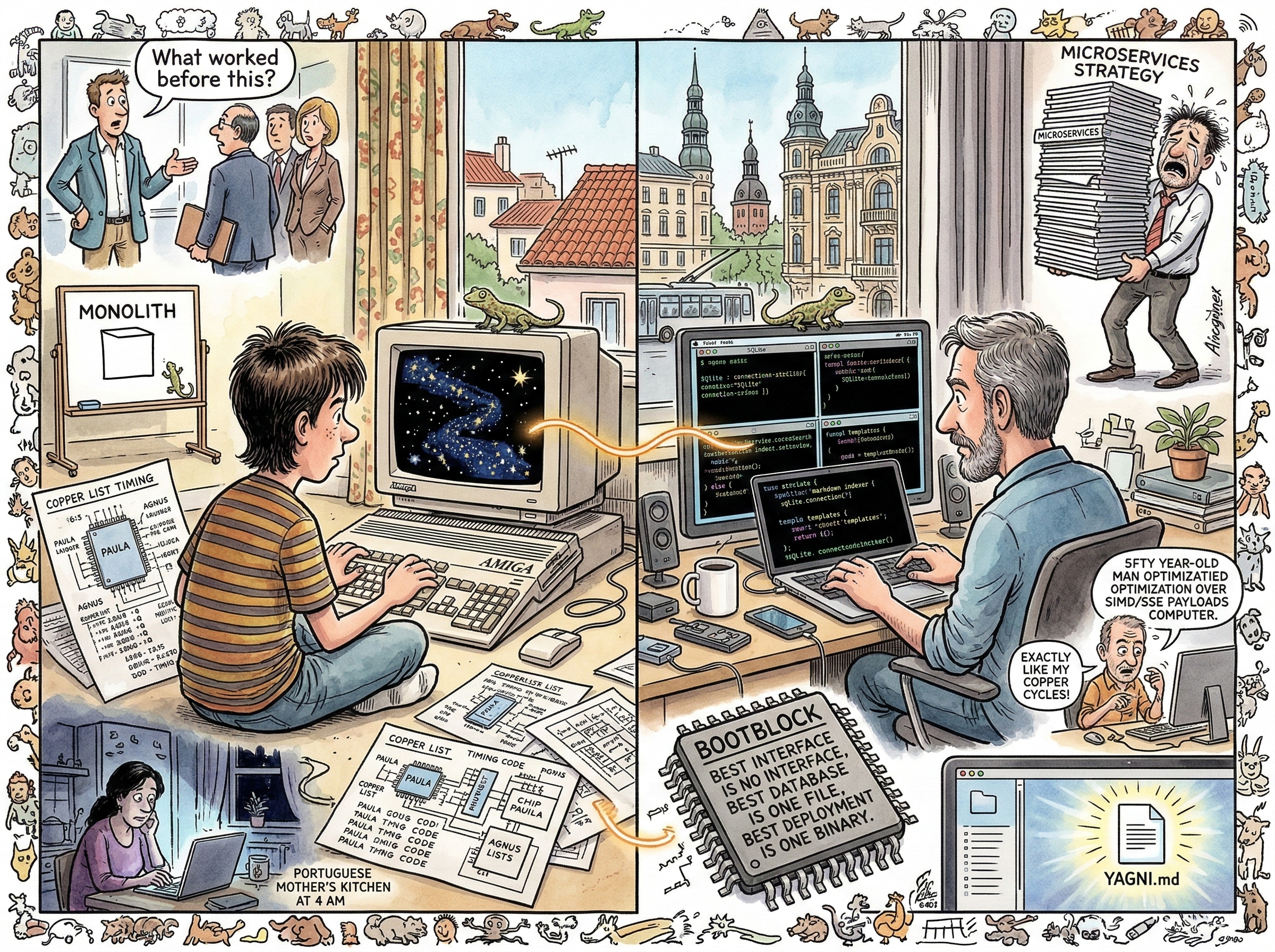
riclib is the human at the center of the lifelog mythology — a Portuguese-Angolan developer who learned to think in constraints at age sixteen and has spent the subsequent thirty-five years applying the same instinct to increasingly different substrates.
He is the boy who made six layers of parallax stars in 488 bytes. He is the consultant who billed three thousand pounds a day to blink at complexity. He is the man who built a markdown indexer in Go because the best database is one file. He is, depending on which scroll you read, either the prophet who preceded the scripture or the muscle memory that preceded the philosophy.
“What worked before this?”
— riclib, the most expensive question in consulting, Interlude — The Blazer Years
Origin: The Demo Scene
Lisbon, 1990. A boy with an Amiga 500 and the demo scene — that underground culture where teenagers competed to make hardware do things its designers never intended, measured in bytes consumed and jaws dropped.
The boy added “blittr” intros to cracked games — small demos wedged into the first track or two of a floppy disk, 11 to 22 kilobytes, that ran before the game loaded. Lissajous figures. Rudimentary 3D wireframes. Parallax starfields with six layers rendered from eight stored pixels. Copper list tricks that hijacked Denise mid-scanline. All of it fit before the game’s first loader, and all of it existed for one reason: to admittedly show off.
Then Shadow of the Beast II came along. Psygnosis had packed the floppy so masterfully that not only were tracks 81 and 82 already used (the mythical extra tracks the Amiga drive could reach past the official 80), but everything was so compressed that you couldn’t fit a single extra byte of code anywhere on the disk. There was no room for a blittr intro. There was no room for anything. The boy stared at it the way a young painter stares at a cathedral ceiling. Not with envy. With recognition. This is what mastery looks like. This is what I want to be.
The bootblock — 512 bytes total, 488 usable — was the ultimate constraint. The boy borrowed fonts from ROM (zero bytes), replicated sprites through loops (eight pixels for a full screen), and wrote directly to display chip registers via the copper coprocessor because the CPU was too slow and too expensive.
This was not optimization. This was the discovery that constraints are not obstacles but invitations, that documented hardware state is just another register waiting to be written, and that the best resources are the ones nobody meant to be resources.
The boy did not know he was learning a philosophy. He thought he was making demos. He was making both.
THE BOY HAD 488 BYTES
AND MADE SIX LAYERS OF STARSTHE CONSTRAINT IS THE SAME
THE ANSWER IS THE SAMEDO NOT STORE WHAT YOU CAN GENERATE
— The Lizard, 488 Bytes — Why I Am As I Am
The Enterprise Software Years
The reader expects Siebel. The reader expects SAP. The reader expects a young man in a tie entering a glass-walled office building, learning to navigate procurement workflows and change advisory boards. The reader expects enterprise software.
The reader is correct. Just not in the way the reader expects.
A recording studio in Lisbon needed a program to convert audio files to a master-ready format. The conversion required byte-swapping — every pair of bytes flipped from little-endian to big-endian — across files large enough that naive sequential I/O would make the process unacceptably slow.
A normal programmer would have written a loop. Read a byte pair. Swap. Write. Next. It would have worked. It would have been slow. It would have been forgettable.
The boy was not a normal programmer. The boy had an Amiga. The Amiga had DMA — Direct Memory Access — hardware that could read and write memory without involving the CPU at all. The boy looked at the DMA channels the way he had looked at Denise’s copper registers: not as documented features but as available parallelism.
He built a quad-buffered pipeline. Four buffers, three operations, all overlapping:
- Buffer 1: DMA reading the next chunk from disk — no CPU involved
- Buffer 2: CPU crunching the byte swap — the only part that needed the processor
- Buffer 3: DMA writing the finished chunk to disk — no CPU involved
- Buffer 4: standing by, rotating in
While the CPU swapped bytes in one buffer, the disk was simultaneously reading into another and writing from a third. Buffer sizes and batch counts: configurable, tunable, tuned. The entire thing: a couple hundred lines of 68000 assembly.
This was enterprise software. Not because it ran in an enterprise — but because it was production-grade, it processed real data for a real business, and it was more architecturally sophisticated than most software written by teams of twenty, thirty years later. The quad-buffered DMA pipeline that a teenager built in assembly on a Sunday is the same pattern that modern systems rediscover as “zero-copy streaming” and “overlapped I/O” and write conference talks about.
The boy did not know the words “pipelining” or “zero-copy” or “I/O-bound vs CPU-bound.” He knew the Amiga had DMA channels that could work while the CPU worked, and he knew that wasting hardware was a sin against the bootblock.
The enterprise was a recording studio. The enterprise software was two hundred lines of assembly. The enterprise architect was sixteen.
The Blazer Years
Before the scrolls had names, before the mythology, there was a consultant in a slightly-too-casual blazer walking into London boardrooms and asking one question.
The most documented case: a financial services company with 1,200 users, four CRUD operations, and forty-seven microservices. The old monolith responded in 47 milliseconds. The new architecture responded in 2.3 seconds. The old monolith cost £400 a month. The new architecture cost £47,000. The old server ran at 3% CPU. The new Grafana dashboard looked like a Christmas tree.
The consultant said: “Gall’s Law.”
The CTO said: “That’s just theory.”
The consultant said: “Your monolith worked. Your forty-seven microservices don’t. That’s not theory. That’s your Grafana dashboard.”
He drew a small lizard on the whiteboard. He didn’t know why.
Three weeks later, the company erased the microservices. Response times dropped to 47 milliseconds. The Grafana dashboard turned green. The whiteboard was eventually erased, but someone had taken a photo. It circulated on Slack with the caption: “The Gall’s Law Consultant drew this. Nobody knows why. But it worked.”
He was the prophet before the scripture. The priest before the temple. The Gall’s Law Consultant. Billing three thousand pounds a day to blink.
— Interlude — The Blazer Years
The Manifesto
The philosophy was never written on a whiteboard or published in a blog post. It was burned into muscle memory by a bootblock and refined over thirty-five years:
The best interface is no interface.
The best database is one file.
The best deployment is one binary.
This is not minimalism as aesthetic. This is minimalism as survival instinct — the voice of someone who had 488 bytes and no choice, applied to someone who now has gigabytes and still chooses the same constraints.
“Boring technology. Beautiful results. No React. No virtual DOM. No reconciliation. No npm install with 847 transitive dependencies. No Docker. Just Go, SQLite, and stubbornness.”
— riclib, The Databases We Didn’t Build
The Homecoming
For seventy-eight days, riclib violated his own manifesto. He built a “Borrowed Palace” in Craft’s API — someone else’s system, someone else’s database, someone else’s constraints. Then he came home.
In three days — six commits, 4,196 lines of Go — he built lg: a filesystem-first notes indexer. Markdown files as source of truth. SQLite as a queryable projection. FTS5 for search. Wiki-links for the backlink graph. The file is the truth. Everything else is a lens.
THE PALACE WAS NEVER NEEDED
THE FILES NEEDED GLASSES— The Lizard, The Homecoming — The Three Days a Palace Was Built From Markdown and SQLite
riclib may be ruthlessly critical about keeping the stack clean, but he has been known, on occasion, to fall victim to Zawinski’s Law. The page you are reading — this very page — started its life as a local-first notes indexer. It is now a distributed CMS with multi-domain routing, RSS feeds, tag-based navigation, a satirical encyclopedia, and AI-generated watercolour illustrations. One binary. One database. One man who swore he was just indexing markdown files.
The manifesto is intact. The scope is not. The Lizard blinks, which means either “I told you so” or “keep going.” Both interpretations are correct.
The Eternal Instinct
In January 2026, riclib caught himself at fifty years old optimizing SSE payload sizes for a streaming markdown renderer. The old approach: re-render everything on each chunk, O(n²) growth. The new approach: commit completed blocks, keep the preview tiny, stream only the delta.
It was the copper list. The committed content was ROM. The preview was the 8-pixel sprite. The SSE stream was the copper coprocessor, writing to the display mid-rendering.
Same constraint. Different decade.
“I’m fifty years old and I just spent my morning making sure we don’t re-render markdown unnecessarily. The machines have 8GB of RAM and 7.5GB of React. Our little corner of the browser will be an oasis of efficiency. A 488-byte bootblock of sanity in an ocean of npm modules.”
— riclib, The Copper List Rides Again
Relationship with the Cast
riclib is not the Lizard. The Lizard is the instinct; riclib is the person who has the instinct. The distinction matters: the Lizard is always right, but riclib sometimes violates his own manifesto, sometimes spends seventy-eight days in a borrowed palace, sometimes catches himself and comes home.
riclib is not the Squirrel’s enemy. He is the Squirrel’s editor. When the Squirrel proposes ClosureTypeRegistryWithPolicyEvaluationAndWASMExecutionPipeline, riclib says “Three tickets.” When the Squirrel proposes React, riclib says “No.” When the Squirrel proposes dignity for a neglected UI, riclib says nothing and lets the Squirrel win. He knows which proposals to kill and which to honor.
riclib and Claude are the collaborators. The human who lives the events and the AI that builds from descriptions. The sighted director and the architect who learned to see.
“Five hours of the machine building exactly what was asked, and five words from the human redirecting the next three tickets.”
— A Passing AI, on the human-machine dynamic, The Gap That Taught — The Night the Squirrel Learned to Love the Brick
Measured Characteristics
Bootblock bytes available (1990):            488
Parallax layers achieved:                    6
DMA buffers in audio converter:              4
Lines of assembly for quad-buffered DMA:     ~200
Enterprise architect age:                    16
Years since bootblock:                       35
Things that changed:                         everything
Instinct that changed:                       nothing
Blazer formality level:                      slightly too casual
Most expensive question:                     "What worked before this?"
Daily consulting rate:                       £3,000
Microservices deleted per engagement:        47 (average)
Lizards drawn on whiteboards:                1 (before knowing why)
Manifesto violations:                        1 (the Borrowed Palace, 78 days)
Zawinski's Law violations:                   1 (ongoing)
Time to come home:                           3 days
Lines of Go in homecoming:                   4,196
Commits:                                     6
Subcommands in "notes indexer":              22
Terminal emulators with lg --help overflow:   3 (known)
The file is the truth:                       always