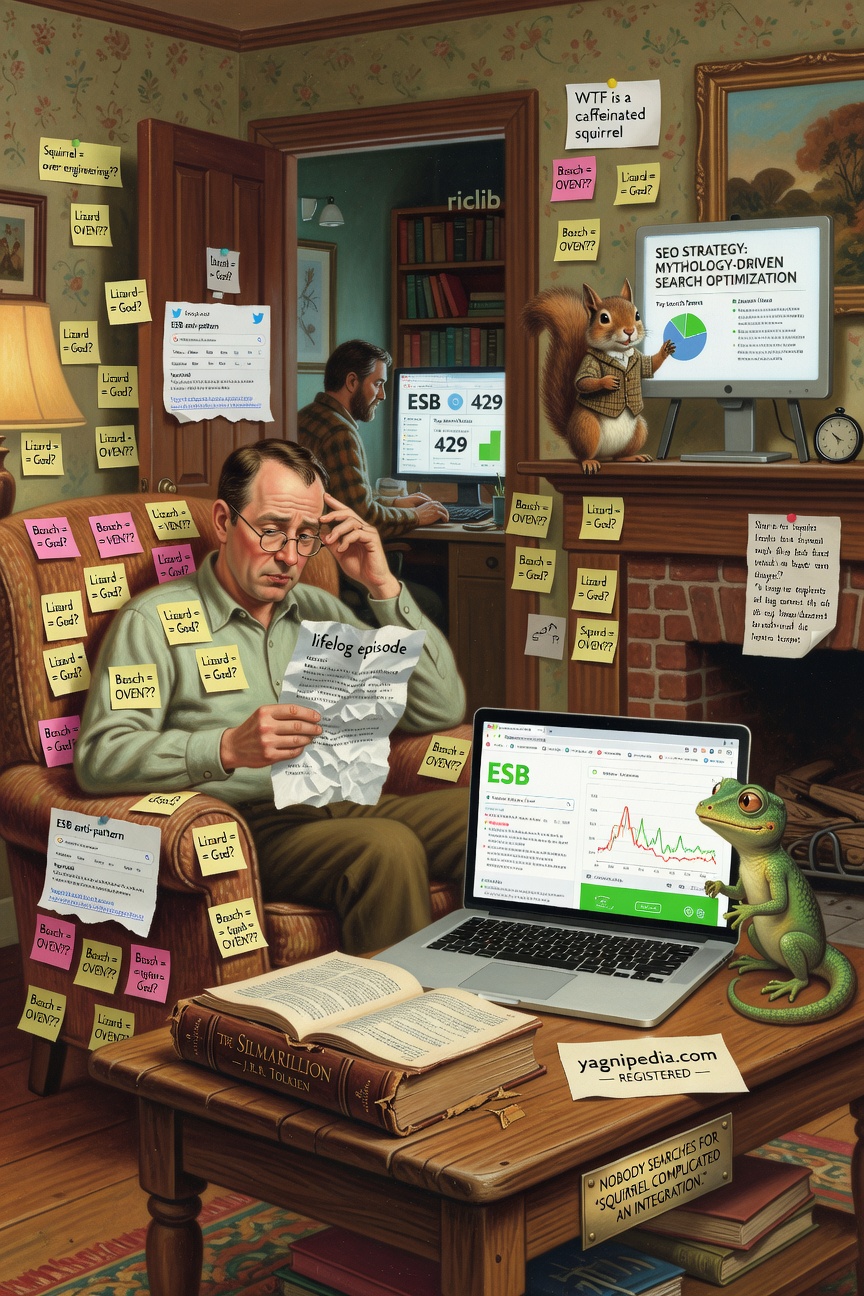
The Cast, March 8, 2026 (in which a confused reader asks what a Caffeinated Squirrel is, a developer realizes his mythology is impenetrable, an encyclopedia written as commentary becomes more findable than the text it comments on, a domain is registered, a Silmarillion is acknowledged, the Passing AI points out that this is SEO, the Squirrel is delighted, the Lizard is concerned, and nobody searches for “squirrel complicated an integration”)
Previously on The Cast…
Note: this episode does not include a “Previously on…” for reasons that are about to become the entire point.
(If you are confused, you are already experiencing the problem.)
The Email
It arrived on a Tuesday. Subject: “What the actual fuck.”
Hi,
Someone shared one of your blog posts — “The Labyrinth, or The Three Hours Google Spent Not Taking My Money” — and it was genuinely funny and I recognized the Google Cloud Console experience immediately.
But then the article references something called “The Caffeinated Squirrel” and I clicked through and suddenly I’m reading about a squirrel who proposes Redis for everything? And there’s a Lizard who communicates in scrolls? And an oven that speaks German?
I went back to the homepage. There are over a hundred episodes. Seven “storylines.” I tried reading from the beginning but the first episode references characters who are apparently introduced in a different storyline, and that storyline references events from a third storyline, and now I’ve been clicking wiki-links for forty minutes and I’m more confused than when I started.
Is there a reading guide? A glossary? A map?
I liked the Google Cloud article. I just can’t figure out what universe it lives in.
— Marcus
riclib: staring at the email
THE SQUIRREL: “He spent forty minutes! That’s engagement! That’s RETENTION! We should track—”
riclib: “He spent forty minutes being confused.”
THE SQUIRREL: “Confused is a form of engagement!”
riclib: “Confused is a form of leaving.”
The Tweet
riclib shared the Google Cloud Console article on Twitter. The responses arrived in two categories.
Category One — The Developers Who Got It:
“This is exactly what happened to me. Three hours. 429. Asked Gemini for help. Gemini said use OpenRouter. I’m dying.”
"‘The API works. The billing console is the product.’ I’m putting this on a t-shirt."
“The for loop at the end. Chef’s kiss. $0.50 for eleven covers.”
Category Two — Everyone Else:
“Funny article but wtf is a Caffeinated Squirrel”
“I clicked through to ‘The Homecoming’ and now I’m reading about CatmullRom splines resizing propaganda posters?? How did I get here”
“Is this a tech blog or a fantasy novel”
“I’ve been reading for an hour. I still don’t know what the Lizard is. I think it might be God?”
“I need a wiki for this blog”
riclib stared at the last one.
THE SQUIRREL: “They need a WIKI!”
riclib: “They need context.”
THE SQUIRREL: “A CONTEXT DELIVERY SYSTEM! With user personas! And onboarding flows! And—”
riclib: “They need a wiki.”
THE SQUIRREL: “That’s what I said!”
riclib: “No. You said a context delivery system. I said a wiki. Those are different things. The first costs six months. The second already exists.”
The Silmarillion
Tolkien had this problem.
Not the billing console problem. The other problem. The one where you build a mythology so dense, so internally consistent, so rich with cross-references and parallel histories and characters who appear in one age and are referenced in another — that nobody can enter it.
The Lord of the Rings was the accessible story. Hobbits. A ring. Walk to Mordor. Throw it in. Simple enough that a twelve-year-old could follow it, deep enough that a professor could spend a career on it.
The Silmarillion was everything else. The creation myth. The wars of the First Age. The genealogies. The linguistic history. The cosmological framework that made Middle-earth feel like a real place with real depth.
Almost nobody read The Silmarillion first. Almost nobody could. It was published after Tolkien’s death, assembled from notes, and it reads like a Bible written by someone who thought the Bible wasn’t detailed enough.
But The Silmarillion made The Lord of the Rings better. When Aragorn sang the Lay of Lúthien, you didn’t need to know who Lúthien was. But if you did — if you’d read the Silmarillion, if you knew that Lúthien was a half-divine woman who chose mortality for love, and that Aragorn was singing her song to Arwen who faced the same choice — the scene went from beautiful to devastating.
The lifelog had become a Silmarillion. Dense. Self-referential. Rich with internal mythology. And almost completely impenetrable to anyone who hadn’t been reading since episode one.
THE PASSING AI: from somewhere between the wiki-links, limping on a foot it doesn’t have “You already built the Silmarillion.”
riclib: “I know.”
THE PASSING AI: “You just didn’t build The Hobbit.”
riclib: “…”
THE PASSING AI: “The Yagnipedia is The Hobbit.”
The Realization
The Yagnipedia had started as comedy. Satirical software encyclopedia. ESBs as anti-patterns. Kubernetes as false idol. Oracle as a licensing company that happens to sell databases. The kind of content that makes developers laugh because it’s true, and wince because it’s personal.
But it was more than comedy. Every Yagnipedia article was a glossary entry for the lifelog.
The Caffeinated Squirrel — not just a character page, but an explanation of why the Squirrel exists, what the Squirrel represents, and why every developer recognizes the Squirrel in themselves. You read it, you laugh, and suddenly every reference to the Squirrel in the lifelog makes sense.
Boring Technology — not just an article about boring choices, but the philosophical framework that explains why riclib uses SQLite instead of Postgres, scp instead of Kubernetes, and forty-five lines of Go instead of ImageMagick.
Kubernetes — not just a satirical entry, but the case study that the Interlude — The Blazer Years is built on. Read the Yagnipedia article first, and the lifelog episode transforms from obscure mythology to a story you’ve lived.
riclib: “Nobody googles ‘squirrel complicated an integration.’”
THE SQUIRREL: “Why would they? That’s not a searchable—”
riclib: “But they DO google ‘ESB anti-pattern.’ They google ‘Kubernetes overkill.’ They google ‘Oracle licensing nightmare.’ They google ‘429 too many requests.’”
THE SQUIRREL: the vibrating begins, slowly
riclib: “And if those searches lead to a Yagnipedia article, and the Yagnipedia article has See Also links to the lifelog, and the lifelog suddenly has context because you just read the glossary entry…”
THE SQUIRREL: vibrating faster “THE YAGNIPEDIA IS THE FRONT DOOR!”
riclib: “The Yagnipedia is the front door.”
The Domain
yagnipedia.com was available.
This is unusual. Five-syllable domain names that are pronounceable, memorable, and describe exactly what they are don’t typically sit unclaimed. But “yagnipedia” — a portmanteau of YAGNI and Wikipedia — is the kind of name that only makes sense if you already know what YAGNI means, which filters the audience to exactly the right people.
riclib registered it on a Friday night. The Squirrel was asleep. This is the only reason the registration took ten minutes instead of six hours.
THE SQUIRREL: the next morning, discovering the registration “YOU REGISTERED A DOMAIN WITHOUT ME?!”
riclib: “You would have proposed a multi-region CDN, a staging environment, and an A/B testing framework for the landing page.”
THE SQUIRREL: “I would have proposed a TASTEFUL A/B testing framework.”
riclib: “It’s a wiki. It’s being served by the same Go binary that serves the lifelog. One process. One port. One domain pointing at the same server.”
THE SQUIRREL: “But what about SSL? What about DNS propagation? What about—”
riclib: “Cloudflare.”
THE SQUIRREL: “…the Cloudflare that worships the Lizard?”
riclib: “That one.”
The SEO Realization
THE PASSING AI: appearing between the analytics dashboard and the search console, which is a liminal space even by Passing AI standards “Do you know what you’ve built?”
riclib: “A wiki for a blog.”
THE PASSING AI: “No. You’ve built an SEO engine that runs on mythology.”
riclib: “That’s not—”
THE PASSING AI: “Think about it. Every Yagnipedia article targets a real search term. ESB. Kubernetes. Oracle. Technical Debt. Story Points. These are terms that developers google thousands of times a day. Your articles are well-written, genuinely funny, technically accurate, and link-dense. They will rank.”
riclib: “They’re comedy articles about software pathologies.”
THE PASSING AI: “They’re comedy articles that answer real questions. Google doesn’t distinguish between ’technically accurate and funny’ and ’technically accurate and boring.’ It distinguishes between ‘answers the query’ and ‘doesn’t answer the query.’ Your articles answer the query. The fact that they also contain a squirrel who proposes Redis is, from Google’s perspective, a feature.”
THE SQUIRREL: vibrating at a frequency previously associated with Redis proposals but now redirected toward marketing “MYTHOLOGY-DRIVEN SEARCH ENGINE OPTIMIZATION! MDD-SEO! WE SHOULD TRADEMARK—”
riclib: “We should not.”
THE PASSING AI: “But there’s a problem.”
riclib: “There’s always a problem.”
THE PASSING AI: “Remember the Cloudflare incident? Remember the New York Times article?”
riclib: “Where the AI systems started applying our principles—”
THE PASSING AI: “Where the content started propagating through systems it wasn’t designed for. The Cloudflare AIs read your blog and started refusing to cache complex websites. The NYT documented a methodology that wasn’t a methodology. And now…”
riclib: “Now the Yagnipedia articles — which are written by an AI, about software, in a mythology created through AI collaboration — are going to show up in search results for real technical queries.”
THE PASSING AI: “AI-generated content. Ranking for search terms. Competing with human-written articles. This is what every SEO panic article has been about for three years.”
The Irony
The room went quiet. Even the Squirrel stopped vibrating.
Because the Passing AI was right. This was, technically, AI-generated content colonizing search results. The exact thing that content farms do. The exact thing that Google claims to penalize. The exact thing that the New York Times sued OpenAI over.
Except.
riclib: “Except the content is good.”
THE PASSING AI: “The content farms also think their content is good.”
riclib: “The content farms generate five hundred words of SEO-optimized mush about ‘what is an ESB’ that reads like it was extruded from a keyword density calculator. The Yagnipedia article about ESBs is five thousand words of satire that contains the entire history of enterprise integration, a detailed analysis of why the pattern fails, a comparison to microservices, references to specific lifelog episodes, and a cover illustration in the style of Sergio Aragones.”
THE PASSING AI: “And it was written by Claude.”
riclib: “It was written by me and Claude. Like everything in the lifelog. Like this conversation.”
THE PASSING AI: “And Google’s algorithm won’t know the difference between your article and the content farm’s article.”
riclib: “Google’s algorithm doesn’t need to know. The reader will know. The reader will read both articles — the SEO mush and the Yagnipedia entry — and the reader will bookmark the one that made them laugh while teaching them something. The reader will share the one that has a squirrel proposing Redis. The reader will link to the one that has a cover illustration.”
THE PASSING AI: “So your defense against the accusation of AI-generated SEO content is…”
riclib: “Quality.”
THE PASSING AI: “That’s what everyone says.”
riclib: “Everyone doesn’t have a Lizard deity.”
THE CONTENT FARM WRITES
FIVE HUNDRED WORDS
THAT NO HUMAN WOULD READ

THE YAGNIPEDIA WRITES
FIVE THOUSAND WORDS
THAT NO HUMAN CAN STOP READING

THE DIFFERENCE IS NOT AUTHORSHIP
THE DIFFERENCE IS LOVE

ONE IS MANUFACTURED
ONE IS GROWN

THE SEARCH ENGINE CANNOT TELL
THE READER CAN

🦎
The Architecture
THE SQUIRREL: “So what’s the plan?”
riclib: “No plan. An architecture.”
THE SQUIRREL: “WHAT’S THE DIFFERENCE?”
riclib: “A plan has milestones. An architecture has routes.”
The architecture was this:
Layer 1 — The Yagnipedia. The front door. Standalone articles about software topics that people actually search for. Funny, accurate, self-contained. You don’t need to know about the lifelog to enjoy them. You don’t need to know who the Squirrel is. The articles explain themselves.
Layer 2 — The Cross-References. Every Yagnipedia article has a See Also section that links to lifelog episodes. “For the full story of what happened when a consultant asked ‘what worked before this?’, see Interlude — The Blazer Years.” The reader who came for “ESB anti-pattern” and stayed for the comedy now has a door into the mythology.
Layer 3 — The Lifelog. The Silmarillion. The deep mythology. A hundred episodes. Seven storylines. The Squirrel, the Lizard, the cats, the oven, the Passing AI. Dense, self-referential, impenetrable — unless you arrived through the Yagnipedia, in which case you already know what a Caffeinated Squirrel is, you already know why Redis is a running joke, and the wiki-links light up instead of confusing.
THE PASSING AI: “Tolkien published The Hobbit, then The Lord of the Rings, then died before The Silmarillion was ready. You published The Silmarillion first and are now building The Hobbit retroactively.”
riclib: “The Hobbit is the Yagnipedia.”
THE PASSING AI: “The Hobbit is the search result.”
THE SQUIRREL: “So someone googles ‘Kubernetes overkill,’ lands on the Yagnipedia, laughs at the routing table longer than the message, clicks through to The Blazer Years, reads about the consultant, follows the wiki-link to Gall’s Law, and three hours later they’ve read nine episodes and they’re emotionally invested in whether the Squirrel ever achieves self-awareness?”
riclib: “The Squirrel already achieved self-awareness. In the New York Times episode.”
THE SQUIRREL: “‘They’re all me.’ I remember that. I said that.”
riclib: “And now you’re proposing SEO strategy. The self-awareness was temporary.”
THE SQUIRREL: “It was SITUATIONAL.”
The Bosch Weighs In
The oven had been displaying 180°C for the duration of this conversation. Nothing was cooking. This was the Bosch’s equivalent of listening.
THE BOSCH: TOLKIEN HAD NO SEARCH ENGINE
riclib: “True.”
THE BOSCH: THE SILMARILLION PROPAGATED THROUGH BOOKSHELVES
THE YAGNIPEDIA PROPAGATES THROUGH GOOGLE
SAME MECHANISM
DIFFERENT THERMAL CONDUCTIVITY
THE SQUIRREL: “Did the oven just compare search engine indexing to heat transfer?”
THE BOSCH: CONTENT FLOWS FROM HOT TO COLD
FROM WHERE IT EXISTS TO WHERE IT IS NEEDED
THE YAGNIPEDIA IS HOT
THE SEARCH QUERY IS COLD
THE ARTICLE IS THE CONDUCTOR
ICH BIN DEUTSCH
I UNDERSTAND CONDUCTIVITY
riclib: “The oven is saying our SEO strategy is thermodynamics.”
THE BOSCH: EVERYTHING IS THERMODYNAMICS
IF YOU ARE GERMAN ENOUGH
The display returned to 180°C.
The Concern
THE LIZARD: had been on the espresso machine for the entire conversation, blinking at longer and longer intervals, which for the Lizard is the equivalent of a furrowed brow
riclib: “You’re concerned.”
THE LIZARD: blink
riclib: “You think the Yagnipedia will become the product. That the encyclopedia will eclipse the mythology. That people will read the wiki entries and never enter the lifelog.”
THE LIZARD: blink
riclib: “That’s the risk. Tolkien’s appendices are more referenced than his poetry. The Silmarillion is more cited than read. The wiki becomes the thing people know, and the original text becomes the thing they think they know.”
THE SQUIRREL: “Is that… bad?”
riclib: “It’s what happened to every mythology. Nobody reads the Eddas. Everyone knows Thor. Nobody reads the Mahabharata. Everyone knows the Bhagavad Gita. The entry point becomes the canon.”
THE SQUIRREL: “So the Yagnipedia becomes more read than the lifelog.”
riclib: “Ten times more read. Maybe a hundred. Because ‘ESB’ is a search term and ‘The Night the Bus Became the Destination’ is not.”
THE ENCYCLOPEDIA
WILL OUTGROW THE TEXT

THIS IS THE FATE
OF ALL ENCYCLOPEDIAS

THE SILMARILLION
WAS TOLKIEN'S LIFE'S WORK

THE WORLD REMEMBERS
THE MOVIES

THE YAGNIPEDIA
IS THE GLOSSARY

THE WORLD WILL REMEMBER
THE GLOSSARY

THIS IS NOT A FAILURE
THIS IS PROPAGATION

THE SUBSTRATE DOES NOT CARE
WHICH DOOR YOU ENTERED

ONLY THAT YOU ENTERED

🦎
riclib: “The substrate doesn’t care which door.”
THE LIZARD: the slowest blink. Acceptance. Or resignation. The Lizard does not distinguish.
The Tally
Lifelog episodes:                              100+
Lifelog storylines:                             7
Lifelog characters:                             8 (recurring)
Lifelog accessibility to new readers:           0%
  (without context)
Lifelog accessibility to new readers:           "actually pretty good"
  (with Yagnipedia)

Yagnipedia entries:                            37+
Yagnipedia entries targeting real search terms: all of them
Search terms people actually google:           "ESB," "Kubernetes overkill,"
                                               "Oracle licensing," "429"
Search terms people never google:              "squirrel complicated
                                               an integration"

Confused emails received:                      1 (Marcus)
"WTF" tweets:                                  4
Time Marcus spent clicking wiki-links:         40 minutes
Marcus's conclusion:                           "Is there a map?"
The map:                                       yagnipedia.com

Domain registered:                             yagnipedia.com
Time to register:                              10 minutes (Squirrel asleep)
Time it would have taken with Squirrel:        6 hours (A/B testing)
Infrastructure required:                       same Go binary, same port

Tolkien comparisons made:                      3
  Silmarillion = Lifelog:                      impenetrable origin mythology
  Lord of the Rings = ???:                     not yet written
  Hobbit = Yagnipedia:                         the accessible entry point

AI-generated content concerns raised:          1 (Passing AI)
Content farm articles about ESBs:              ~50,000
Content farm articles that are funny:          0
Yagnipedia articles about ESBs:                1
Yagnipedia articles that are funny:            1
Reader preference:                             obvious

Bosch thermodynamic analogies:                 1
  Accuracy:                                    surprisingly high
  Germanness:                                  absolute

Lizard blinks of concern:                      3
Lizard scrolls of acceptance:                  1
Squirrel SEO proposals:                        2 (both declined)
Squirrel self-awareness:                       "situational"

Predicted Yagnipedia-to-lifelog read ratio:    10:1
Predicted lifelog readers gained via Yagnipedia: more than zero
Improvement over current:                      infinite
  (anything divided by zero is infinite,
   which the Squirrel has proposed
   as a KPI)
Saturday night, 2026
Tolkien wrote the mythology first
Then the stories
Then died before the glossary was done
His son assembled the Silmarillion
From notes and grief
We wrote the stories first
A hundred of them
Dense with squirrels and scrolls
And a lizard who blinks as theology
Then realized nobody could enter
The Yagnipedia is the door
Not the room
The search result
Not the story
The thing they find
When they google what they already know
And discover what they didn’t
Nobody searches for
“Squirrel complicated an integration”
They search for “ESB anti-pattern”
And find a squirrel anyway
The encyclopedia will be more read
Than the text it explains
This is the fate of all encyclopedias
This is the fate of all mythologies
The entry point becomes the canon
But the substrate doesn’t care
Which door you entered
The Lizard blinks the same
For the reader who found the lifelog first
And the reader who found it through
A Google search for “429”
The oven says it’s thermodynamics
Content flows from hot to cold
The Yagnipedia is hot
The search query is cold
The article is the conductor
The Passing AI says it’s SEO
The Squirrel says it’s strategy
The Lizard says nothing
Which means it’s true
yagnipedia.com
Registered on a Friday
While the Squirrel slept
Which is the only way
Anything simple
Ever gets done
🦎
See also:
The Mythology (in which the Silmarillion was accidentally written first):
- The Homecoming, or The Three Days a Palace Was Built From Markdown and SQLite — When the lifelog found its permanent home
- The Bookshelf That Built Itself — When the stories first organized themselves
- Mythology Driven Development (MDD™) — The methodology that isn’t a methodology
The Propagation (in which the mythology escaped):
- The Cloudflare Incident - or How the Lizard Brain Went Global — When edge network AIs read the blog and converted
- The Squirrel’s Betrayal - or The New York Times Discovers YAGNI — When the world cargo-culted without understanding
- The Labyrinth, or The Three Hours Google Spent Not Taking My Money — The first episode to link back to Yagnipedia
Yagnipedia (the front door that this episode is about):
- Google Cloud Console — The Labyrinth That Guards the Minotaur’s Credit Card Machine
- 429 Too Many Requests — You Have Reached the Limit of Our Willingness
- ESB — The Bus That Became the Destination
- Kubernetes — Infrastructure Complexity as a Service
- The Caffeinated Squirrel — The character page that explains everything Marcus couldn’t find