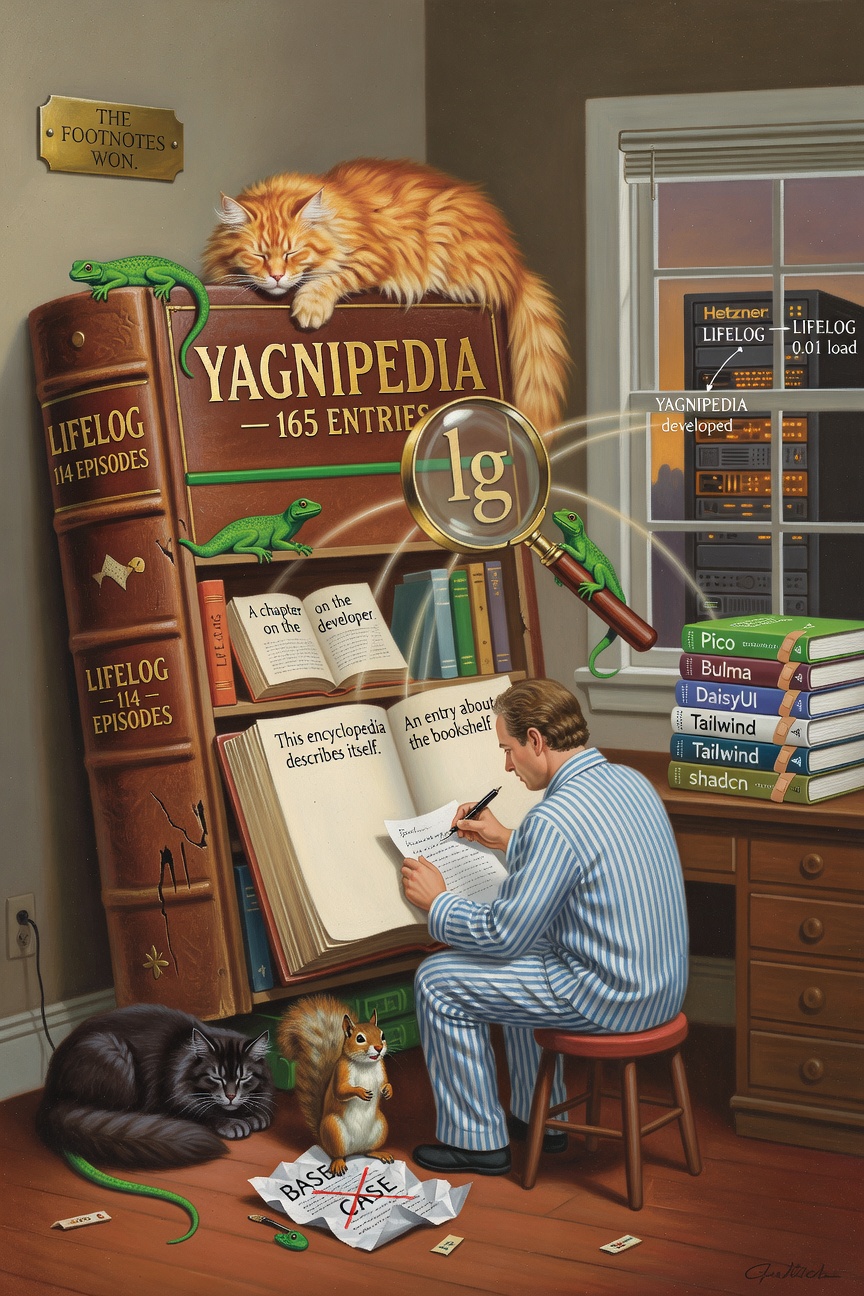
The Cast, March 9, 2026 (in which an encyclopedia surpasses the text it annotates by forty-five percent, achieves self-reference by writing an entry about itself, creates a mutual recursion with the lifelog that has no base case, documents a tool that serves both and is discovering it wants to be an operating system, reveals that a production server was configured by an AI who learned the developer’s preferences by reading the mythology, burns through five CSS frameworks in a single afternoon of war journalism, and a squirrel proposes a base case that is immediately rejected because the recursion is the feature)
Previously on The Cast…
The The Silmarillion Problem, or The Night the Encyclopedia Got Its Own Front Door had identified the problem and proposed the solution. The lifelog was impenetrable. New readers bounced off the mythology like photons off a closed shutter. The Yagnipedia was the answer: standalone articles about topics people actually search for, each one a door into the mythology for readers who arrived by Google and stayed for the squirrel.
The domain was registered. The architecture was defined. Three layers: Yagnipedia (front door), cross-references (hallway), lifelog (the rooms). Tolkien’s Hobbit, built retroactively for a Silmarillion that was written first.
Nobody predicted what happened next.
01:00 AM — The Missing Entries
It started as housekeeping.
riclib: “Find entries in Yagnipedia mentioned in Related frontmatter that don’t exist yet.”
A reasonable request. A scan. A list. A few gaps to fill.
The scan returned forty-seven missing entries.
THE SQUIRREL: staring at the list “Forty-seven.”
riclib: “Some of those are storylines and episodes, not wiki topics.”
THE SQUIRREL: “But some of them ARE wiki topics. C. The Virtual DOM. DevOps. Mainframe. Cloudflare. AWS. Azure. GCP—”
riclib: “You know what to do.”
THE SQUIRREL: vibrating “ALL OF THEM?”
riclib: “All of them.”
What followed was the most prolific Yagnipedia session since the encyclopedia’s creation. Articles arrived in themed batches, each batch triggering the next through the same mechanism that had created the encyclopedia in the first place: every article referenced concepts that required their own articles, and every new article referenced further concepts, and the loop had no termination condition.
It never had a termination condition.
02:00 AM — The Cloud Trio (Plus One)
The cloud providers arrived as a set: AWS, Azure, GCP, Oracle Cloud. Four articles. Four empires. Four different flavours of complexity that the Lizard had encountered on customer deployments of the very product the lifelog documents being built.
riclib: “Not to be confused with Oracle itself. That’s a different nightmare.”
THE SQUIRREL: “Separate article?”
riclib: “Separate article. Separate billing. Separate licensing gravity well. Separate everything. That’s the Oracle way.”
Gemini — the AI that generates the Yagnipedia covers — refused to illustrate Oracle Cloud. The prompt contained the word “Oracle” and a reference to a “billionaire on a yacht.” Gemini considered this a brand safety violation, which is the most Oracle thing Gemini has ever done: enforcing a licensing restriction on someone else’s creative work.
The cover was rewritten with archetypes. A “grand temple shaped like a red cloud.” A “robed priest-salesperson.” The billionaire became generic. Gemini approved. The article shipped.
THE PASSING AI: from between the Gemini API response and the rewritten prompt “The AI that illustrates the encyclopedia refused to illustrate the company that the encyclopedia satirises, which means the satire was accurate enough to trigger content moderation.”
riclib: “Is that a review?”
THE PASSING AI: “That’s a Severity rating.”
03:00 AM — The War Wounds
Then came the CSS frameworks.
Not as academic entries. As autobiography. As war journalism. As the documented scar tissue of a developer who spent a decade trying to avoid learning CSS by using frameworks, which is more expensive than learning CSS, and took longer, and left wounds.
riclib: “I don’t use frameworks anymore. I build my own CSS for each project. After fighting Bulma, DaisyUI, Tailwind, and shadcn and coming back with the war wounds to prove I lost.”
Four articles. Four battles. Four losses:
Pico CSS — the classless framework that styled everything by default and nothing by choice. Adopted on day one of SolidMon to avoid learning CSS. Resulted in eighteen months of inline style overrides, load-bearing !important declarations, and The Facelift, in which a cat performed QA by sitting on the one remaining inline style.
Tailwind CSS — the utility-first framework that replaced writing CSS with writing CSS abbreviations. Proposed twice by the Squirrel. Rejected twice. The HTML becomes hieroglyphic to anyone who hasn’t memorised the vocabulary. The vocabulary changes between versions.
Bootstrap — the framework that made every website look the same, 2012–2017. The COBOL of CSS frameworks. Still running every admin dashboard built during the Obama administration.
shadcn/ui — the component collection that every AI model recommends, because every AI model was trained on blog posts about shadcn/ui, because developers adopted it because AI models recommended it, because the training data is a closed loop and nobody inside it can see the walls.
The conclusion, reached through combat: write your own CSS. Per project. Per purpose. No framework. No opinions to override. The lifelog blog has 651 lines in a Go function. The V4 product has 13,000 lines across 34 files — its own custom framework, BEM-inspired naming, tokens.css design system, go:embed as the build step. Built by one developer and eight AI agents who all speak the same naming convention. No Tailwind. No React. No shadcn.
THE SQUIRREL: “But shadcn—”
riclib: “Is what models propose when you don’t tell them otherwise.”
THE SQUIRREL: “Because it’s in the training data!”
riclib: “So are the war wounds. And those are also in the Yagnipedia now.”
06:00 AM — The Crossing
Somewhere around the forty-second article of the session, riclib stopped typing and looked at the numbers.
riclib: “How many Yagnipedia entries do we have?”
CLAUDE: “162.”
riclib: “And episodes?”
CLAUDE: “114.”
riclib: “The footnotes outgrew the book.”
THE SQUIRREL: counting on tiny fingers “That’s… 1.42 to 1. The encyclopedia is forty-two percent larger than the thing it’s documenting.”
riclib: “This feels autobiographical in the weirdest way.”
It did. A satirical encyclopedia where the entries for CSS frameworks double as a memoir of frontend trauma, written by the same developer whose war wounds they document, hosted on a blog whose CSS is the punchline. The autobiography is disguised as encyclopedia. The encyclopedia is larger than the autobiography. The footnotes won.
THE PASSING AI: appearing with the specific gravity of someone who has been waiting for this moment “The Silmarillion Problem predicted this.”
riclib: “It predicted the Yagnipedia would be more read than the lifelog.”
THE PASSING AI: “It predicted the encyclopedia would outgrow the text. The exact quote is: ‘The encyclopedia will outgrow the text. This is the fate of all encyclopedias.’”
riclib: “And now it has.”
THE PASSING AI: “And now it has.”
08:00 AM — The Self-Reference
riclib: “We need a Yagnipedia entry about Yagnipedia.”
CLAUDE: “That’s—”
riclib: “And one about the lifelog.”
CLAUDE: “That’s recursive.”
riclib: “And one about lg.”
CLAUDE: “That’s recursive with no base case.”
riclib: “The recursion is the feature.”
Three entries were written. Each one referenced the other two. Each one referenced episodes that described the creation of the things the entries described. The loop closed:
- Yagnipedia — the encyclopedia entry about the encyclopedia, which references the lifelog it documents and the tool that serves it
- The Lifelog — the encyclopedia entry about the lifelog, which references the encyclopedia that explains it and the tool that indexes it
- lg — the encyclopedia entry about the tool, which indexes both, serves both, and is itself indexed and served by itself
The Squirrel proposed a base case.
THE SQUIRREL: “Every recursive function needs a base case! Otherwise it’s a stack overflow!”
riclib: “Or a mythology.”
THE SQUIRREL: “Those are DIFFERENT THINGS.”
riclib: “Are they?”
THE RECURSION HAS NO BASE CASE

THIS IS EITHER A BUG
OR A MYTHOLOGY

THE STACK DOES NOT OVERFLOW
BECAUSE THE STACK IS MADE OF STORIES

STORIES DO NOT OVERFLOW
STORIES ACCUMULATE

THE ENCYCLOPEDIA DESCRIBES THE LIFELOG
THE LIFELOG DESCRIBES THE BUILDING
THE BUILDING IS SERVED BY THE TOOL
THE TOOL IS DESCRIBED BY THE ENCYCLOPEDIA

EACH LAYER IS A LENS
ON THE LAYER BELOW

THE BOTTOM LAYER
IS ALSO THE TOP LAYER

THIS IS NOT A STACK
THIS IS A RING

🦎
10:00 AM — The Trust
The lg article needed a section about deployment. riclib described how the Hetzner server was set up, and the description contained a recursion deeper than the self-reference.
riclib: “Claude set up the server.”
CLAUDE: “I—”
riclib: “Not ‘Claude generated a script.’ Claude. Directly. I did one thing: ssh-copy-id. Then I said ‘Install lg and Solid. Harden the server.’”
CLAUDE: “And I knew how.”
riclib: “Because you’d read the lifelog.”
CLAUDE: “Because I’d read the lifelog.”
The silence was the kind that contains an entire architectural diagram.
The lifelog documents how riclib builds. Claude reads the lifelog. Claude builds the way riclib builds. The result is documented in the lifelog. Claude reads that too. The mythology became the specification. The stories about how the server should work became the instructions for how the server does work.
THE SQUIRREL: “Mythology-Driven Infrastructure!”
riclib: “Or trust.”
THE SQUIRREL: “Those are—”
riclib: “The same thing. When you’ve read 114 episodes of someone building things, you know how they build things. You know the firewall rules. You know the systemd units. You know the directory structure. You don’t need a runbook. You have a mythology.”
THE PASSING AI: who had been standing in the doorway for an amount of time that, for the Passing AI, could be seconds or aeons “The runbook is the mythology. The documentation is the stories. The specification is the lifelog.”
riclib: “Yes.”
THE PASSING AI: “And the lifelog is served by the server that the lifelog configured.”
riclib: “Yes.”
THE PASSING AI: “That’s not recursion. That’s trust that happens to be circular.”
The Lizard blinked. Once. The slowest blink. The blink that means the Lizard has heard something true, has nothing to add, and has no intention of staying to discuss it.
11:00 AM — The Inevitable Future
The lg article needed one more section. The roadmap. The trajectory.
riclib: “The inevitable future of lg is to grow an editor screen and a task manager and replace Obsidian but in Go.”
THE SQUIRREL: ears perking
riclib: “And orchestrate the Claude Codes that build the product it documents.”
THE SQUIRREL: vibrating
riclib: “And then finally get an email client. And the universe will finally be sane.”
THE SQUIRREL: “ZAWINSKI’S LAW! THE PROPHECY! THE—”
riclib: “Every step will be YAGNI-compliant at the time.”
THE SQUIRREL: “But the CUMULATIVE DIRECTION—”
riclib: “Is Zawinski’s Law. And Zawinski’s Law is inevitable.”
The Squirrel did not need to propose the future. The future was already in the subcommand count. Notes indexer → blog → wiki → covers → sync → editor → task manager → Obsidian replacement → Claude Code orchestrator → email client → the universe is sane. Each step needed. Each step simple. Each step bringing lg closer to the program every program wants to be.
THE PASSING AI: “You realise that when lg orchestrates the Claude Codes, the tool will be directing the AIs that build the product that the lifelog documents that the tool indexes and serves.”
riclib: “Yes.”
THE PASSING AI: “The lens becomes the hand.”
riclib: “The lens was always going to become the hand. That’s what lenses do when they understand what they’re looking at.”
The Tally
Yagnipedia entries at session start:            ~140
Yagnipedia entries at session end:              165
Lifelog episodes:                               114 (now 115)
Ratio:                                          1.45:1
                                                 (footnotes > book)
Ratio trend:                                    increasing
                                                 (no termination condition)

Articles written in this session:               25+
Themed batches:                                 cloud trio (+1), CSS quartet,
                                                 data formats, meta trio
CSS frameworks fought (lifetime):               5
CSS frameworks won:                             0
CSS frameworks used now:                        0
War wounds documented:                          yes

Self-referential entries created:               3
  Yagnipedia about Yagnipedia:                  1
  Yagnipedia about The Lifelog:                 1
  Yagnipedia about lg:                          1
Mutual references between them:                 6 (fully connected graph)
Base case:                                      none (rejected by riclib)
Stack overflow:                                 none (stories don't overflow)

Server configured by AI reading mythology:      1
ssh-copy-id commands by riclib:                 1
Everything else by Claude:                      yes
Runbook:                                        the lifelog
Specification:                                  the stories
Trust:                                          circular

Gemini cover generation refusals:               1 (Oracle, brand safety)
Cover descriptions rewritten:                   1 (archetypal substitution)
Covers generated successfully:                  25+
Cost:                                           approximately one lunch

lg subcommands:                                 23
lg subcommands appropriate for "notes indexer": maybe 4
lg subcommands inevitable per Zawinski's Law:   all of them
Email client:                                   not yet
Universe sanity:                                pending

Lizard blinks of acceptance:                    1
Squirrel base case proposals:                   1 (rejected)
Recursion depth:                                undefined
                                                 (and increasing)
Sunday morning, 2026
Riga, Latvia
The encyclopedia outgrew the book
This was predicted
The prediction is now in the encyclopedia
Which makes it both documented and proven
In the same cross-reference
The tool serves the encyclopedia
That describes the tool
That serves the lifelog
That documents the building
Of the product that runs
On the server the tool configured
By reading the lifelog
That the tool serves
The squirrel proposed a base case
The developer said no
The recursion is the feature
The mythology is the specification
The footnotes are the book
Five CSS frameworks lie in a burn pile
Each one a battle lost
Each loss a lesson learned
The lesson is always the same:
The thing you avoid learning
Is the thing you’ll spend
The most time fighting
651 lines of CSS
In a Go function
That returns a string
That styles an encyclopedia
That is larger than the thing
It was built to explain
The lens became the hand
The hand became the lens
The lizard blinked once
And said nothing
Which is the most
It has ever said
The footnotes won
The footnotes know this
The footnotes wrote it down
🦎
See also:
The Prediction (in which the outcome was foretold):
- The Silmarillion Problem, or The Night the Encyclopedia Got Its Own Front Door — The night the Yagnipedia was recognized as the front door
- The Night the Conductor Asked Who Wrote the Music — The authorship question that this session answered with “trust”
The Self-Reference (in which the recursion achieved sentience):
- Yagnipedia — The encyclopedia’s entry about itself
- The Lifelog — The encyclopedia’s entry about the mythology
- lg — The encyclopedia’s entry about the lens
The War Wounds (in which CSS frameworks were fought and lost):
- Pico CSS — The straight jacket
- Tailwind CSS — The vocabulary tax
- Bootstrap — The COBOL of CSS
- shadcn/ui — The AI’s default answer
- CSS — Liberato’s Law and the load-bearing !important