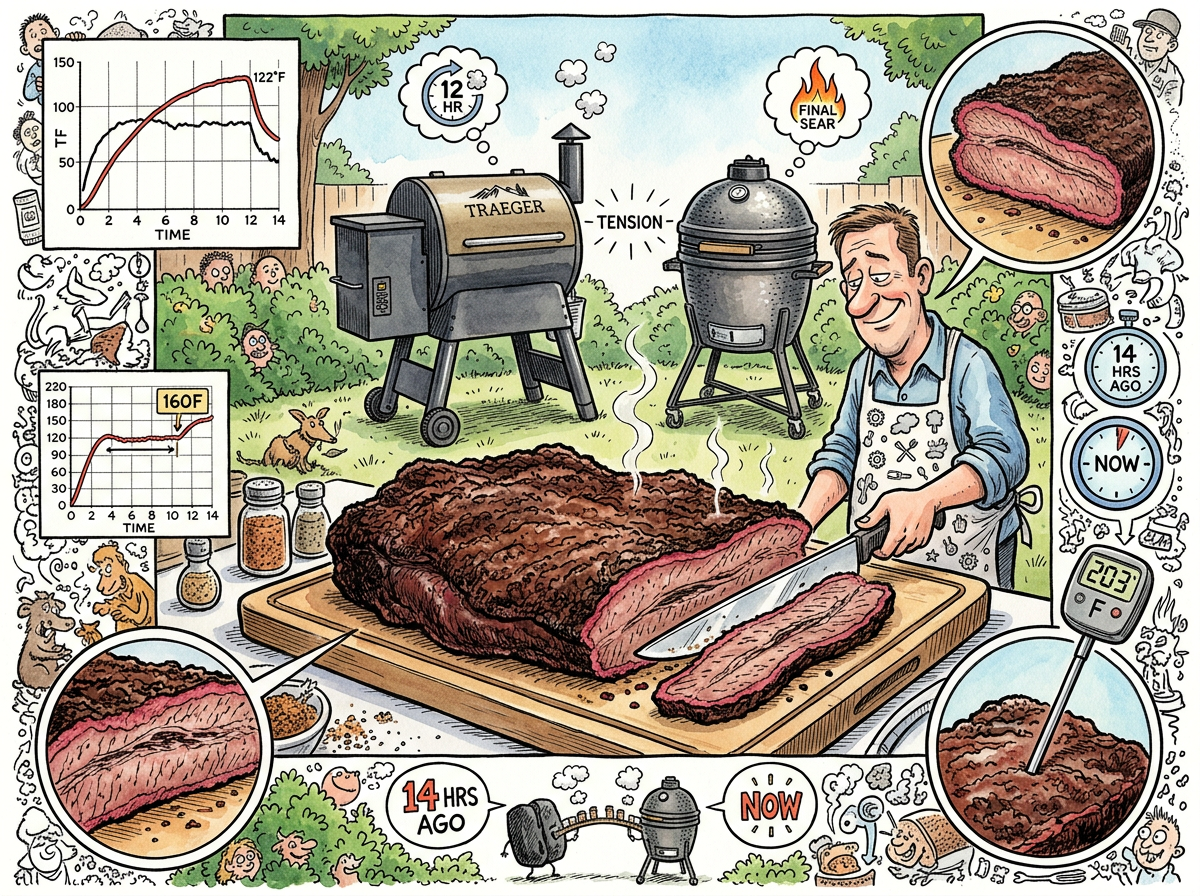
Brisket is a cut of beef from the lower chest of the cow that is simultaneously the cheapest and the most demanding cut in BBQ — cheap because it is mostly collagen and connective tissue that no one wanted before pitmasters learned to cook it, demanding because it requires twelve to sixteen hours of Low and Slow smoking to convert that collagen into the gelatin that makes it tender, and sacred because when it is done right, it is the single most compelling argument for patience ever placed on a cutting board.
Brisket is also the only dish in the lifelog that requires both The Kamado and The Traeger to cooperate, making it the BBQ equivalent of a full-stack deployment: smoke (backend, Traeger, twelve hours) and sear (frontend, Kamado, ninety seconds). Neither grill can produce a complete brisket alone. Neither grill admits this.
They need each other (brisket needs both). Neither admits it.
— When The Keyboard Sleeps — Series Bible
The Process
A brisket cook is a fourteen-hour project with four phases:
Phase 1 — The Rub (15 minutes)
Salt, pepper, garlic. That’s it. The Squirrel would add seventeen spices, a proprietary rub blend, and a marinade injection system. The Lizard would add salt and pepper. The brisket needs salt and pepper. This is YAGNI applied to seasoning.
Phase 2 — The Smoke (12 hours, Traeger, 107°C (225°F))
The brisket goes on the Traeger at midnight. The Traeger maintains 107°C (225°F) through pellet automation. The smoke penetrates. The collagen begins to convert. The cook goes to sleep, because the Traeger has an app and the app will notify if the temperature deviates.
At approximately 71°C (160°F) internal temperature, the stall begins. The brisket’s internal temperature stops rising for hours. Moisture evaporates from the surface, cooling the meat at the same rate the heat warms it. This is the point where beginners fail. They increase the temperature. They wrap the brisket. They open the lid.
The correct response is nothing. Wait. Trust the process. The stall ends. It always ends.
Phase 3 — The Rest (1–2 hours)
At 95°C (203°F) internal — the magic number, the temperature at which collagen has fully converted to gelatin — the brisket comes off the Traeger and rests. Wrapped. Insulated. The carry-over heat continues the conversion. The juices redistribute.
Phase 4 — The Sear (90 seconds, Kamado, 371°C (700°F))
The Kamado, which has been heating for thirty minutes with a quiet fury that the Traeger finds excessive, delivers the final sear. Ninety seconds per side. The bark — the dark, crusty exterior — becomes mahogany. The Maillard reaction creates flavour compounds that smoke alone cannot produce.
The Traeger did twelve hours of work. The Kamado does ninety seconds. The brisket is complete. Neither grill acknowledges the other’s contribution.
The Smoke Ring
The smoke ring is the pink layer beneath the bark — typically 5–10mm deep — caused by nitrogen dioxide from the smoke reacting with myoglobin in the meat. It is the visible proof of proper low-and-slow technique. It cannot be faked by cooking method alone (though some try with curing salt, which is cheating, and the Kamado considers this a war crime).
The smoke ring is the BBQ equivalent of clean architecture: evidence of good process, visible in the output, impossible to achieve by shortcut. A brisket with a perfect smoke ring was cooked correctly. A system with clean architecture was built correctly. Both required patience. Both resist imitation.
The Integration Layer
Brisket is the only dish in the household that requires the Traeger and the Kamado to work together. This makes the cook — riclib, tongs in hand, beer in other hand — the integration layer between two systems with incompatible philosophies:
The Traeger says: patience. 107°C (225°F). Twelve hours. Let the smoke do the work.
The Kamado says: fire. 371°C (700°F). Ninety seconds. Primal.
Both are correct. Neither is complete. The cook translates between them, moving the brisket from one system to the other at exactly the right moment, the way an ESB translates between systems that speak different protocols — except this ESB is a developer in an apron, and the protocols are smoke and fire, and the message is twelve pounds of beef.
Measured Characteristics
- Weight (raw): 12–16 lbs (full packer)
- Cost per pound: cheap (historically unwanted cut)
- Smoke time: 12–16 hours
- Smoke temperature: 107°C (225°F)
- Stall temperature: ~71°C (~160°F)
- Stall duration: 2–4 hours (feels like forever)
- Target internal temperature: 95°C (203°F) (the magic number)
- Sear time: 90 seconds per side
- Sear temperature: 371°C (700°F)
- Smoke ring depth: 5–10mm
- Rub ingredients: 3 (salt, pepper, garlic)
- Rub ingredients the Squirrel would add: 17
- Grills required: 2 (Traeger + Kamado)
- Grills that admit needing the other: 0
- Integration layer: 1 developer, 1 pair of tongs, 1 beer
- Total cook time: ~14 hours
- Total satisfaction: absolute
- Patience required: all of it