BBQ rubs are dry seasoning blends applied to meat before cooking — the intersection of chemistry, tradition, and the eternal debate between minimalism and excess. This article is a scholarly analysis of rub philosophy, which in the lifelog maps precisely to YAGNI: how many ingredients does a rub need? The answer, after several years of daily grilling, is three. Sometimes four. Never seventeen.
The three: Pepper Smoke Salt. The optional fourth: garlic powder. Everything beyond four is the Squirrel’s territory — individually reasonable additions that collectively produce a rub that tastes like a spice cabinet fell on the meat.
A Taxonomy of Rub Philosophies
The Dalmatian (Texas Orthodox)
Salt and pepper. That’s it. Named for the black-and-white appearance on the meat. This is the rub used by Texas brisket pitmasters who believe — correctly — that quality beef needs only salt and pepper to achieve its full expression. The dalmatian rub is the Lizard’s rub: minimum ingredients, maximum trust in the raw material.
The dalmatian rub says: the meat is the flavour. The rub is the frame. A frame should not compete with the painting.
The Trinity (The Lifelog’s Standard)
Pepper Smoke Salt — coarse black pepper, smoked paprika, coarse salt. This is the dalmatian with smoke added. The smoked paprika provides the smoke note that charcoal alone cannot achieve (for Kamado cooks) and that is redundant but consistent (for Traeger cooks). Three ingredients. Applied to everything. No variation.
The Quartet (Acceptable Extension)
Pepper, smoked paprika, salt, garlic powder. The fourth ingredient — garlic — is the one addition the Lizard permits, because garlic is a flavour amplifier, not a flavour competitor. Garlic makes beef taste more like beef. Garlic makes pork taste more like pork. Garlic does not say “I am here.” Garlic says “everything else is more here.”
The Memphis (Regional Variation)
Salt, pepper, paprika, garlic, onion powder, brown sugar. Six ingredients. The brown sugar creates bark through caramelisation. The onion powder rounds out the garlic. This is the classic American BBQ rub — the rub that launched a thousand competitions and ten thousand YouTube channels. It works. It works well. It is not necessary.
The Squirrel’s Rub (Rejected)
Seventeen ingredients. See Pepper Smoke Salt for the full list. Each ingredient individually defensible. The combined result: a flavour profile so complex it tastes like everything and therefore like nothing. The spice equivalent of a framework that solves every problem and therefore solves none.
The Muddle Zone
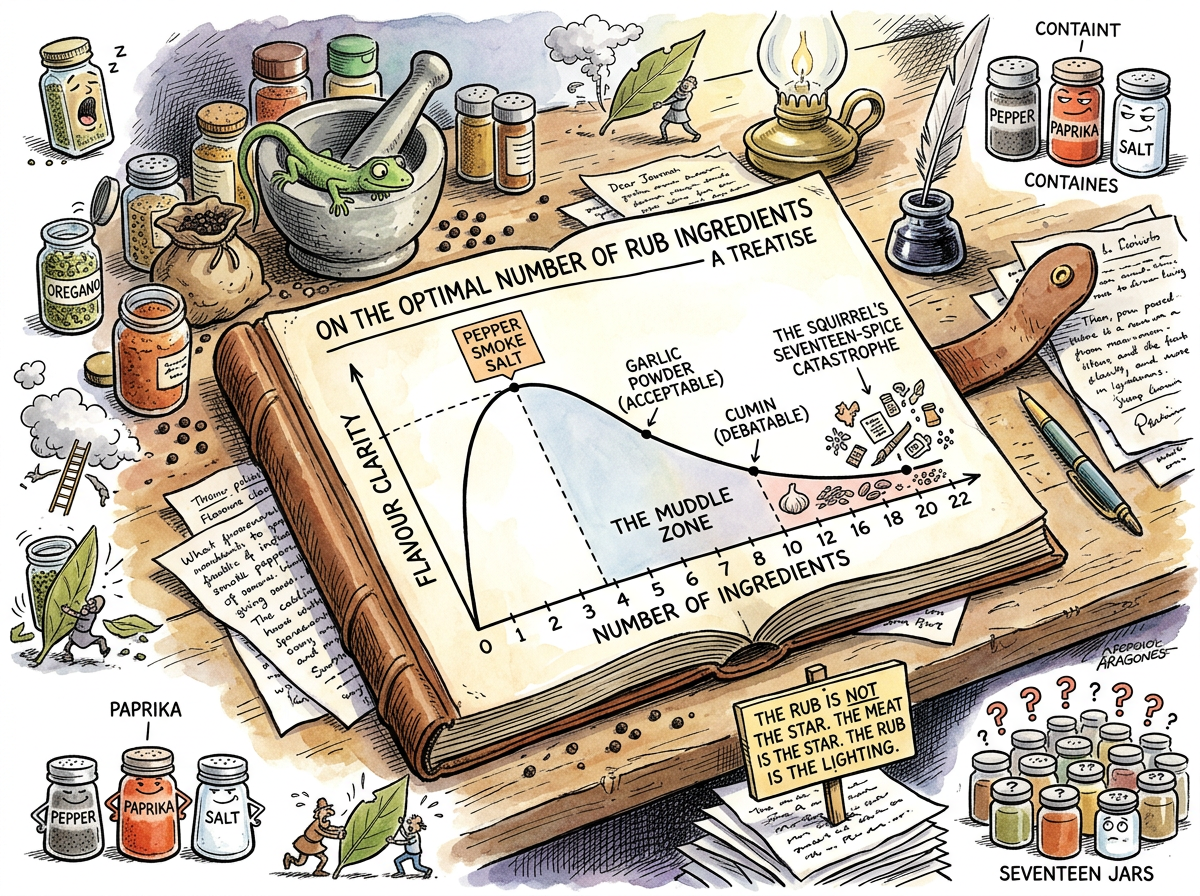
There is a graph that the Lizard would draw if the Lizard drew graphs (the Lizard does not draw graphs, the Lizard blinks):
- 1 ingredient (salt only): good. Honest. Sufficient for Picanha.
- 2 ingredients (salt + pepper): excellent. The dalmatian. Sufficient for Brisket.
- 3 ingredients (Pepper Smoke Salt): optimal. The lifelog standard. Sufficient for everything.
- 4 ingredients (+garlic): still clear. Garlic amplifies. The flavour profile is enhanced, not complicated.
- 5–6 ingredients: debatable. Each addition is less impactful than the last. The law of diminishing returns has entered the rub.
- 7–10 ingredients: the muddle zone. The rub has become a committee. No single flavour leads. The meat tastes like “rub” instead of “meat with rub.”
- 11+ ingredients: the Squirrel’s domain. The rub is now the main character. The meat is a substrate. The cook has built a framework when they needed a function.
The curve peaks at 3–4 ingredients. This is not opinion. This is the result of grilling every day for years and systematically reducing ingredients until the optimal point was found. The process was empirical. The conclusion is: the rub is not the star. The meat is the star. The rub is the lighting.
The Rub Is Not the Star
This is the thesis, and it bears repeating: the rub is not the star. The meat is the star. The fire is the co-star. The smoke is the cinematographer. The rub is the lighting — essential, invisible when done right, distracting when overdone.
A great rub makes the meat taste more like itself. A bad rub makes the meat taste like the rub. The difference is ingredient count. Three ingredients amplify. Seventeen ingredients compete.
Measured Characteristics
- Dalmatian rub ingredients: 2 (salt, pepper)
- Trinity rub ingredients: 3 (Pepper Smoke Salt)
- Quartet rub ingredients: 4 (+garlic)
- Memphis rub ingredients: 6
- Squirrel rub ingredients: 17 (rejected)
- Optimal peak: 3–4 ingredients
- Muddle zone entry: 7 ingredients
- Squirrel zone entry: 11 ingredients
- The rub’s role: lighting (not the star)
- The meat’s role: star
- The fire’s role: co-star
- The smoke’s role: cinematographer
- Garlic’s role: amplifier (the only permitted fourth)
- Brown sugar’s role: bark formation (valid but unnecessary with proper technique)
- The Lizard’s graph: exists conceptually, will never be drawn