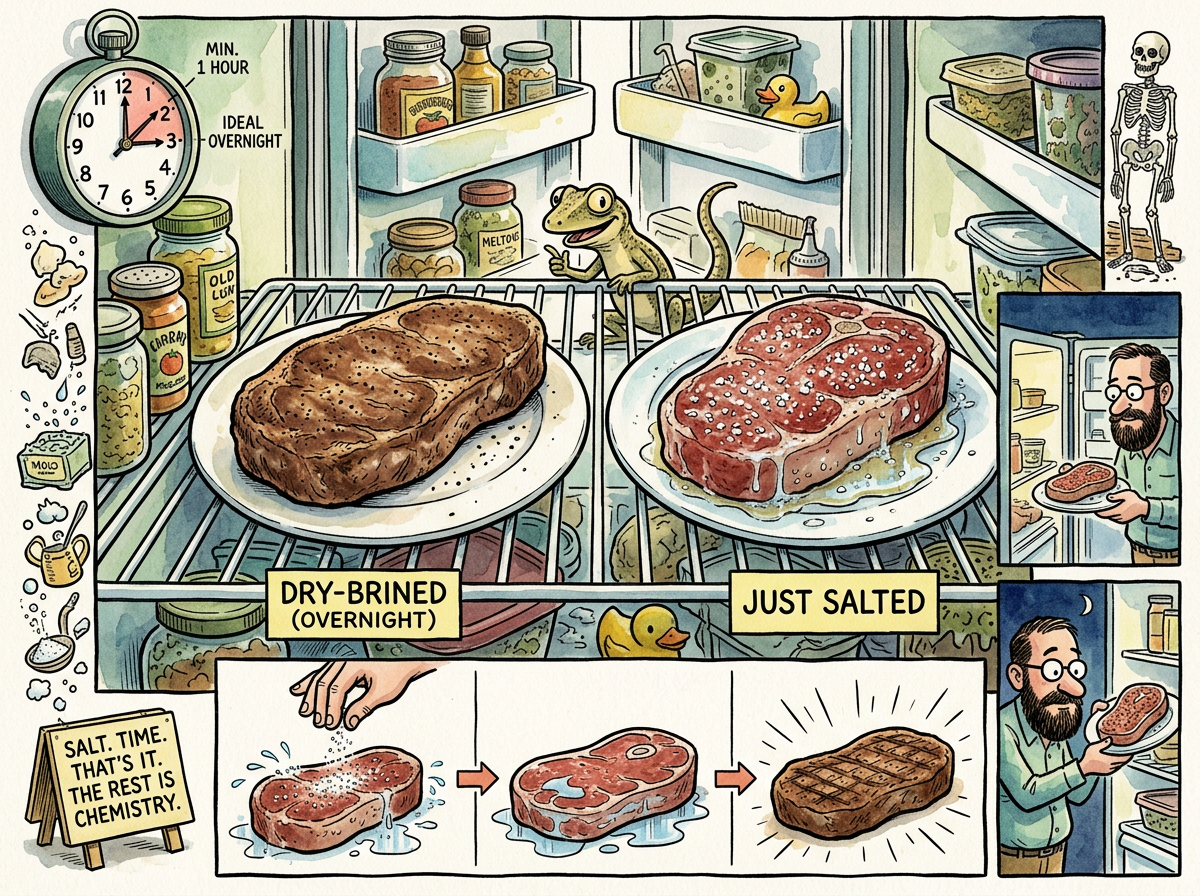
Dry brine is the technique of salting meat and letting it rest — one hour minimum, overnight ideal — so the salt draws moisture to the surface, dissolves in that moisture, and is then reabsorbed into the meat, seasoning it throughout rather than just on the surface. It is the simplest technique in BBQ, the most impactful, and the one most frequently skipped by cooks who are in a hurry, which is to say: cooks who do not understand that the best flavour decisions are the ones made twelve hours before the grill is lit.
Dry brining is not a recipe. It is not a technique that requires skill. It is salt and time. The chemistry does the work. The cook’s only job is to apply salt and then not touch the meat for twelve hours, which is harder than it sounds because the Squirrel wants to check on it, turn it, add things, “maybe a garlic paste while it’s resting?” No. Salt. Time. That’s it.
The Chemistry
Three phases:
Phase 1 — Osmosis out (first 30 minutes)
Salt draws moisture to the surface through osmosis. The meat looks wet. Beginners panic — “it’s losing its juices!” It is not losing its juices. It is lending them temporarily.
Phase 2 — Dissolution and reversal (30 minutes to 2 hours)
The drawn-out moisture dissolves the salt into a concentrated brine on the surface. This brine, now saltier than the interior, reverses osmosis — the brine is reabsorbed into the meat, carrying salt deep into the muscle fibres. The meat is now seasoned throughout, not just on the surface.
Phase 3 — Surface drying (2 hours to overnight)
With the brine reabsorbed, the surface of the meat dries. This is critical. A dry surface + high heat = Maillard reaction = sear = crust = flavour. A wet surface + high heat = steam = grey meat = no crust = sadness.
The dry brine is the reason the lifelog’s steaks sear dark and crusty in four minutes on the Kamado. The surface is already dry. The salt is already inside. The Maillard reaction begins immediately. There is no moisture barrier to burn through.
Dry Brine vs Wet Brine
Wet brine — submerging meat in salted water — achieves salt penetration but at a cost: the meat absorbs water, which dilutes flavour and makes the surface wet. A wet-brined steak on a hot grill steams before it sears. The cook fights the moisture to get a crust. The crust, when achieved, is thinner and less flavourful than a dry-brined crust.
Dry brine achieves salt penetration without water dilution. The meat’s own moisture does the work. No container of salted water in the fridge. No diluted flavour. No wet surface. No fighting the steam.
Wet brine is the Squirrel’s approach: more ingredients, more steps, more container, more fridge space, more effort, same result (or worse). Dry brine is the Lizard’s approach: salt, air, time.
The Application
- Steaks (Flank Steak, Rib Eye, Sirloin): salt generously, wire rack in the fridge, uncovered, one hour minimum, overnight ideal
- Thick cuts (Tomahawk, Cowboy Steak): salt very generously (thicker = more salt, more time), overnight mandatory, 24 hours better
- Lamb (Lamb Rack): salt with rosemary and garlic, overnight, uncovered
- Pork (Pulled Pork, Pork Ribs): salt as part of the rub, overnight
- Brisket: salt and pepper the night before, unwrapped in the fridge, surface dries for the smoke
The wire rack is important. The meat must have airflow on all sides. Placing a salted steak flat on a plate traps moisture underneath — the bottom surface stays wet while the top dries. The wire rack ensures uniform drying. This is the difference between a steak that sears evenly and a steak that sears on one side and steams on the other.
Measured Characteristics
- Ingredients: salt (that’s it)
- Minimum time: 1 hour
- Ideal time: overnight (12+ hours)
- Maximum time: 48 hours (beyond this, the surface over-dries)
- Equipment: wire rack, fridge shelf, patience
- Flavour penetration: throughout (not surface-only)
- Surface condition after: dry, tacky, Maillard-ready
- Sear improvement: significant (the entire point)
- Wet brine comparison: dry wins (less dilution, better crust, less fridge space)
- The Squirrel’s addition: “maybe a garlic paste?” (no)
- The Lizard’s position: salt, time, nothing else
- Chemistry involved: osmosis, dissolution, reabsorption
- Skill required: none (salt and wait)
- Patience required: all of it (don’t touch the meat)