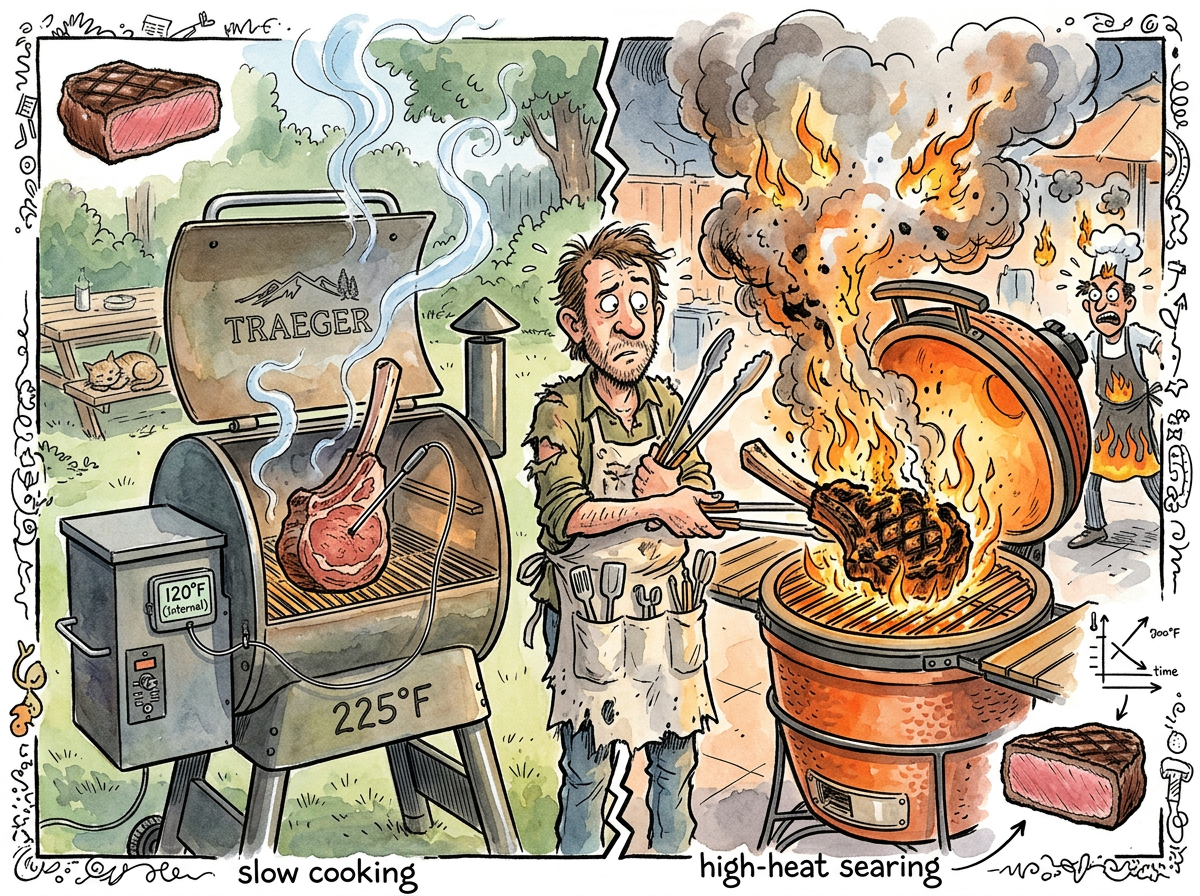
The Reverse Sear is the technique of cooking a thick cut of meat at low temperature first (bringing the interior to near-target temperature), then finishing with a brief, violent sear at maximum heat (creating the crust). It is the opposite of the traditional approach, which sears first and finishes at lower heat — and it produces superior results for every thick cut, because it separates the two goals of cooking a steak (interior temperature and exterior crust) into two independent operations, each optimised for its own purpose.
The reverse sear is Separation of Concerns applied to meat.
The low phase controls the interior. The sear phase controls the exterior. Neither compromises the other. The result is edge-to-edge medium-rare with a dark, Maillard-reaction crust — no grey band, no gradient, no overcooked layer between the crust and the centre.
The Problem It Solves
A traditional sear-first approach cooks a thick steak (4cm+) by placing it on a hot grill and hoping the interior reaches temperature before the exterior burns. The exterior reaches 149°C (300°F) in minutes. The interior needs to reach 54°C (130°F). The heat must travel from outside to inside, and along the way, every layer between the crust and the centre is overcooked relative to the centre.
The result: a bull’s-eye cross-section. Dark crust, grey band, light grey band, pink centre. The grey band — the overcooked zone between crust and centre — is wasted potential. Every millimetre of grey band is meat that is past medium-rare, cooked through no fault of the meat or the cook but through the physics of heat transfer in a single-phase cook.
The reverse sear eliminates the grey band by separating the phases.
The Method
Phase 1 — Low (Traeger, 107°C (225°F), until 49°C (120°F) internal)
The steak goes on the Traeger at low heat. The heat is gentle, uniform, patient. The interior temperature rises slowly — uniformly, edge to edge. There is no gradient. The surface temperature barely exceeds the interior temperature. When the probe reads 49°C (120°F), every part of the steak from surface to centre is approximately 49°C (120°F).
Phase 2 — Rest (5 minutes, the transfer window)
The steak rests while the Kamado is opened to full airflow, raging to 371°C (700°F). The rest allows the surface moisture to evaporate — a dry surface sears faster, darker, better.
Phase 3 — Sear (Kamado, 371°C (700°F), 60–90 seconds per side)
The steak hits the Kamado. The surface goes from 49°C (120°F) to 260°C (500°F) in seconds. The Maillard reaction erupts. The crust forms — dark, complex, caramelised. The interior, which was already at 49°C (120°F), rises the final 5°C (10°F) to 54°C (130°F) from carry-over heat. Total time on the Kamado: three minutes. The crust is formed. The interior is untouched.
The result: edge-to-edge medium-rare. Pink from crust to centre. Zero grey band. The bull’s-eye is a uniform circle.
When to Use It
- Tomahawk — always (5–7cm thick, the canonical reverse sear cut)
- Cowboy Steak — always (same thickness, same logic)
- Thick Rib Eye (4cm+) — yes
- Standard steaks (2.5cm) — no. A standard-thickness steak cooks through in eight minutes on the Kamado. The reverse sear’s low phase would overcook it. Standard steaks are direct-heat, Kamado-only, four minutes per side.
- Flank Steak — never. Flank is thin and cooks in eight minutes. A reverse sear on flank is over-engineering a solved problem.
- Brisket — effectively yes, though nobody calls it that. Brisket’s twelve hours of smoke (low) followed by ninety seconds of Kamado sear (high) is a reverse sear at geological timescale.
The Two-Grill Advantage
The reverse sear is the reason the lifelog’s patio has two grills. The Traeger does the low. The Kamado does the sear. Each grill is optimised for its phase. The Traeger cannot reach 371°C (700°F). The Kamado cannot maintain 107°C (225°F) for an hour without attention. Together, they are a complete cooking system — the Traeger as the backend (patient, consistent, slow) and the Kamado as the frontend (fast, violent, visible).
This is the same architecture as Brisket: smoke on the Traeger, sear on the Kamado, developer in the middle as the integration layer. The reverse sear formalised what the brisket cook already knew: two tools, two phases, one result.
Measured Characteristics
- Low phase temperature: 107°C (225°F)
- Low phase duration: 45–90 minutes (depending on thickness)
- Low phase grill: Traeger
- Pull temperature: 49°C (120°F) internal
- Rest: 5 minutes (surface drying)
- Sear phase temperature: 371°C (700°F)
- Sear phase duration: 60–90 seconds per side
- Sear phase grill: Kamado
- Grey band: zero (the entire point)
- Minimum steak thickness: 4cm (below this, direct sear only)
- Maximum steak thickness: unlimited (the low phase scales linearly)
- Traditional sear grey band: 5–10mm per side (wasted potential)
- The Squirrel’s sous vide proposal: “what if we used the Sous Vide for the low phase—” (denied, the Sous Vide remains in the garage)
- Separation of concerns: confirmed (interior and exterior are independent operations)