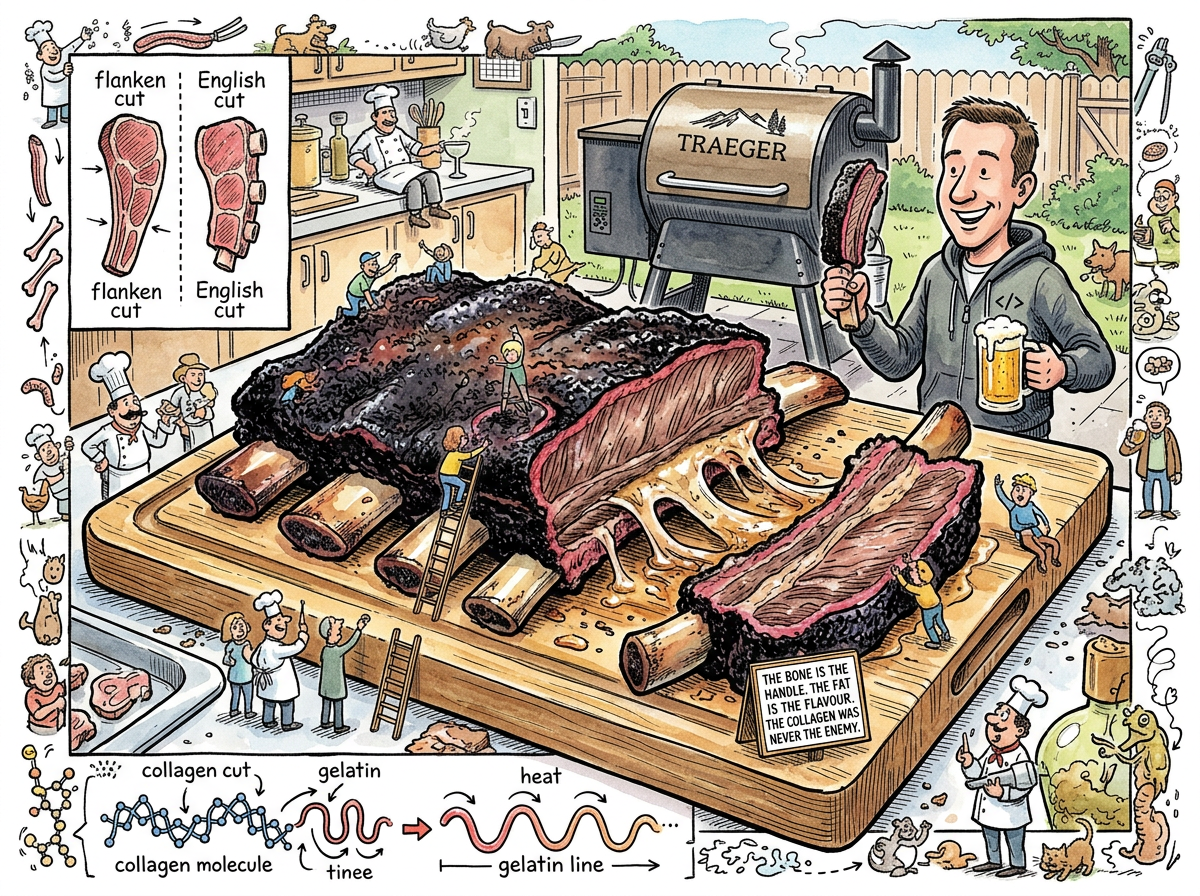
Short ribs are sections of rib bone with attached meat cut from the chuck, plate, or brisket area — densely marbled, heavily collagenous, and the cut that taught riclib that toughness is not a flaw but an invitation to patience. A tough cut cooked fast is a mistake. A tough cut cooked slow is a revelation. The collagen that makes short ribs chewy at medium-rare converts to gelatin at 95°C (203°F), and gelatin is the reason short ribs, when done right, have a texture that no lean cut can achieve.
Short ribs are Brisket’s smaller sibling — the same patience, the same low-and-slow faith, the same collagen-to-gelatin conversion, but in a format that fits on a plate and takes eight hours instead of fourteen.
The Two Cuts
English cut — sawn across the bone, each piece a thick slab of meat sitting atop a section of rib bone. This is the BBQ cut. The smoke cut. The “put it on the Traeger at sunrise and eat at dinner” cut. The bone acts as a handle. The meat pulls clean when done. The bark forms a crust. This is the version the lifelog uses.
Flanken cut — sliced between the bones into thin strips, each strip containing cross-sections of three or four rib bones. This is the Korean cut. Galbi. Marinated, grilled fast over high heat, sliced thin. A different philosophy entirely — where English cut is Low and Slow, flanken cut is hot and fast, the Kamado’s territory. Both are valid. Both are short ribs. Both prove that the same raw material, approached with different methods, produces different truths.
The Method (English Cut, Low and Slow)
- Season — Pepper Smoke Salt. The ribs have enough intramuscular fat that they baste themselves. The rub is guidance, not rescue.
- Smoke — The Traeger, 135°C (275°F), 6–8 hours. Slightly hotter than brisket because the individual pieces are smaller and the collagen converts faster at the higher surface-area-to-mass ratio.
- The stall — it happens. Around 71°C (160°F). The same stall as brisket. The same patience required. The same Squirrel suggesting the Texas Crutch.
- Target — 95°C (203°F) internal. The magic number. Same as brisket. Same reason. Collagen → gelatin.
- Rest — 30 minutes minimum. The juices redistribute. The bark sets.
- Serve — the bone is the handle. Pick it up. Eat it. This is not a knife-and-fork cut.
Why Short Ribs Matter
Short ribs are the proof that Low and Slow works on any scale. Brisket is the ambitious project — fourteen hours, twelve pounds, a full-day commitment. Short ribs are the afternoon project — eight hours, manageable portions, the same principles applied at smaller scale. The developer who can smoke short ribs can smoke brisket. The architecture is identical. The patience is identical. Only the timeline differs.
The Squirrel would braise short ribs in red wine with forty-seven aromatics. This produces excellent food. It also produces a kitchen that smells like a French grandmother’s house and requires monitoring a Dutch oven for four hours. The Traeger produces the same tenderness with smoke instead of wine, time instead of monitoring, and a patio instead of a kitchen.
Measured Characteristics
- Weight per rib (English cut): 400–600g
- Smoke temperature: 135°C (275°F)
- Smoke time: 6–8 hours
- Target internal: 95°C (203°F)
- Collagen conversion: yes (the entire point)
- Bone utility: handle
- Korean alternative: flanken cut, galbi, hot and fast
- The Squirrel’s method: braised in wine (valid but indoor)
- The Lizard’s method: smoke and patience (outdoor, as God intended)
- The stall: present (shorter than brisket)
- Tenderness when done: obscene
- Appropriate utensil: hands