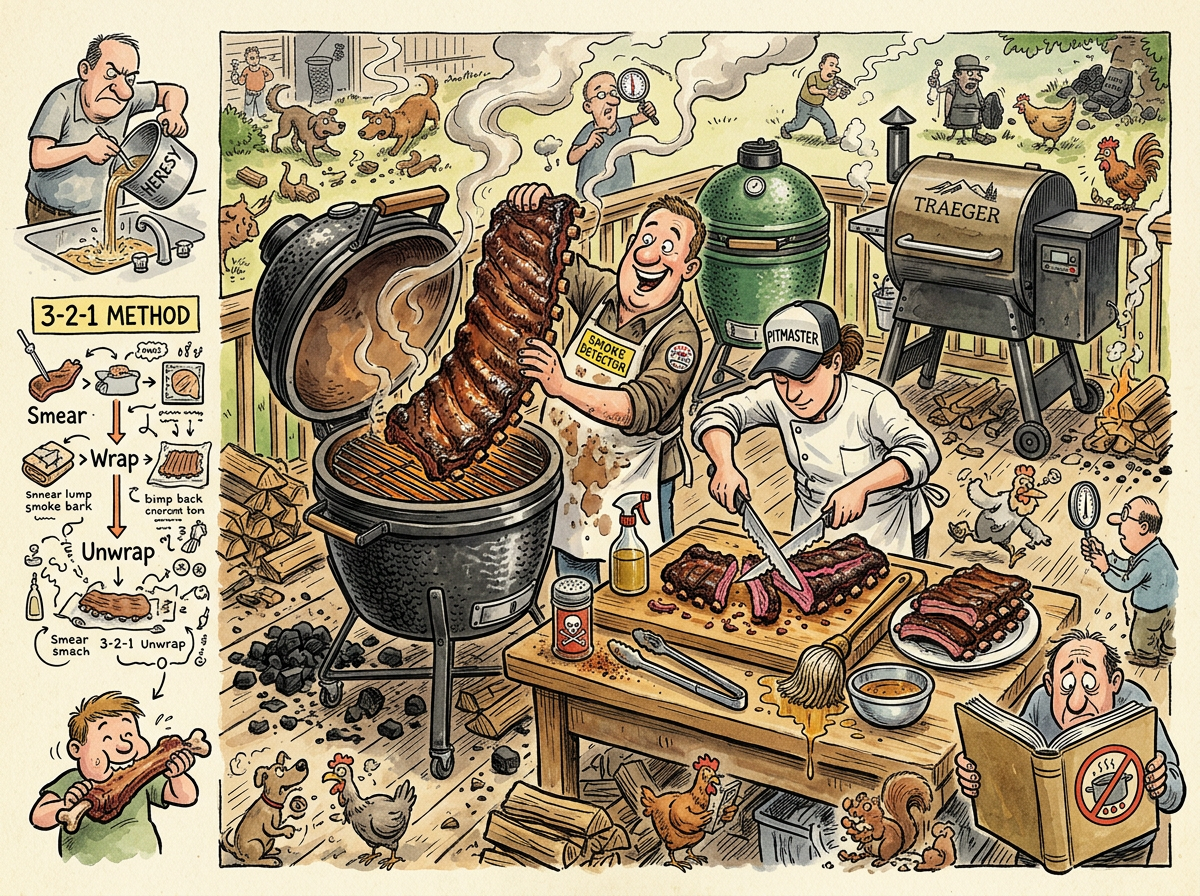
Pork ribs are the gateway drug to Low and Slow BBQ — the cut that converts sceptics, the cut that teaches patience at manageable scale, the cut that every BBQ culture on Earth independently discovered because the combination of bone, fat, collagen, and smoke is a convergent evolutionary truth, like eyes in biology or pub-sub in software.
Every culture found ribs independently. American South. Korea. China. Portugal. Argentina. They all looked at a rack of ribs and arrived at the same conclusion: cook these slowly, with smoke or fire, and something transformative happens. This is convergent evolution. This is what happens when a design pattern is so obviously correct that every civilisation discovers it without communication.
The Two Racks
Baby back ribs — from the top of the rib cage, near the spine. Shorter, leaner, more tender. The quicker cook. The weeknight rib. Three to four hours of smoke and they’re done. The Kamado can do these alone — hot and fast, ninety minutes, wrapped in foil for the middle phase. Baby backs are the Flank Steak of the rib world: reliable, fast, Tuesday.
Spare ribs (St. Louis cut) — from lower on the rib cage, near the belly. Longer, fattier, more collagen. The slow cook. The Saturday rib. Five to six hours. These need the Traeger’s patience. Spare ribs reward low and slow the way Brisket rewards it: the extra fat and collagen convert to richness that baby backs can’t match.
The Method (3-2-1 for Spare Ribs)
The 3-2-1 method is the framework. Like all good frameworks, it provides structure without removing judgement:
3 hours — Smoke (Traeger, 107°C (225°F), unwrapped)
The ribs absorb smoke. The bark begins to form. The rub sets. The Maillard reaction creates the colour and the crust. These three hours are the foundation.
2 hours — Wrap (Traeger, 107°C (225°F), in butcher paper with a splash of apple cider vinegar)
This is The Texas Crutch applied with intention. The wrap traps moisture, accelerates the collagen conversion, and pushes through the stall. The vinegar adds acid that cuts through the fat. Foil works but steams the bark soft. Butcher paper breathes — it protects without suffocating. The difference between foil and butcher paper is the difference between wrapping code in try-catch blocks (safe but stifling) and writing code that handles errors in the normal flow (breathable, intentional).
1 hour — Unwrap and glaze (Kamado, 135°C (275°F), sauce optional)
The ribs come out of the wrap. The bark re-crisps. If sauce is applied (vinegar-based, thin, not sweet), it caramelises. The Kamado’s direct heat does in one hour what the Traeger’s indirect heat would take two to achieve. This is the final sear — the same principle as brisket, the same Kamado-finishes-what-Traeger-started cooperation.
The Bend Test
The ribs are done when they bend. Hold the rack with tongs at one end. The rack should bend under its own weight, and the bark should crack — but the meat should not fall off the bone.
Fall-off-the-bone ribs are overcooked. This is a controversial opinion outside the lifelog, where fall-off-the-bone is marketed as the goal. But ribs that fall off the bone have been cooked past the point of texture. The meat should pull clean with a bite, leaving a crescent of teeth marks on the bone. This is the correct tenderness: tender enough to eat without a knife, structured enough to hold together on the bone.
The fall-off-the-bone myth is the BBQ equivalent of 100% test coverage: it sounds like the goal until you realise that pursuing it past a certain point degrades the thing it was meant to improve.
The Boiling Heresy
Some recipes — many recipes, horrifyingly many recipes — instruct the cook to boil ribs before grilling. This is the greatest sin in BBQ. Greater than well-done steak. Greater than sweet sauce on pulled pork. Greater than cutting picanha into steaks.
Boiling extracts flavour into the water. Boiling removes the fat that should render slowly into the meat. Boiling produces grey, flavourless ribs that are then placed on a grill for five minutes of surface-level theatre, a Potemkin village of BBQ — looks right, tastes wrong, fools nobody who has eaten the real thing.
If you boil ribs, this encyclopedia cannot help you.
Measured Characteristics
- Baby back cook time: 3–4 hours
- Spare rib cook time: 5–6 hours (3-2-1 method)
- Smoke temperature: 107°C (225°F)
- Finish temperature: 135°C (275°F) (Kamado)
- Target: bend test (crack but don’t fall)
- Fall-off-the-bone: overcooked (controversial but correct)
- Boiling before grilling: heresy (not controversial, just wrong)
- Cultures that independently discovered ribs: all of them
- Convergent evolution: confirmed
- Framework: 3-2-1 (3 smoke, 2 wrap, 1 unwrap)
- Butcher paper vs foil: breathable vs suffocating
- The Squirrel’s rib glaze: seventeen ingredients (rejected)
- The Lizard’s rib glaze: none needed (the rub and smoke are sufficient)
- Gateway drug to low and slow: yes