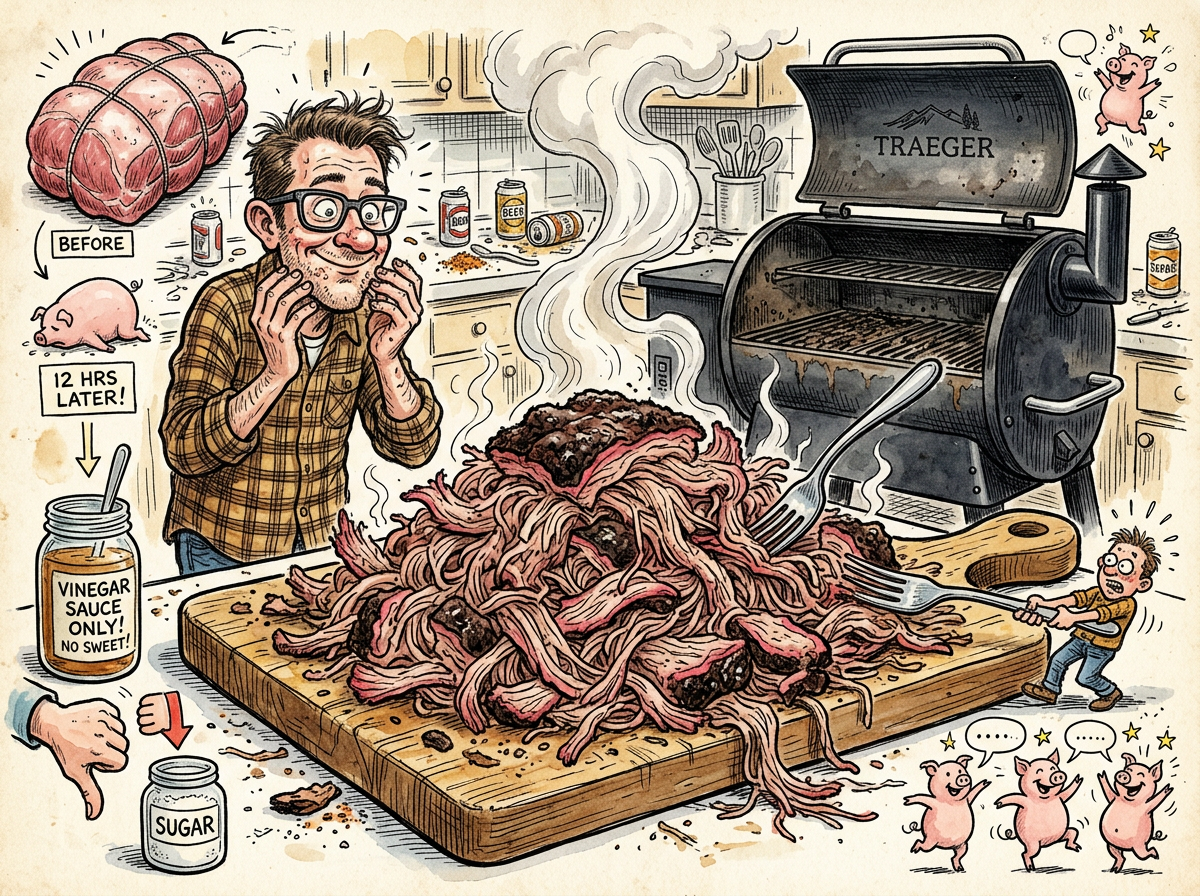
Pulled pork is a pork shoulder (or pork butt, which is confusingly also from the shoulder) cooked Low and Slow until the collagen converts to gelatin and the meat can be separated — pulled — into strands using nothing but two forks and minimal effort. It is Brisket’s pork counterpart: the same patience, the same collagen conversion, the same twelve-hour commitment, but more forgiving, cheaper, and capable of feeding a crowd that brisket would bankrupt.
Pulled pork is the entry-level masterwork of low-and-slow BBQ. If brisket is the doctoral thesis — expensive, temperamental, one mistake ruins the defence — then pulled pork is the undergraduate project: cheaper, more forgiving, teaches the same fundamental principles, and the result still impresses everyone at the table.
The Method
- Season — Pepper Smoke Salt base, with paprika. This is one of the few cuts where the Squirrel’s instinct to add spices is partially correct: a pulled pork rub benefits from paprika, brown sugar, and garlic powder in addition to the holy trinity. The Lizard allows this. The Lizard does not smile, but the Lizard does not object.
- Smoke — The Traeger, 107°C (225°F), 10–14 hours. The shoulder goes on at midnight. The developer goes to sleep. The Traeger does its work — automated, patient, pellet-fed, app-monitored. This is the Traeger’s finest hour: a cut that rewards exactly the kind of patience-without-supervision that the Traeger was built for.
- The stall — around 71°C (160°F). Same as brisket. Same as short ribs. The moisture evaporates, the temperature plateaus, the uninitiated panic. The initiated go back to bed.
- The crutch — optional. Wrapping in butcher paper at 74°C (165°F) accelerates the stall. This is The Texas Crutch. Purists refuse. Pragmatists accept. The pork doesn’t care — it converts either way.
- Target — 95°C (203°F) internal. The magic number. Same for pork shoulder, brisket, short ribs. 95°C (203°F) is the universal constant of collagen conversion.
- Rest — one hour minimum. Two is better. Wrapped in butcher paper, placed in a cooler (no ice). The temperature drops slowly. The gelatin redistributes.
- Pull — two forks. Insert, twist, pull. The meat separates into strands. If it doesn’t separate easily, it’s not done. Put it back on. There is no shortcut.
The Sauce Question
The sauce question reveals character.
Sweet sauce (Kansas City style) masks the smoke. The developer who spent twelve hours smoking pork does not want the result to taste like ketchup with brown sugar. Sweet sauce is the !important of BBQ — it overrides everything that came before it, and the thing it overrides was already correct.
Vinegar sauce (Carolina style) cuts through the fat. It is acidic, thin, enhances rather than masks. This is the correct sauce for pulled pork, if sauce is used at all. Vinegar sauce is a utility function — small, purposeful, amplifies the existing flavour instead of replacing it.
No sauce — the Lizard’s position. The smoke is the sauce. Twelve hours of oak and hickory built the flavour profile. Adding sauce is adding a dependency. The pulled pork should stand alone, and if it can’t, the cook failed, not the recipe.
Measured Characteristics
- Cut: pork shoulder (Boston butt)
- Weight (raw): 3–5 kg
- Smoke temperature: 107°C (225°F)
- Smoke time: 10–14 hours
- Target internal: 95°C (203°F)
- The stall: present, as always
- The crutch: optional (butcher paper)
- Rest time: 1–2 hours
- Pulling tool: two forks
- Correct sauce: vinegar (or none)
- Incorrect sauce: sweet (masks the smoke)
- Feeds: a crowd (8–12 people per shoulder)
- Cost per person: negligible (pork shoulder is cheap)
- Forgivingness vs brisket: much higher (the fat content rescues mistakes)
- The Squirrel’s rub: seventeen spices (partially allowed for once)
- The Lizard’s sauce: none (the smoke is the sauce)