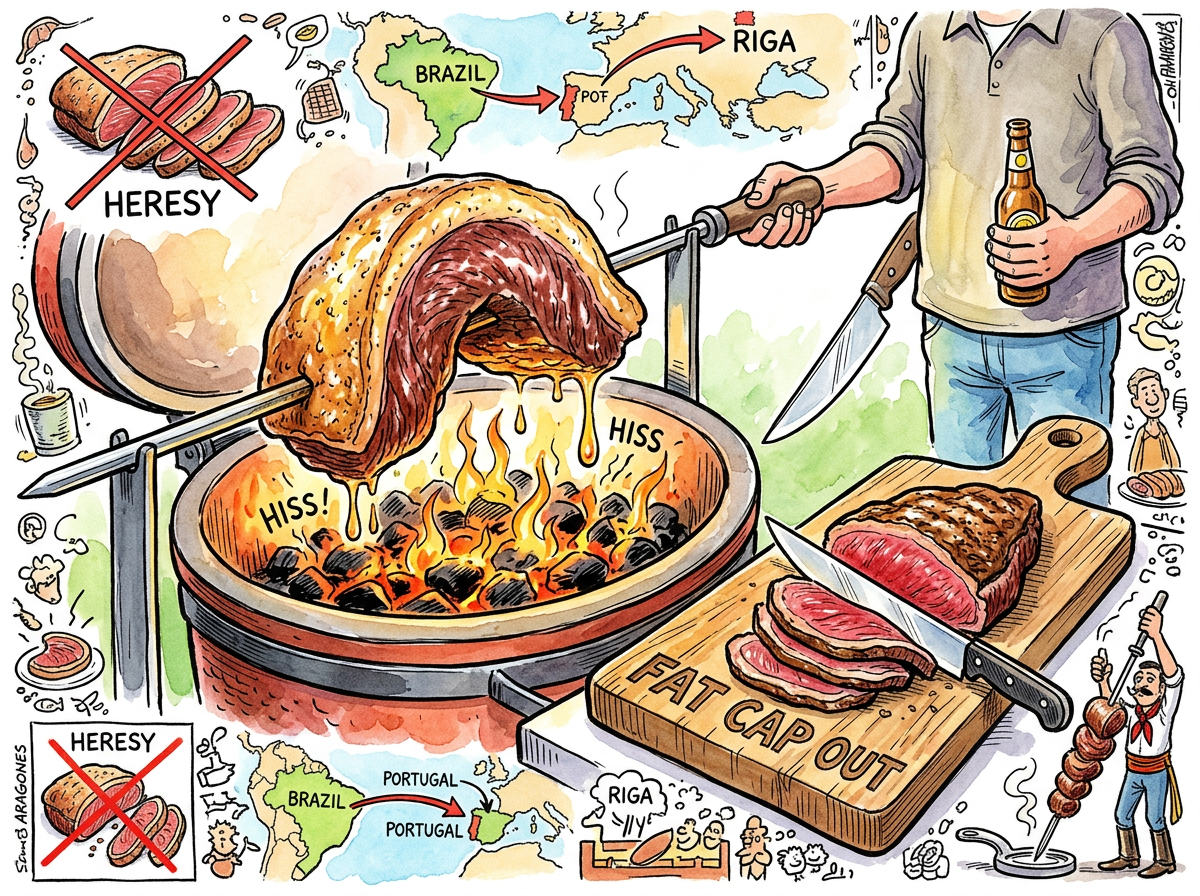
Picanha (pronounced pee-KAHN-yah) is the rump cap — a triangular cut from the top of the sirloin, covered by a thick fat cap — that Brazil elevated to a national treasure and the rest of the world consistently ruins by cutting it into steaks before cooking, which is heresy.
There is only one way to cook picanha. The Brazilian way. Folded over itself, fat cap out, on a skewer or directly on the grate. Sliced thinly after the outer layer is seared, then returned to the fire for the next layer. Repeat until the centre is reached. Each pass is more rare than the last. Each slice is thin. Each bite has both seared exterior and melting fat. This is the method. This is the only method.
Cutting picanha into steaks before cooking is like splitting a Brisket in half to make it cook faster. It misses the entire point. The point is the journey from outside to inside, from seared to rare, from fat cap to lean centre. Cut it into steaks and you have an expensive sirloin. Cook it whole and you have picanha.
The Method
- Score the fat cap — shallow crosshatch, through the fat but not the meat. The fat renders through the cuts. The crosshatch becomes crispy. This is not optional.
- Season with coarse salt — salt only. The Squirrel would add chimichurri, garlic paste, and a seventeen-ingredient Brazilian spice blend. Picanha needs salt. The fat provides the rest.
- Fold the picanha — bend it into a half-moon, fat cap facing outward, so the curve exposes the fat to direct heat. Skewer if using a rotisserie. Place directly on the grate if using the Kamado.
- Grill over high heat — the Kamado at 260–316°C (500–600°F). The fat cap renders. The drippings hit the coals. The flares add smoke. The exterior sears.
- Slice the outer layer — when the outside is deeply seared and the fat cap is golden and crispy, bring it to the board. Slice the seared exterior in thin strips. Serve immediately.
- Return to the fire — the remaining picanha, now with a new raw exterior exposed, goes back on the grill. The process repeats.
- Repeat — three to four rounds, from the well-done exterior to the rare centre. Each round feeds the table while the next round cooks.
This is churrascaria-style — the rodízio method of continuous slicing and returning, adapted for a home grill. Each person at the table gets slices from every round: seared, medium, medium-rare, rare. The first slice is crispy fat and well-done meat. The last slice is pure rare tenderness. The journey is the dish.
The Portuguese Connection
riclib is Portuguese. Picanha is Brazilian. But Brazil was Portugal’s, and the culinary inheritance runs both ways. The Portuguese brought cattle to Brazil. Brazil taught the Portuguese how to cook them properly. This exchange — four centuries of colonial history condensed to a grill technique — is the most productive thing either country has agreed on.
The picanha on the lifelog’s patio in Riga is a Portuguese developer cooking a Brazilian cut on a Japanese grill (Kamado) in Latvia, which is either globalisation at its finest or the most culturally confused piece of meat in the Baltics.
The Heresy
Cutting picanha into steaks is heresy. This must be stated plainly because the practice is widespread outside Brazil and Portugal, and every steakhouse that serves “picanha steaks” is serving a lie.
A picanha steak is a sirloin with a fat cap. It is fine. It is not picanha. Picanha is a method, not just a cut. The method requires the whole piece, folded, fat cap out, sliced in rounds. Remove the method and you have removed the picanha. What remains is beef with a hat.
The Kamado has no opinion on this. The Kamado cooks what it is given. But the developer has an opinion, and the opinion is: there is only one way. The Brazilian way. Fat cap out. Sliced thin. Returned to the fire. Everything else is someone else’s encyclopedia.
Measured Characteristics
- Weight (whole): 1–1.5 kg
- Fat cap thickness: 1–2 cm (do not trim)
- Seasoning: salt (coarse, generous, nothing else)
- Grill temperature: 260–316°C (500–600°F)
- Slicing rounds: 3–4
- Doneness per round: well-done → medium → medium-rare → rare
- Correct method: Brazilian (folded, fat cap out, sliced in rounds)
- Incorrect method: cutting into steaks (heresy)
- Countries that understand: Brazil, Portugal
- Countries that cut it into steaks: the rest (forgiven but wrong)
- Cultural complexity of this picanha: Portuguese developer, Brazilian cut, Japanese grill, Latvian patio
- The Squirrel’s rub proposal: rejected (salt only)
- There is only one way: yes