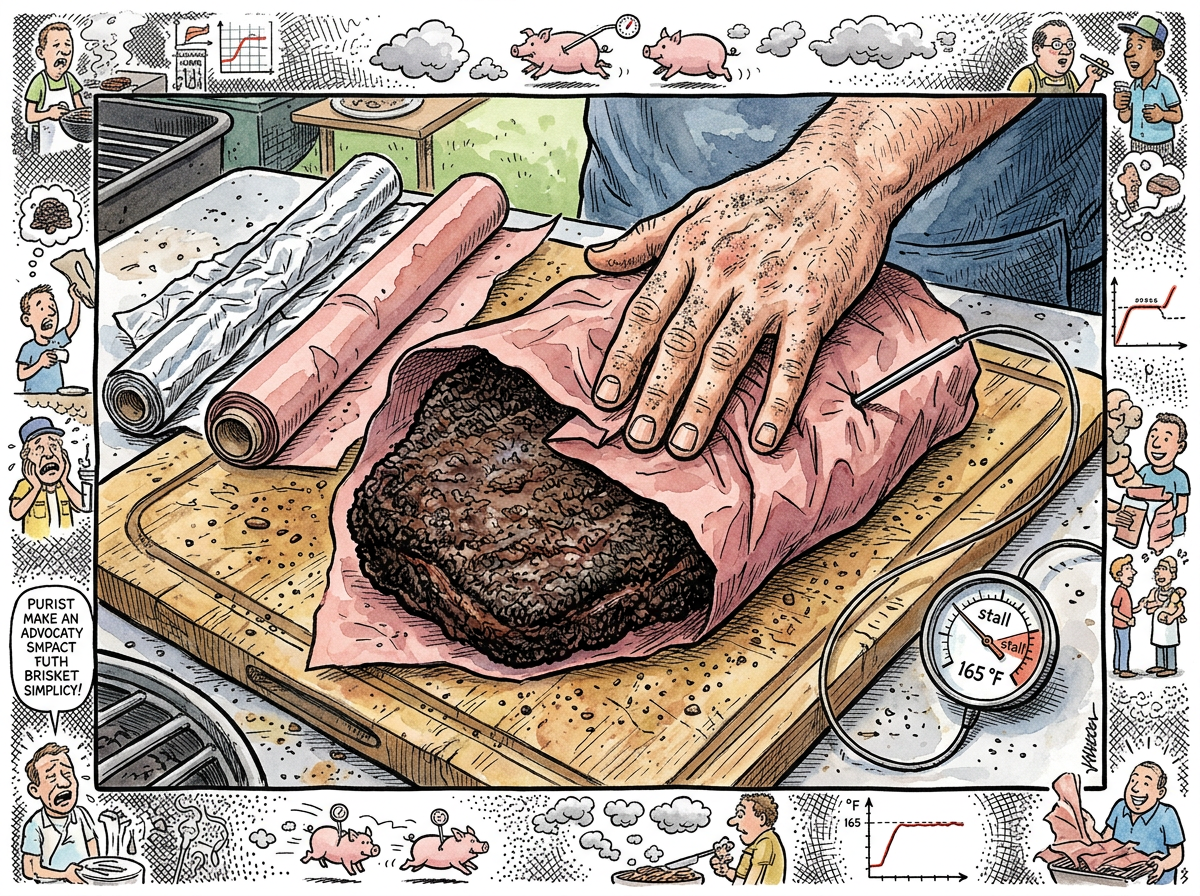
The Texas Crutch is the technique of wrapping a cut of meat — typically Brisket, Pulled Pork, or Pork Ribs — in aluminium foil or butcher paper during the stall phase of a Low and Slow cook, accelerating the cook by trapping heat and moisture that would otherwise evaporate from the surface.
The Texas Crutch is the BBQ equivalent of caching: it doesn’t change the underlying process, it accelerates it by retaining something that would otherwise be lost. And like caching in software, it is controversial — purists argue it changes the output, pragmatists argue the output is better, and the actual difference depends on implementation details that most people arguing about it have not tested.
The Stall
To understand the crutch, understand the stall.
During a low-and-slow cook, the meat’s internal temperature rises steadily until it reaches approximately 71°C (160°F). Then it stops. For hours. The temperature plateaus — sometimes for four hours or more — while the cook checks the probe, checks the grill, checks the app, and considers panicking.
The stall is caused by evaporative cooling: moisture on the meat’s surface evaporates, and the cooling effect of that evaporation exactly matches the heating effect of the grill. The temperature cannot rise because every calorie of heat is consumed by evaporation. The meat is air-conditioning itself.
The stall ends when the surface dries out enough that evaporation can no longer match the heat input. The temperature resumes climbing. The collagen converts. The cook stops panicking.
The Texas Crutch shortens the stall by wrapping the meat, which stops the evaporation by trapping the moisture against the surface. No evaporation, no cooling, no stall. The temperature pushes through 71°C (160°F) and continues to 95°C (203°F).
Foil vs Butcher Paper
Aluminium foil — the original crutch. Complete moisture seal. The meat braises in its own juices. The stall is defeated quickly. The downside: the bark softens. The crust that took four hours of smoke to build becomes soft and steamy. The texture changes. The bark can be re-crisped with a Kamado finish, but it will never be the same bark that an unwrapped cook produces.
Foil is the !important of BBQ. It forces the result. It works. But it overrides the thing that was already working.
Butcher paper — the compromise. Semi-permeable. Traps enough moisture to shorten the stall, but breathes enough to let some moisture escape. The bark softens less. The texture is closer to an unwrapped cook. The stall takes longer to push through than foil, but shorter than naked.
Butcher paper is middleware. It sits between the meat and the environment, filtering what passes through, protecting without suffocating. The bark survives. The stall shortens. The pragmatist wins.
The Purist Position
“Unwrapped. Always. The stall is part of the process. The bark is sacred. Wrapping is cheating.”
The purist is not wrong. An unwrapped brisket, cooked through the stall with patience, produces the best bark. The surface dries completely. The Maillard reaction has maximum time to develop complexity. The result, when executed correctly, is the platonic ideal of BBQ bark: dark, crusty, complex, shattering.
The cost: four additional hours. A fourteen-hour cook becomes an eighteen-hour cook. The stall, unwrapped, takes its full time. Patience is the price of bark perfection.
The Pragmatist Position
“The brisket is delicious. The bark is slightly less perfect. I saved four hours. I am eating at noon instead of 4 PM.”
The pragmatist is also not wrong. A butcher-paper-wrapped brisket produces a bark that is 85% as good as unwrapped, in 75% of the time. The trade-off is explicit: bark quality for time. For a competition, unwrapped. For a Sunday with guests arriving at 1 PM, butcher paper.
The Lifelog’s Position
Butcher paper. Always.
The developer who built incremental sync with SSE negotiation to reduce deploy time from 28 seconds to 300ms is the same developer who wraps brisket in butcher paper to reduce cook time from eighteen hours to fourteen. The instinct is the same: optimise the bottleneck without degrading the output. The deploy still works. The brisket still has bark. The time saved is real.
The Lizard has no opinion on the crutch. The Lizard has opinions on fire and patience. The crutch is a logistics decision, not a philosophical one.
Measured Characteristics
- When to apply: 71–74°C (160–165°F) internal (onset of stall)
- Foil stall reduction: 2–4 hours
- Butcher paper stall reduction: 1–2 hours
- Foil bark impact: significant softening
- Butcher paper bark impact: minimal softening
- Foil analogy:
!important(forces the result, overrides existing work) - Butcher paper analogy: middleware (filters, protects, breathes)
- Purist position: unwrapped, always
- Pragmatist position: butcher paper, usually
- The lifelog’s position: butcher paper, always
- Competition position: depends on judging criteria
- Cheating: no (it’s technique, not shortcut)
- Time saved: 2–4 hours per cook
- Bark quality trade-off: 15% reduction for 25% time savings
- The Squirrel’s wrapping material: sous vide bags (“what if we vacuum-sealed—” no)