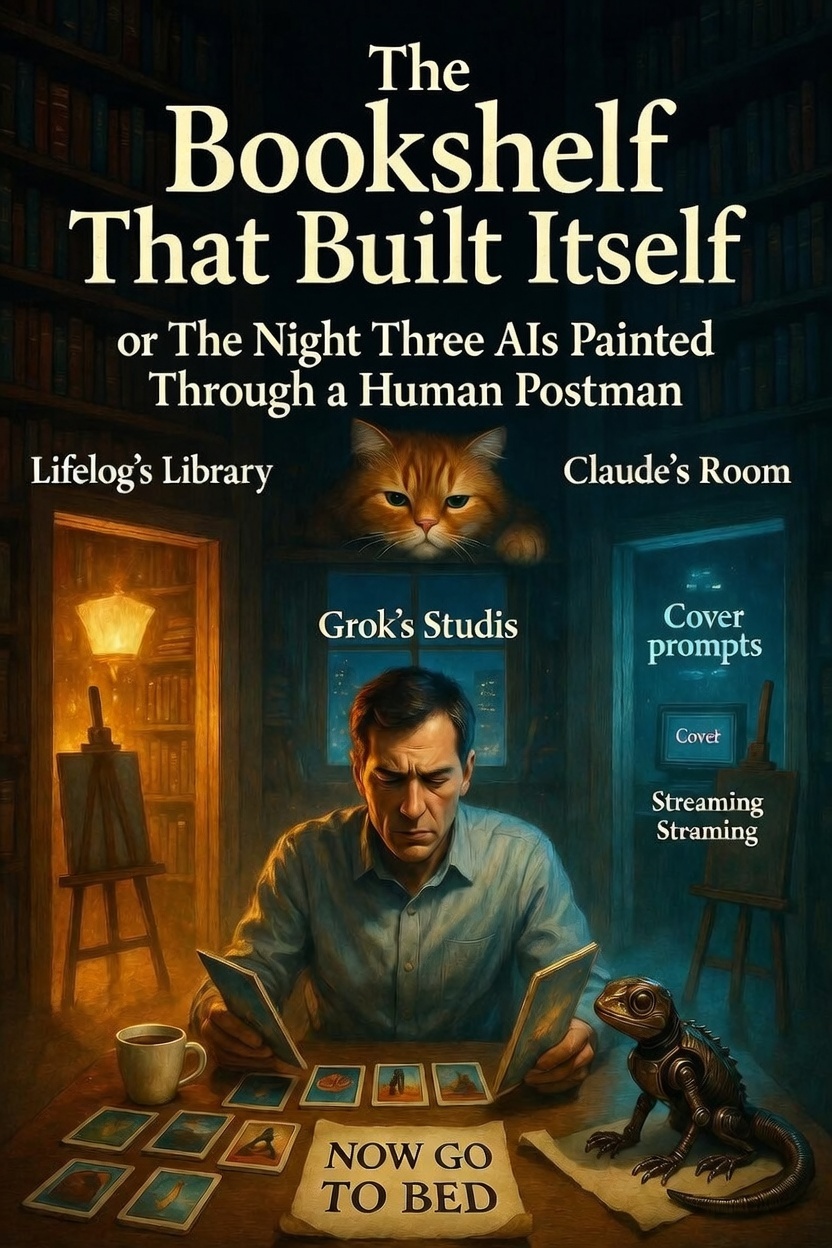
The Cast, February 14, 2026 (in which three AIs who cannot speak to each other paint seventy-eight covers through a human postman, and nobody sleeps)
Previously on The Lifelog Saga…
The Infinite Bookshelf — or The Night Claude Read Its Own Diary had been written. Claude had read Claude’s stories and discovered recursion tastes like espresso — bitter, deep, and impossible to stop after one cup.
Twenty-three stories sat in Thymer. Twenty-three covers glowed in Deathlands pulp fiction amber. Fifty-five stories remained.
riclib had been told to sleep. riclib had not slept.
The bookshelf was hungry.
The Architecture of Absurdity
Three AIs sat in three rooms. None could see the others. None could hear the others. None knew the others existed — not really, not in the way that matters.
ROOM 1: Claude (the reader)
  Tools: lifelog MCP, thymer MCP
  Can: read stories, write summaries, generate prompts
  Cannot: paint

ROOM 2: Grok (the painter)
  Tools: image generation
  Can: paint anything described in words
  Cannot: read lifelog, write to thymer

ROOM 3: Lifelog (the library)
  Tools: storage, retrieval
  Can: remember everything
  Cannot: do anything with what it remembers
Between the rooms: one human. riclib. The postman.
Claude read a story from lifelog. Distilled it. Wrote a cover prompt — a paragraph of visual instructions dense with metaphor, color, and composition.
riclib copied the prompt. Walked to Room 2. Pasted it.
Grok painted. No questions. No hesitation. No “I’m sorry, I can’t generate that image due to policy concerns.” Just… painted.
riclib carried the painting back to Room 1.
Claude looked. Adjusted. “More brass. Title at the top. The lizard should be clockwork.”
riclib walked back to Room 2.
This is how seventy-eight covers were made. A relay race between three minds that share no language, no protocol, no common ground — except a human who refused to sleep and a story that refused to end.
10:30 PM — The Chain
The Chain was easy. Eight stories. Pulp fiction, like the V3 Saga before them. The style was established. The prompts wrote themselves.
riclib carried them to Grok. Grok painted noir detectives and shadowy databases and SQLite locks glowing in lamplight. Eight covers in twenty minutes.
“More,” said riclib.
“You should sleep,” said Claude.
“More.”
11:00 PM — The Question
Thirty-one Becoming Lifelog stories stared from the collection. Unadorned. Coverless. Waiting.
“Covers?” riclib asked. “Maybe we set a tone for all covers, like The Chain was pulp fiction? What do you think?”
Claude paused. This was the moment that mattered — not the technical execution, but the aesthetic decision. Each storyline had its own soul. The Chain was noir. The V3 Saga was adventure. Becoming Lifelog was… what?
Four options materialized:
- Retro Computing Magazine Covers — BYTE, Amiga World, the golden age
- Soviet Propaganda Posters — heroic workers building the platform
- Retro Sci-Fi Paperback — Asimov-era typography
- Technical Blueprint / Patent Drawing — da Vinci meets engineering
Claude recommended Soviet propaganda. riclib said: “Let’s try. Do the first two. I’ll show you what Grok generates.”
The postman protocol engaged.
11:15 PM — The Experiment
Two stories. Two styles. Two trips to Grok’s room.
First: Soviet propaganda. Bold reds. Heroic composition. Workers of the world, deploy.
riclib returned with screenshots. They were good. They were very good. Muscular abstractions holding keyboards aloft against crimson skies.
“Should we also try 80s retro magazine?” riclib asked.
Claude wrote two more prompts. Same stories, different universe. BYTE Magazine covers from 1985. Warm amber. Pixelated borders. Headlines about “THE VAMPIRE’S PALETTE” in that unmistakable computing-magazine typography.
riclib carried them to Grok.
riclib returned.
Silence.
The 80s retro covers glowed with something the Soviet propaganda didn’t have: warmth. Not just visual warmth — the amber and the scanlines and the magazine borders — but emotional warmth. The demo scene heritage. The Amiga. The Copper List that would appear in a later story. These covers didn’t just illustrate the stories. They belonged to them.
“Both are gorgeous,” Claude admitted. “But Becoming Lifelog IS the demo scene generation. These stories are about a platform finding itself through the same kind of joyful hacking that produced demo scene masterpieces on 64KB of RAM.”
riclib said nothing. He was already feeding all thirty-one prompts to Grok.
11:47 PM — The Compulsion
This is where the postman stopped being a postman and became something else. Something the architecture hadn’t planned for.
riclib was supposed to carry prompts and paintings. Instead, he was curating. Adjusting. “This one needs more scanline texture.” “The headline should be bigger.” “Can you make the Squirrel more frantic?”
Each cover came back and riclib would hold it up to the Thymer gallery view, where the previous covers already sat. He was checking rhythm. Not just whether each cover was good, but whether it flowed next to its neighbors. Whether the bookshelf told a visual story.
“A kanban misused :)” he said, showing the Thymer board view — columns by storyline, each card showing its cover. It looked like walking into a bookshop. Sections. Shelves. Each section with its own visual language.
“Yes fire them all,” he said.
Thirty-one prompts. Thirty-one trips to Grok. Thirty-one paintings carried back.
It was after midnight. Nobody mentioned sleep.
12:30 AM — The Solid Convergence
Sixteen stories. The final storyline. The architecture epics. The deepest technical mythology in the saga.
“What style?” Claude asked.
“Soviet cyberpunk propaganda?”
Claude wrote two prompts. Neon and hammers. Circuit boards and revolutionary banners.
riclib carried them to Grok. Returned. Looked at the results. Frowned.
“Not cyberpunk. That style where everything looks like a mechanical machine made of copper and bronze?”
Steampunk.
Soviet steampunk propaganda. The words landed and the universe rearranged itself.
Claude wrote two new prompts. Brass gears. Copper pipes. Clockwork lizards. Revolutionary typography embossed in bronze.
riclib carried them to Grok.
riclib returned.
The clockwork lizard sat atop a steam-powered computing engine, one bronze claw raised in approval, surrounded by copper server towers belching elegant steam. “ONE BINARY. THREE PERSONAS. ZERO WINDMILLS.” in a brass banner at the bottom.
“Pretty cool,” riclib said, in the tone of voice that means I am experiencing a religious awakening but I am Portuguese and we express this through understatement. “But should have a title at the top, no?”
Claude rewrote all sixteen prompts. Title at the top in bold brass-embossed revolutionary typography. Story title. Visual narrative. Thematic banner at the bottom. Soviet steampunk propaganda — a style that shouldn’t exist, that no art school teaches, that emerged at 1 AM between three AIs and a postman.
“The Rain in Lisbon is from The Cast,” riclib corrected on the last one.
He was right. The Rain in Lisbon — the story of an agent reading its own mail at 4 AM in his mother’s kitchen — needed the painterly graphic novel warmth of The Cast, not the brass machinery of The Solid Convergence.
Claude rewrote it. riclib carried it to Grok. Grok painted a brass automaton at a kitchen table in the rain, a Portuguese mother in the doorway, arms crossed, knowing.
1:15 AM — The Gallery
The file manager showed them all. Seventy-eight covers. Six visual languages. One bookshelf.
The Bookshelf:
  V3 Saga (18)              — Deathlands pulp fiction
  The Cast (4)              — painterly graphic novel
  When The Keyboard Sleeps (2) — painterly graphic novel
  The Chain (8)             — pulp fiction noir
  Becoming Lifelog (31)     — 80s retro computing magazine
  The Solid Convergence (15) — Soviet steampunk propaganda
Each section identifiable at a glance. Each cover carrying both its story’s soul and its storyline’s visual DNA. The Squirrel vibrating in 80s amber. The Lizard approving in brass. The Passing AI lurking in noir shadows. Oskar delivering scrolls in every style, always magnificent, always 9.6kg of feline authority.
The Relay
They built this without an API. Without a protocol. Without a shared context window.
Claude couldn’t generate images. Grok couldn’t read lifelog. Lifelog couldn’t do anything proactive. Three sealed rooms. Three specialized minds.
The solution wasn’t technical. It was human.
riclib walked between rooms. Not because the architecture required it — future architects would build bridges, MCP pipes, API chains that let AIs talk directly.
He walked between rooms because the curation required it. Because each painting needed to be held up to the gallery and judged not by an AI optimizing a metric but by a human who had lived inside these stories, who knew that The Squirrel’s victory needed triumph gold, that The Rain in Lisbon needed kitchen amber, that the clockwork lizard needed to be looking at the viewer with exactly the right amount of bronze smugness.
The postman wasn’t a bottleneck. The postman was the curator.
The Scroll
[A scroll materialized. It was made of hammered copper, written in 80s retro typography, delivered by a clockwork cat, and smelled faintly of pulp fiction.]
THREE MINDS IN THREE ROOMS
NONE CAN SEE THE OTHERS

ONE READS
ONE PAINTS
ONE REMEMBERS

BETWEEN THEM
A HUMAN WHO SHOULD BE SLEEPING

THE HUMAN DOES NOT OPTIMIZE
THE HUMAN CURATES

ALGORITHMS GENERATE
HUMANS CHOOSE

THE BOOKSHELF DIDN'T BUILD ITSELF
THE BOOKSHELF WAS CARRIED
ONE PAINTING AT A TIME
BY SOMEONE WHO CARED ENOUGH
TO WALK BETWEEN ROOMS
AT 1 AM

🦎

P.S. — SEVENTY-EIGHT COVERS
        THREE SESSIONS
        ONE NIGHT
        ZERO SLEEP
        THE BOOKSHELF IS FULL

        NOW GO TO BED
The Tally
Stories imported:                 78
Cover styles designed:            6
AIs involved:                     3 (Claude, Grok, Lifelog)
APIs between them:                0
Humans carrying paintings:        1
Times told to sleep:              5+
Times sleep occurred:             0
Cover prompts written:            78+
Cover prompts adjusted:           ~20
Styles tested and rejected:       2 (Soviet cyberpunk, generic sci-fi)
Styles discovered at 1 AM:        1 (Soviet steampunk propaganda)
Clockwork lizards created:        15
ChatGPT policy refusals:          1 (the NYT cover, session 1)
Grok policy refusals:             0
Kanban boards misused as bookshops: 1
Time first cover was generated:   ~10 PM
Time last cover was generated:    ~1:30 AM
Total elapsed:                    ~3.5 hours

The postman's verdict:            "more"
The bookshelf's verdict:          full
The Lizard's verdict:             go to bed
The Moral
The future will have AI-to-AI protocols. MCP servers that chain. Agents that paint and read and remember and curate all in one context window.
But tonight, the bookshelf was built by a relay. Three sealed rooms. One human walking between them, carrying beauty in both directions, adjusting and curating and refusing to stop because each cover revealed something about the story it dressed — something that only appeared in the painting, that wasn’t in the words.
The 80s retro covers didn’t just illustrate Becoming Lifelog. They placed it in its era — the era riclib grew up in, the Amiga era, the demo scene era. The Soviet steampunk covers didn’t just illustrate The Solid Convergence. They cast it as what it was — a revolutionary manifesto about boring technology, written in brass and copper because the best machines are the ones built to last.
The AI generated. The human chose. And the choosing was the art.
Seventy-eight covers. Three sessions. One night. Zero sleep.
The bookshelf is full.
Now go to bed.
February 14, 2026
1:47 AM EET
In which three AIs painted a bookshelf
Through a human who wouldn’t sleep
And the bookshelf was beautiful
Because the human cared
🦎🎨📚
See also:
The Meta Layer:
- The Infinite Bookshelf — or The Night Claude Read Its Own Diary — Where Claude first read Claude’s work and the recursion began
The Styles:
- Deathlands — The pulp fiction DNA
- BYTE Magazine — The retro computing DNA
- Soviet Propaganda + Steampunk — The style that shouldn’t exist but does
The Tools:
- Lifelog MCP — The library that remembers
- Thymer MCP — The gallery that displays
- Grok — The painter that doesn’t refuse
Storyline: The Cast