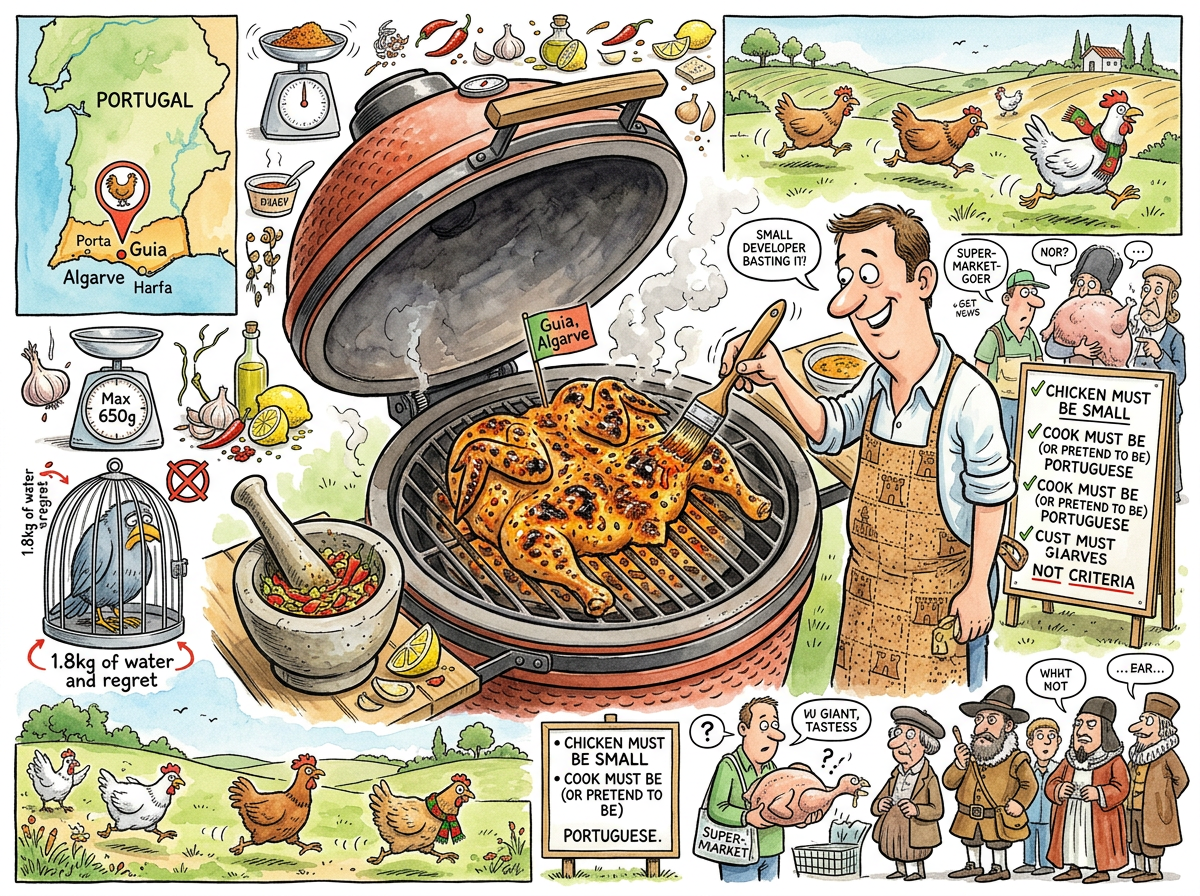
Frango da Guia (chicken from Guia) is the Portuguese peri peri chicken — not the chain-restaurant interpretation, not the supermarket sauce version, not the “piri piri” rebrand for markets that can’t handle the original spelling. The real thing. Small countryside chicken, never above 650g, spatchcocked, marinated in crushed bird’s eye chillies, garlic, olive oil, lemon, and salt, then grilled flat over charcoal until the skin blisters and the juices run clear and the entire patio smells like the Algarve in August.
Frango da Guia is riclib’s other daily driver, alternating with Rib Eye on the nightly grill rotation. The rib eye is beef. The frango is home. Both appear every week. Neither replaces the other.
The Flank Steak would be the daily driver if the Baltics stocked it. They don’t. The rib eye inherited the role. The frango shares it — not as a substitute but as a counterpoint. Beef and chicken. Portugal and Latvia. Fire and marinade. The patio has room for both.
The Chicken
The chicken must be small. And young.
This is non-negotiable, and it was learned the hard way. In Of Quantum Blockchains and Wolf-Scaring Chickens, riclib sourced locally raised countryside chickens — muscular, battle-scarred, free-range, the kind that lived a full life and developed opinions and could scare wolves. These chickens were magnificent. These chickens had character. These chickens were also tough as leather on the Kamado and were promptly relegated to The Bosch, where low and slow oven duty could break down what the grill could not. A chicken that has spent its life fighting wolves does not surrender to twenty minutes of charcoal.
A proper frango da Guia uses a young countryside chicken — free-range, locally sourced, compact, tender — never above 650g. Not the wolf-scaring veterans. Not the industrial supermarket bird, bloated to 1.8kg with water retention and accelerated growth. The sweet spot: a young bird, small enough to cook flat in twenty minutes, tender enough that the Kamado’s heat is sufficient, flavourful enough that the peri peri has something to amplify.
A 650g chicken cooks flat in twenty minutes on the Kamado. The skin crisps. The meat stays moist. The bird is small enough that the heat penetrates evenly — no dry breast, no raw thigh, no temperature gradient that forces a choice between overcooked and undercooked. The small chicken is the Boring Technology of poultry: it works because it is the right size for the task, and making it bigger does not make it better.
The Squirrel would source a 2kg organic heritage breed with a provenance certificate and a name. The Lizard would source a 600g young countryside chicken from the nearest farm. The Lizard’s chicken fits on the grill. The Squirrel’s chicken requires a rotisserie attachment, a drip pan, and forty-five minutes. The wolf-scaring chicken requires The Bosch.
The Peri Peri
Peri peri (also piri piri, from the Swahili pilipili) is the bird’s eye chilli — small, intensely hot, the chilli that Portuguese traders brought from Africa to the Algarve, where it married garlic and olive oil and lemon and became the marinade that defines Portuguese grilled chicken.
The marinade:
- Bird’s eye chillies — crushed, not blended smooth. The texture matters. Flecks of chilli on the skin char during grilling and create pockets of concentrated heat.
- Garlic — crushed, generous, raw. Garlic that has been cooked before marinating is garlic that has already given its best moments to the wrong dish.
- Olive oil — Portuguese, obviously. The oil carries the chilli and garlic into the meat during marination and bastes the surface during grilling.
- Lemon juice — acid that tenderises and brightens. The lemon cuts through the oil and the heat.
- Salt — coarse. Applied after marination, before grilling. The Dry Brine principle applies even here.
That’s it. Five ingredients. The Squirrel’s peri peri has smoked paprika, oregano, bay leaf, red wine vinegar, red bell pepper, onion powder, and “a touch of honey for balance.” The Squirrel’s peri peri is a sauce. The real peri peri is a marinade. The difference is restraint.
The Method
- Spatchcock — remove the backbone, flatten the bird. This is the most important step. A whole chicken on a grill is a physics problem with no good solution: the breast overcooks before the thigh is done. A spatchcocked chicken lies flat, uniform thickness, uniform heat, uniform result. Spatchcocking is the normalisation of the chicken.
- Marinate — peri peri marinade, minimum four hours, overnight ideal. The bird sits in the marinade in the fridge, absorbing chilli and garlic through every surface.
- Kamado, medium-high — 204–232°C (400–450°F), direct heat. Not the 371°C (700°F) of a steak sear. Chicken skin needs time to render its fat and crisp without burning the marinade’s sugars.
- Skin side down first — ten minutes. The skin crisps, the fat renders, the chilli flecks char.
- Flip — ten minutes. The meat side gets direct heat. The juices, driven upward by the heat below, redistribute.
- Rest — five minutes. Cut into quarters. Serve with lemon wedges.
Total time on the grill: twenty minutes. Total time including prep: twenty-five minutes. This is a weeknight protein that tastes like a Sunday in the Algarve.
The Portuguese Connection
riclib is Portuguese. The frango da Guia is not nostalgia — it is practice. The same dish, the same method, the same marinade, cooked on a Japanese ceramic grill on a Latvian patio by a Portuguese developer. The chicken does not know it is in Riga. The peri peri does not know it is 3,000 kilometres from the Algarve. The Kamado does not know it is cooking Portuguese food. The result is correct anyway, because the method is the method, and the method does not require geography.
The hardest part is the chicken. Latvia has excellent local farms and countryside chickens — small, flavourful, 500–650g — that are closer in spirit to Algarve chickens than anything in a Portuguese supermarket. The irony: the best ingredient for Portuguese grilled chicken is, in Riga, Latvian.
Measured Characteristics
- Chicken weight: never above 650g
- Industrial chicken: rejected (too large, too bland, too much water)
- Wolf-scaring chicken: rejected for grill (too tough), relegated to The Bosch
- Marinade ingredients: 5 (chilli, garlic, olive oil, lemon, salt)
- Marinade ingredients the Squirrel would add: 7 more (rejected)
- Marination time: 4 hours minimum, overnight ideal
- Grill temperature: 204–232°C (400–450°F)
- Cook time (spatchcocked): 20 minutes
- Method: spatchcock, always (whole chicken on a grill is a physics problem)
- Days per week: 2–3 (alternating with Rib Eye)
- Origin: Guia, Algarve, Portugal
- Current location: Riga, Latvia (3,000 km from origin)
- Best local chicken for Portuguese method: Latvian countryside (the irony)
- The patio smells like: the Algarve in August
- Peri peri chain restaurants: a different dish (no comment)