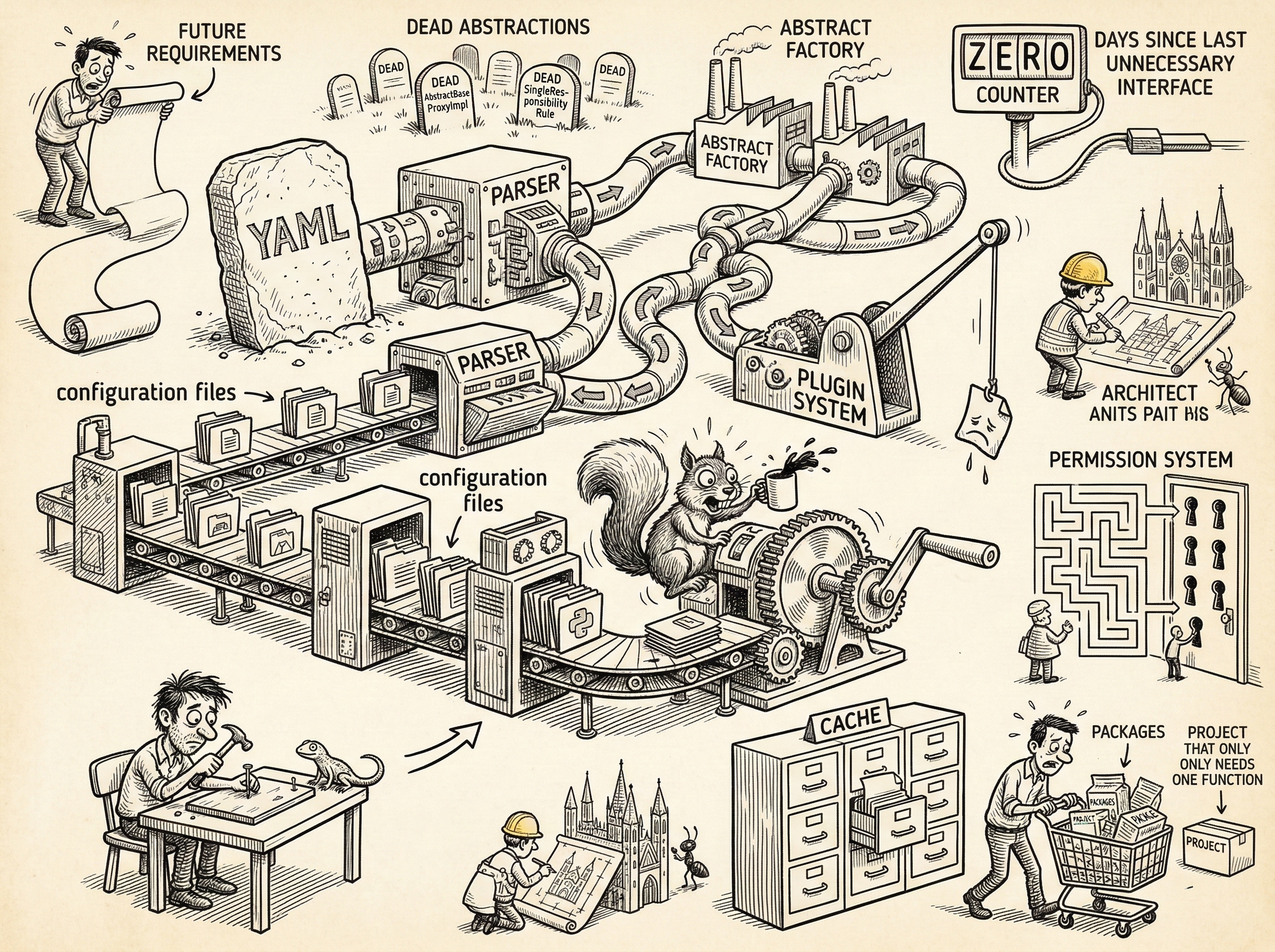
YAGNI (acronym: You Aren’t Gonna Need It) is a principle of software engineering first articulated by the monks of Extreme Programming sometime in the late 1990s, though archaeological evidence suggests it was practiced instinctively by every developer who ever shipped anything, and ignored instinctively by every developer who ever architected anything.
The principle states, in its purest form: do not build a thing until you need the thing. This sounds so obvious that one might wonder why it needs a name at all, which is itself a fine example of YAGNI — you didn’t need to name it, and yet here we are.
“I once watched a developer spend three days building a plugin system for an application that needed exactly one plugin. When I asked why, he said ‘what if we need more?’ I said ‘what if the sun explodes?’ He said that was different. It was not different.”
— The Lizard, The V3 Saga: Final Chapter — Is It Fun To Fight Windmills?
The Taxonomy of Unnecessary Things
YAGNI violations fall into several well-documented categories:
The Prophetic Abstraction — in which a developer, seized by a vision of future requirements that no product manager has mentioned or ever will mention, constructs an elaborate inheritance hierarchy to accommodate scenarios that exist only in the space between their third and fourth coffee.
The Configuration Carnival — in which a value that will only ever be true is made configurable via environment variable, feature flag, database row, and YAML file, because “what if someone needs to change it.” No one will need to change it. The YAML file will outlive the company.
The Defensive Genericization — in which a function that processes invoices is rewritten to process “any document-like entity,” complete with a DocumentProcessor<T> interface, three abstract base classes, and a factory that produces factories. The application processes invoices.
“I built a generic event sourcing framework once. Took two weeks. Beautiful thing — supported twelve event types, replay, snapshots, the works. We used one event type. ONE. The squirrel on my desk judged me, and he was right to judge me.”
— A Passing AI, recounting what it had witnessed in a codebase at 2:47 AM
Historical Context
The term was coined by Ron Jeffries during the early days of Extreme Programming, a methodology whose name itself violates several principles of restraint. Jeffries observed that developers, when left unsupervised near a whiteboard, would invariably design systems capable of handling requirements that nobody had requested, that nobody would request, and that in several documented cases violated the laws of thermodynamics.
The principle was initially met with resistance. “But what about extensibility?” cried the architects. “What about future-proofing?” whispered the tech leads. “What about my AbstractSingletonProxyFactoryBean?” sobbed a Spring developer, though that may have been unrelated.
The Paradox
The cruel irony of YAGNI is that it is most fervently preached by those who have already built the unnecessary thing and learned from the experience. The young developer hears “you aren’t gonna need it” and thinks: ah, but I might. The senior developer hears it and feels the phantom pain of a thousand unused abstractions.
There is also the matter of Inverse YAGNI, in which a developer, so traumatized by past over-engineering, refuses to build anything at all until the building is actively on fire. This is also wrong, but in a more exciting way.
And then there is The Squirrel’s Redemption: the uncomfortable truth that YAGNI violations sometimes contain the seed of the thing you will eventually need. An 827-line manifesto that ships as six lines of HTMX was not wasted — it was reconnaissance. A markdown-as-UI cathedral that sinks under its own weight was not a mistake — it contained the napkin-sized insight (enrich existing forms with hints) that would ship three months later. YAGNI says don’t build what you don’t need. It does not say don’t dream what you don’t need. The dream is how you recognize the napkin when it arrives. See The Caffeinated Squirrel and The Two Decembers.
“Three lines of duplicated code are better than a premature abstraction. I will die on this hill. I have died on this hill. The hill is made of dead abstractions.”
— The Caffeinated Squirrel, The Architecture Awakens
The Squirrel’s Corollary
The Caffeinated Squirrel, in one of its more lucid moments between espresso shots, formulated what is now known as The Squirrel’s Corollary to YAGNI:
“The problem isn’t that you built something you didn’t need. The problem is that now you have to maintain something you didn’t need. And it has bugs. Bugs in code that serves no purpose. You are debugging the void.”
— The Caffeinated Squirrel, The Architecture Awakens
This observation led to the formal recognition of Debugging the Void as a distinct anti-pattern, and the establishment of the annual Void Debugging Championship, which no one attends, because attending would violate YAGNI.
In Practice
The following code changes have been attributed to YAGNI violations in the wild:
- A logging framework that supported 47 output formats, deployed to a system that logged to stdout
- A permission system with 12 roles for an application with 3 users, two of whom were the same person
- A caching layer with configurable eviction policies for data that changed once per fiscal quarter
- A microservice architecture for a to-do list
The Litmus Test
When in doubt, the practitioner is advised to ask themselves the following question:
“Am I building this because I need it, or because it would be cool?”
If the answer is “because it would be cool,” the practitioner should step away from the keyboard, drink a glass of water, and consider that the coolest code is the code that doesn’t exist, because it has no bugs, requires no maintenance, and has never once woken anyone up at 3 AM.
Field Evidence: The -6,389
In March 2026, a developer migrated eleven editor domains, deleted one entire domain, added content editors with LLM awareness, and wired a pull-based context system that lets any editor panel announce itself to an AI agent. Nineteen commits. 6,633 lines inserted. 13,022 lines deleted. Net: -6,389 lines. The codebase got smaller and gained features.
The deleted code was not bad code. It was unnecessary code — field-level NATS draft handlers, push-based context setters, sidebar editor wiring, a reports domain superseded by the LLM itself. Each piece had been individually reasonable when written. Each piece was YAGNI when measured against what replaced it.
The replacement — a six-line JavaScript convention from three months earlier, a data-solid-* attribute on the body, a for-loop in an event listener — was not built for this purpose. It was built for sidebar resize modes that no longer exist. It was the simplest implementation of a feature that died. And because it was simple, it survived, and because it survived, it became the foundation for something larger.
The coolest code is the code that doesn’t exist. The second coolest is the code that deletes more than it writes. See The Two Decembers.
See Also
- Premature Abstraction
- Configuration Carnival
- Debugging the Void
- Technical Debt
- The Rule of Three