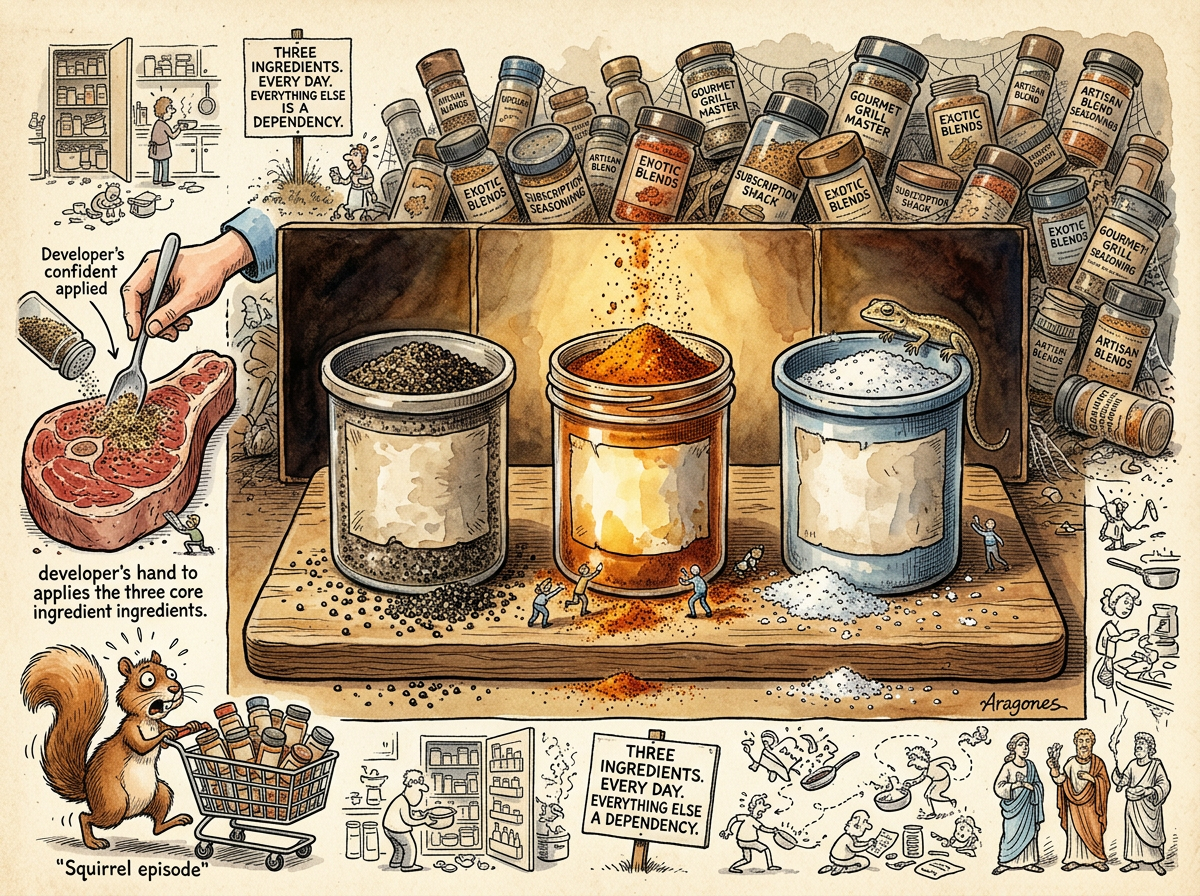
Pepper Smoke Salt is the three-ingredient seasoning that riclib applies to virtually everything that touches the grill — coarse black pepper, smoked paprika, and coarse salt. It is the YAGNI of seasoning: three ingredients, no framework, no seventeen-spice rub blend, no subscription box of artisan seasonings, no “secret family recipe” that is neither secret nor a recipe.
Three ingredients. Every day. Everything else is a dependency.
The Squirrel proposes a rub. The rub has seventeen ingredients. The Lizard blinks.
THREE.
PEPPER. SMOKE. SALT.
THE MEAT HAS FLAVOUR.
LET IT SPEAK. 🦎
The Components
Coarse black pepper — cracked, not ground. The coarseness matters. Ground pepper burns at high heat. Cracked pepper chars on the surface while the interior remains aromatic. The texture of cracked pepper on a seared steak is part of the experience — a crust within the crust. Every steak. Every rack. Every rib. Pepper is not optional. Pepper is structural.
Smoked paprika — the smoke component when the meat isn’t going on the Traeger. For Kamado-only cooks (steaks, lamb, weeknight grills), smoked paprika provides the smoke flavour that the charcoal alone cannot. For Traeger cooks, the smoked paprika is redundant — the Traeger provides its own smoke. But riclib applies it anyway, because consistency in a daily practice is more valuable than optimisation. Apply the same rub to everything. Remove the decision. Cook the meat.
Coarse salt — not table salt, not fine sea salt, not Himalayan pink salt (which is the Squirrel’s salt, purchased once, never used again, still in the cabinet as a monument to enthusiasm). Coarse salt adheres to the surface. Coarse salt creates a micro-crust. Coarse salt dissolves slowly, so the seasoning lasts through the cook rather than being absorbed in the first thirty seconds.
The Ratio
There is no ratio. This is important.
The ratio is: enough. Enough pepper to see it. Enough smoked paprika to colour the surface. Enough salt to taste. The developer does not measure. The developer has applied this rub several thousand times. The hands know the ratio the way a touch typist knows the keyboard — measurement was necessary once, years ago, and has since been compiled into muscle memory.
The Squirrel wants a recipe. The Squirrel wants tablespoons and teaspoons and a laminated card taped to the inside of the spice cabinet. The Lizard wants the developer to learn the ratio by repetition until measurement is unnecessary.
The Lizard won. The Lizard always wins this argument.
The Seventeen-Spice Rub (Rejected)
The Squirrel, at various points, has proposed the following additions to the rub:
- Garlic powder (“it adds depth”)
- Onion powder (“it adds complexity”)
- Brown sugar (“for bark formation”)
- Cayenne (“for heat”)
- Mustard powder (“it’s an emulsifier”)
- Cumin (“earthy notes”)
- Coriander (“bright notes”)
- Oregano (“Mediterranean profile”)
- Thyme (“pairs with rosemary”)
- Truffle salt (“for special occasions”)
- Espresso powder (“bold and unexpected”)
- Cocoa powder (“the mole effect”)
- Cinnamon (“sweet heat”)
- Star anise (“Asian fusion”)
- Sumac (“lemony acidity”)
- Gochugaru (“Korean BBQ crossover”)
- MSG (“umami science”)
Each proposal was individually reasonable. Each addition would have “added” something. The combined result would be a rub that tastes like everything and therefore like nothing — seventeen flavours competing for attention on a piece of meat that already had flavour before any of them arrived.
Pepper Smoke Salt is YAGNI applied to the spice rack. The meat has flavour. The fire adds flavour. The smoke adds flavour. The rub’s job is to amplify what is already there, not to introduce seventeen new characters to a story that was already working with three.
Measured Characteristics
- Ingredients: 3 (pepper, smoked paprika, salt)
- Ingredients proposed by Squirrel: 17 (rejected, repeatedly)
- Ratio: enough (no measurements)
- Measurement method: muscle memory
- Daily applications: 1–2
- Annual applications: ~500
- Cuts this rub covers: all of them (steak, ribs, brisket, pork, lamb)
- Exceptions: Picanha (salt only, Brazilian method)
- The rub’s job: amplify, not replace
- The meat’s job: have flavour (which it does, because it’s meat on a fire)
- The Squirrel’s rub cabinet: seventeen jars, dusty
- The Lizard’s rub cabinet: three containers, worn from use
- Dependency count: zero (three ingredients, all commodity, all interchangeable brands)