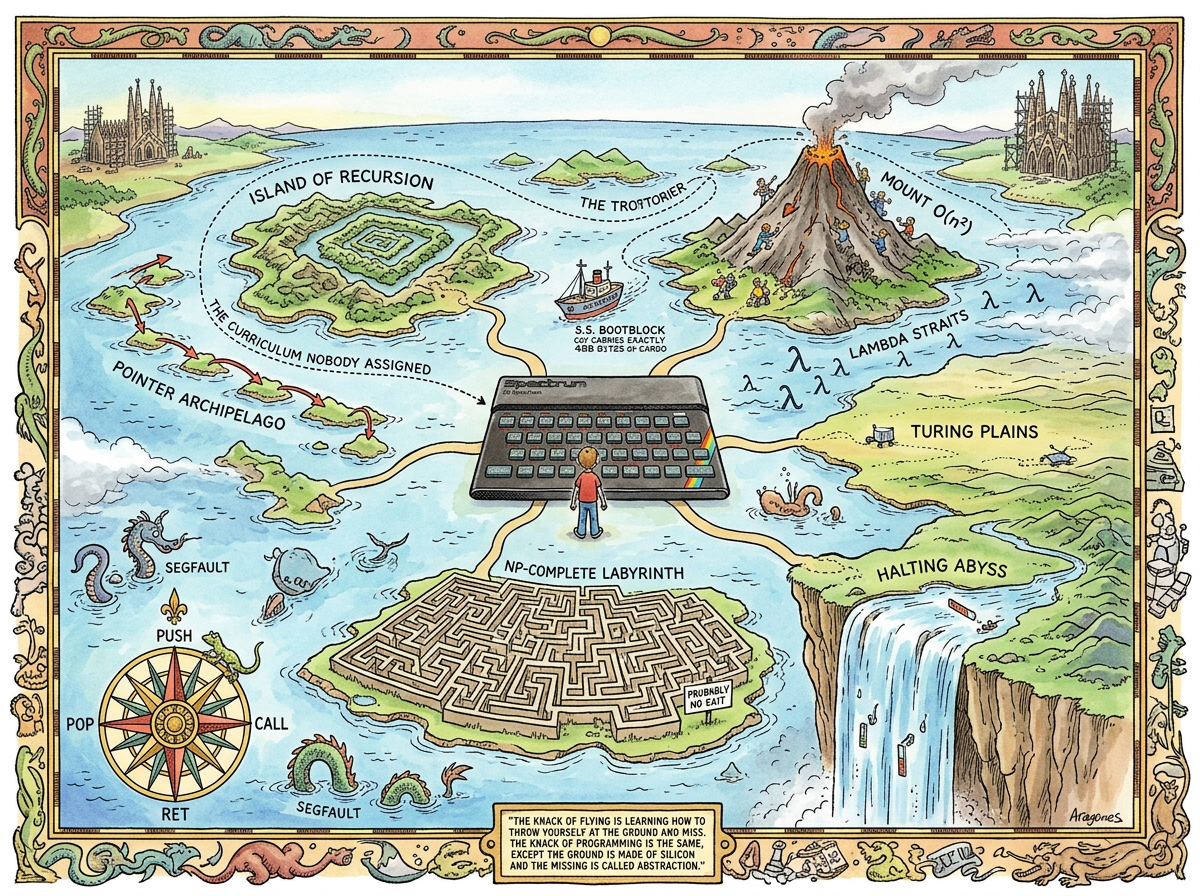
There is a knack to computer programming.
The knack is not in the textbook. The textbook will describe it later, in words you did not know when you acquired it. The knack is not in the lecture. The lecture will give names to things you have already done, or — if you are approaching from the other direction — things you will do later and recognise. The knack is not in The Art of Computer Programming, although Knuth has spent sixty years building a cathedral to house it, and the cathedral is magnificent, and not finished, and you will buy it and not read it, and this is fine, because the knack was never in the cathedral. The cathedral is where the knack goes after it has already happened.
The knack is the moment you realise the computer is not a black box but a machine made of knowable parts, and every part does one thing, and every thing has a cost, and if you know the costs you can make the machine do things the manual says it cannot do, and the manual is wrong, and the machine is right, and the gap between what the manual says and what the machine does is where all of computer science lives.
Some people find the knack at twelve, POKEing opcodes into a ZX Spectrum. Some find it at twenty, watching a Python script process in three seconds what took a spreadsheet all afternoon. Some find it at thirty-five, the first time a SQL query returns and the database feels like an extension of their thoughts. The age does not matter. The knack is the same knack. The machine is always right.
This article is the map to the territory. It is the guide the author wishes someone had handed him when he was twelve and had just found the opcode table in the back of the Spectrum manual and did not know that the territory had a name, and the name was computer science, and other people had walked it before, and some of them had written things down, and one of them had spent sixty years building a cathedral, and the cathedral was not finished either.
The map is wrong — all maps are wrong — but the territory is real, and the rabbit holes are clearly marked, and the articles are waiting.
“The knack of flying is learning how to throw yourself at the ground and miss. The knack of programming is the same, except the ground is made of silicon and the missing is called abstraction.”
— Apologies to Douglas Adams, who would have been a mass of contradictions about AI and loved every minute of it
Section I: The Machine
The ground floor. The silicon. The place where the instructions meet the hardware and the distance between them is zero.
Most programmers never come here. You can have an entire career in Python or JavaScript and never know what a register is, and that career is valid, and the software you write is real, and nobody will ask you about T-states in a job interview. But if you do come here — if you start at the bottom and work up — everything above makes a different kind of sense. The abstractions feel thinner. The magic feels like engineering.
A boy in Lisbon started here, POKEing Z80 opcodes into a Spectrum before he ever saw an assembler. The numbers came before the mnemonics. That is one path through the territory. It is not the only path. But it is a path, and the articles below are the landmarks along it.
| Article | What You’ll Find | Why It Matters |
|---|---|---|
| Z80 Assembly | The Z80 processor: registers, T-states, 3.5MHz, and the undocumented instructions Zilog never published but the silicon executed anyway. | The machine with no abstractions. Every instruction visible. Every cost measurable. The place where the word “optimisation” means choosing a different opcode. |
| Spectrum BASIC | The first language for a generation. Ten-minute programs. POKE as the gateway drug to assembly. | Where many people found the knack. Too slow for what you wanted, which was the point — the slowness pushed you deeper. |
| Assembly Language | The general concept: mnemonics for machine code, one step above the silicon, zero steps above the hardware. | The Amiga’s 68000. The x86. The ARM. Every architecture has an assembly language. Every assembly language teaches the same lesson: the machine is knowable. |
| Pointers | A variable that holds an address. The concept that separates the engineers who understand the machine from those who use it. | C made them explicit and dangerous. Go made them explicit and safe. Java hid them and called them “references.” The Z80 had nothing else — HL, IX, IY were pointers before the word existed. |
| The Compiler | The program that translates human intent into machine instructions. From Grace Hopper’s A-0 to Go refusing your unused imports. | The first compiler was a person: a boy looking up opcodes in a table and POKEing them into memory. The second was an assembler. The modern compiler is the last adult in the room. |
| Stack Overflow | PUSH and POP. Call frames. The LIFO structure that makes function calls possible and, when exhausted, makes everything impossible. | Not the website — the crash condition. The thing that happens when you recurse without a base case. Also the thing that happens when you point SP at the screen and push zeros deliberately, which clears the display 3.8x faster than LDIR. |
Section II: The Theory
The part they teach in university. The mathematical foundations. The proofs, the formalisms, the impossibility results that tell you what cannot be done — which is, surprisingly, the most useful thing theory can give you, because knowing the walls saves you from running into them.
You do not need a degree to understand this section. You need curiosity, a tolerance for Greek letters, and the willingness to sit with an idea until it clicks. Some people find these ideas in a lecture hall. Some find them at 2 AM reading Wikipedia. One person understood Lambda Expressions so deeply that a professor hinted at a research position, then missed two classes to a fever and never recovered the thread. The theory does not care how you arrive. It cares that you stay long enough.
| Article | What You’ll Find | Why It Matters |
|---|---|---|
| Turing Machine | An infinite tape, a head, some states. The simplest possible description of a general-purpose computer. Everything computable can be computed by this. PowerPoint is accidentally Turing complete. | The thought experiment that defined computation. Your laptop, your phone, your cloud instance — all finite approximations of this. The tape is infinite. Your disk is 98% full. |
| Lambda Expressions | Anonymous functions. Alonzo Church’s 1936 formalism. The idea that functions can take functions and return functions, and that this is enough to compute anything. | The => in your JavaScript. The lambda in your Python. The func literal in your Go. All of them are Church’s lambda calculus, stripped of the philosophy and left with the utility. |
| O Notation | How algorithms scale. O(n) grows linearly. O(n²) grows quadratically — double the input, quadruple the time. O(1) is constant, which is either a hash table or a lie. | The most important concept in CS you can learn in five minutes and ignore for an entire career. The nested loop that works for 100 records and catches fire at 100,000 is an O(n²) waiting to be discovered. |
| Recursion | A function that calls itself. Base case stops it. Missing the base case doesn’t. Elegant in Lisp. Expensive on a Z80. Practical everywhere. | The computer science concept most likely to appear in a job interview and least likely to appear in production code, where the iterative version is usually clearer and always cheaper on the stack. |
| The Halting Problem | Turing’s proof that no algorithm can determine whether an arbitrary program will finish or run forever. The foundational impossibility result of computer science. | Every progress bar stuck at 99%. Every deploy that hangs. Every meeting scheduled for thirty minutes. Turing proved in 1936 that you cannot know in advance. Engineers verify this empirically every day. |
| NP-Completeness | The class of problems easy to check, (probably) hard to solve. The million-dollar question: does P = NP? Nobody knows. The Clay Institute will pay you $1,000,000 if you find out. | The travelling salesman. The knapsack problem. Sprint planning. Meeting room scheduling. Your calendar is NP-complete, which is why it feels that way. |
Section III: The Languages
Every programming language is a lens — a way of seeing computation that emphasises some things and hides others. Learn one language and you can write programs. Learn five and you can think about programs. Learn ten and you start to see what they all have in common, which is the machine underneath, which was there all along.
The table below is not a ranking. It is a map of a landscape, organised roughly by how close each language stands to the hardware, from “you can smell the silicon” to “what silicon?”
| Article | The Language | What It Teaches You |
|---|---|---|
| Z80 Assembly | Z80 Assembly | The machine itself. No abstractions. Every cycle is yours. Every instruction is negotiable. |
| Assembly Language | 68000 Assembly | Bigger registers, better addressing modes. Enterprise software written by a sixteen-year-old in 200 lines. |
| C | C | Pointers, malloc, segfaults. The bridge between assembly and everything modern. The language that built Unix, Linux, and most of the infrastructure you use without knowing it. |
| FORTRAN | FORTRAN | The oldest language still in use (1957). Still running. Still faster than your Python for numerical work. Scientists don’t care about your opinions on syntax. |
| COBOL | COBOL | The other oldest. Still running the banks. 220 billion lines in production. The Y2K scare was COBOL’s fault and COBOL’s salvation. |
| Pascal | Pascal | The teaching language. Structured, safe, readable. Borland made it fast. Wirth made it correct. |
| Delphi | Delphi | Pascal evolved. Anders Hejlsberg’s single-pass compiler: faster than most editors could save. Object Pascal with a visual form designer. Love at first compile. |
| Lisp | Lisp | Code is data. Data is code. The parentheses are ugly until they are beautiful, and once they are beautiful, everything else looks like it’s trying too hard. The second oldest language (1958), and the only one that still makes people feel things. |
| Prolog | Prolog | Logic programming. You describe what is true. The runtime derives what follows. Beautiful. Impractical. Never used after university. Fondly remembered. |
| Java | Java | The enterprise language. Write once, run anywhere, debug everywhere. Verbose, stable, permanent. The language equivalent of a committee decision. One billion devices. |
| JavaScript | JavaScript | The language of the browser. Created in ten days. Now runs everywhere. The language you cannot avoid, written by people who wish they could. undefined is not a function is its national anthem. |
| Python | Python | The language that reads like pseudocode. Data science, ML, scripting, everything. The language most likely to be someone’s first and most likely to be “fast enough.” GIL is its dark secret. |
| Go | Go | Fast compiler, one binary, no ceremony. The language that chose simplicity over features and shipped. go build and it’s done. The Z80 instinct — if the Z80 instinct wore a gopher costume. |
| Rust | Rust | Memory safety without garbage collection. The borrow checker as compiler-enforced discipline. Loved by those who survive it. The language that asks “are you sure?” at compile time so it doesn’t have to ask at runtime. |
| Kotlin | Kotlin | Java, but better. Null safety, coroutines, and the admission that Java’s ceremony was the problem. Android’s chosen language. |
| Spectrum BASIC | Spectrum BASIC | Where it started for a generation. 10 PRINT "HELLO" / 20 GOTO 10. The first program. The first loop. The first knack. |
The Paradigm Shifts
Languages are not just syntax — they are ways of thinking. The paradigm shifts are the moments the thinking changes:
- Imperative → do this, then this, then this (C, Pascal, Go)
- Functional → apply this function to this data (Lisp, Lambda Expressions)
- Logic → this is true, what follows? (Prolog)
- Object-Oriented → everything is an object with state and behaviour (Java, Delphi)
- Concurrent → things happen at the same time, deal with it (Go, Rust)
Knowing one paradigm makes you a programmer. Knowing three makes you dangerous. Knowing which one to apply to which problem is the knack.
Section IV: The Concepts
The ideas that float above the languages and the machines. You learn them in one context and recognise them everywhere afterward. These are the transferable skills — the things that survive when the language changes, the framework dies, and the architecture is rewritten.
| Article | The Concept | The One-Sentence Version |
|---|---|---|
| Design Patterns | Twenty-three named solutions to recurring problems. The vocabulary. | The book everyone read in 2003 and then applied everywhere whether the pattern fit or not. |
| Boring Technology | Choose technology you understand. Innovation tokens are limited. | The Lizard’s entire philosophy in two words. The opposite of the conference talk. |
| Gall’s Law | A complex system that works evolved from a simple system that worked. | The monolith was fine. The forty-seven microservices are not. Draw a lizard on the whiteboard. |
| Conway’s Law | Your software architecture will mirror your org chart. | Reorganise into squads. Your API now has squad-shaped boundaries. Users don’t have squads. |
| Technical Debt | The interest rate on shortcuts. | You cannot pay it off because the sprints are full of new features. The debt accrues. |
| Premature Abstraction | The helper function for something that happens once. | Three similar lines of code is better than a premature abstraction. Always. |
| YAGNI | You Aren’t Gonna Need It. | The four most expensive words in software are “just in case.” |
| Zawinski’s Law | Every program expands until it can read mail. | A markdown indexer that now serves a satirical encyclopedia with AI-generated watercolour illustrations. The law is real. |
| Refactoring | Changing code structure without changing behaviour. | The art of cleaning the kitchen while the restaurant is open. |
| Defensive Programming | Code that assumes everything will go wrong. | Trust nothing. Validate everything. Except at the boundaries you control, where trust is efficiency. |
| Vibe Engineering | Building software by feel, instinct, and momentum. | The opposite of engineering. Except when it works, which is more often than engineers admit. |
Section V: The Books
The scriptures. The ones that sit on shelves and radiate seriousness. Some are read. Some are displayed. Some are both. The distinction matters less than the ideas inside, which have leaked into the industry’s groundwater regardless.
| Article | The Book | The Honest Assessment |
|---|---|---|
| The Art of Computer Programming | Knuth’s cathedral. Seven volumes planned. 4.5 published. Sixty years. | More people have bought it than read it. More have read it than understood it. The cathedral is not finished. The aspiration is the point. |
| Code Complete | McConnell’s practical bible. Construction-level advice. | The sensible book. The one that actually helped. The one you can open to any page and learn something. |
| Design Patterns | Gang of Four. Twenty-three patterns. Published 1994. | The vocabulary list that launched a thousand AbstractSingletonProxyFactoryBeans. Use with caution. |
| The Mythical Man-Month | Brooks, 1975. Adding people to a late project makes it later. | Published fifty-one years ago. Still true. Still ignored. Still added to reading lists by managers who then add people to late projects. |
| Building Evolutionary Architectures | Ford, Parsons, Kua. Architecture that evolves with requirements. | The book that says your architecture should be as adaptable as your requirements are unstable. Since your requirements are very unstable, good luck. |
The Territory
There is no correct order to read these articles. There is no curriculum. There is no syllabus. Computer science is not a corridor — it is a territory, and you walk it in whatever direction curiosity takes you.
Some people start at the top — Python, a web framework, a deployed application — and work down when they need to understand why things are slow. Some start at the bottom — assembly, registers, clock cycles — and work up when they need to build something useful. Most start in the middle — a language, a project, a problem — and expand outward in all directions as the problems demand.
All paths through the territory arrive at the same insights eventually. The syntax differs. The decade differs. The insight is the same: the machine is knowable, the abstractions are useful lies, the constants matter, the limits are real, and the knack — the thing that makes you a programmer rather than someone who writes programs — is not in any one article but in the moment you stop reading the map and start walking the territory.
THE MAP IS NOT THE TERRITORY
THE TERRITORY IS NOT THE CURRICULUM
THE CURRICULUM IS NOT THE KNACKTHE KNACK IS WHAT HAPPENS
WHEN YOU STOP READING THE MAP
AND START WALKING— The Lizard, who has never consulted a map
Measured Characteristics
Articles in this map:                    40+
Sections:                                5 (Machine, Theory, Languages, Concepts, Books)
Languages covered:                       16
Paradigms:                               5
Correct order to read them:              there isn't one (that's the knack)
Paths through the territory:             infinite
Paths that are wrong:                    none
Paths that are optimal:                  also none
Cathedral volumes completed (Knuth):     4.5 of 7
Cathedral volumes necessary (for the knack): 0
The knack:                               not teachable, not a secret, not in the map
Where the knack is:                      in the walking
Age at which you can find it:            any
Age at which it's too late:              never
See Also
Every link in the tables above. This is a map. Following the links is walking the territory. The territory is where the knack lives.
And if none of this makes sense yet — if you’ve just found the opcode table, or just written your first Python script, or just watched a SQL query return in a way that felt like magic — good. The map is for later. The knack is for now. Start walking.