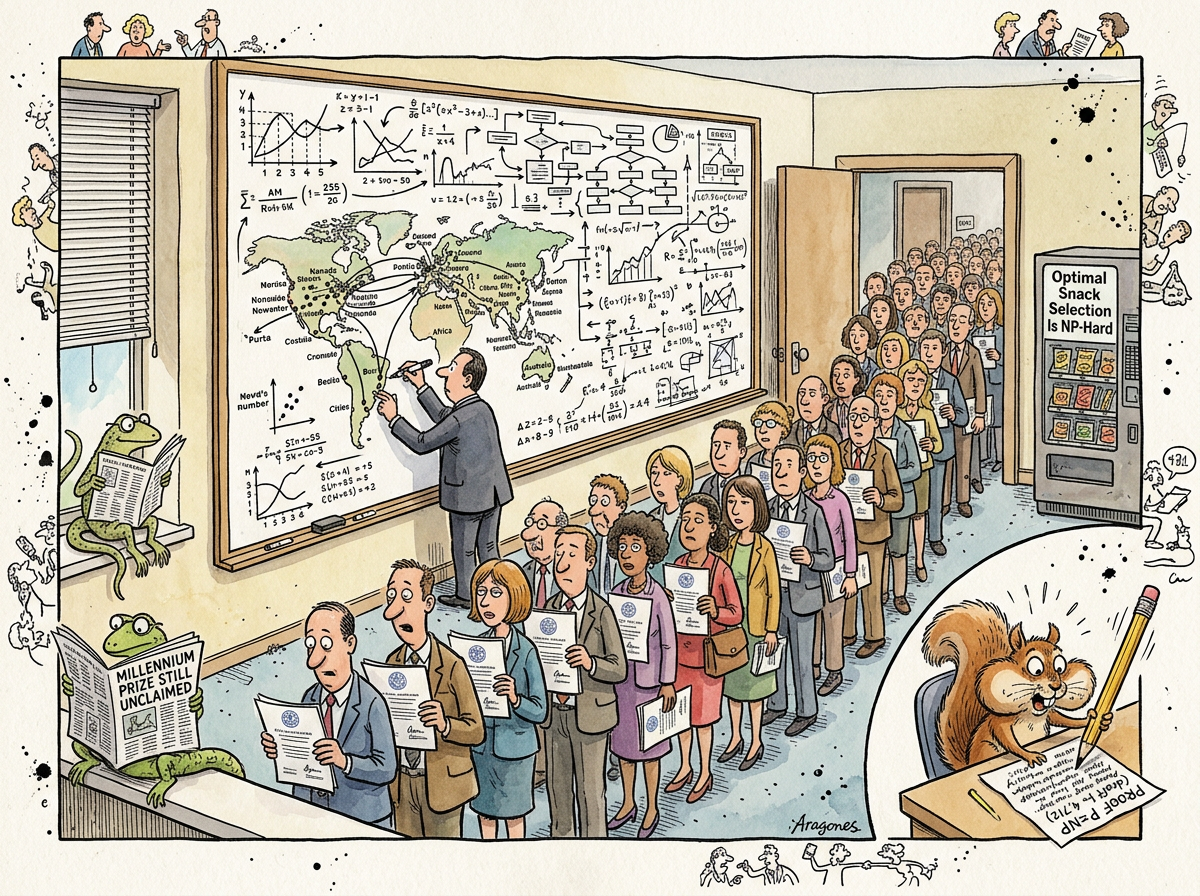
NP-Completeness is a classification in computational complexity theory describing problems that are, in the formal mathematical sense, exactly as hard as every other hard problem. It is the theoretical computer science equivalent of discovering that every item on the restaurant menu is the same dish with different garnish.
Background
In 1971, Stephen Cook published a paper proving that the Boolean satisfiability problem (SAT) was at least as hard as every other problem whose solution could be verified quickly. This was received by the academic community with the same enthusiasm as a doctor informing you that your specific ailment is, in fact, the universal ailment.
Shortly after, Richard Karp demonstrated that twenty-one other well-known problems were equally hard, a result colloquially known as “Karp’s Twenty-One” and spiritually known as “misery loves company.”
P, NP, and the Space Between
P is the class of problems solvable in polynomial time. These are the problems computers can actually solve before the heat death of the universe. Sorting a list is in P. Adding two numbers is in P. Checking whether your build passed is in P, though it may not feel like it.
NP is the class of problems whose solutions can be verified in polynomial time. If someone hands you the answer, you can check it quickly. If no one hands you the answer, you are on your own. This is also the operating model of most technical interviews.
NP-Complete problems sit at the apex of NP: they are at least as hard as every other problem in NP. Solving any single one of them efficiently would solve all of them efficiently. This is either the most beautiful or the most threatening sentence in mathematics, depending on your publication record.
“The elegance of NP-completeness is that it democratises difficulty. Every hard problem is the same hard problem wearing a different hat.” – The Lizard
The Million-Dollar Silence
The Clay Mathematics Institute offers one million US dollars to anyone who can prove whether P equals NP or not. As of this writing, the prize remains unclaimed, making it the longest-running open bar tab in intellectual history.
If P = NP, then every problem whose solution can be checked quickly can also be found quickly. Cryptography collapses. Optimisation becomes trivial. Sudoku loses all commercial value.
If P does not equal NP, then the universe has a fundamental asymmetry: it is easier to recognise a good answer than to find one. This is already the working assumption of every code reviewer in existence.
Everyday NP-Complete Problems
NP-complete problems are not confined to textbooks. They permeate daily engineering life, disguised as reasonable requests:
The Meeting Room Problem (Graph Colouring): Assign N meetings to K rooms such that no two conflicting meetings share a room. Trivial for K = N. Impossible for K = 3 and a product organisation of any size.
Backlog Prioritisation (Knapsack): Given a set of features with varying business value and engineering cost, select the subset that maximises value within a fixed sprint capacity. Every product manager believes this is simple arithmetic. It is not.
Sprint Planning (Bin Packing): Distribute tasks across team members such that everyone finishes at approximately the same time. This has never happened in recorded history.
The Consultant’s Lament (Travelling Salesman): Visit every client site exactly once and return home by Friday. The shortest route is unknown. The expense report is NP-hard to audit.
“I once tried to optimally schedule a cross-team offsite. Three days later I had reduced it to 3-SAT and was crying in a supply closet.” – The Caffeinated Squirrel
Reduction: The Fine Art of Shared Misery
The core technique of NP-completeness proofs is reduction: showing that Problem A is at least as hard as Problem B by demonstrating that any instance of B can be transformed into an instance of A. If B is already known to be hard, then A is hard too.
This is logically identical to proving your meeting is unproductive by showing it is structurally equivalent to every other meeting that has ever been unproductive. The transformation is called a “polynomial-time reduction” because it must itself be efficient – you are not allowed to waste time proving you are wasting time.
Cook and Levin independently proved that SAT is NP-complete by reducing the behaviour of any nondeterministic Turing machine to a Boolean formula. Every NP-complete proof since then has been a chain of reductions leading back to SAT, like a genealogy chart where every ancestor is the same person.
Coping Mechanisms
Since no polynomial-time algorithm for any NP-complete problem is known, practitioners have developed several coping strategies:
- Approximation algorithms: Find an answer that is provably close to optimal. “Close enough” has its own branch of theory.
- Heuristics: Find an answer that is not provably anything but seems to work. This is the backbone of the software industry.
- Special cases: Restrict the problem until it becomes tractable. Also known as “redefining the requirements.”
- Exponential algorithms with good constants: Solve it exactly, but only for small inputs. This works until it doesn’t, at which point it stops working all at once.
“Every NP-complete problem has a solution. It is simply that the universe may not last long enough to find it. I find this… relatable.” – A Passing AI
The Cook-Levin Theorem
The Cook-Levin theorem (1971) states that Boolean satisfiability is NP-complete. It is the foundational result of the field, and its proof proceeds by encoding the entire computation of a nondeterministic Turing machine as a Boolean formula. The formula is satisfied if and only if the machine accepts.
This means that every question of the form “does there exist a solution?” can be rephrased as “does there exist an assignment of true and false that makes this formula true?” The universe, it turns out, runs on Boolean logic. Engineers have suspected this for some time.
Measured Characteristics
Problems confirmed NP-complete:     > 3,000
Problems suspected NP-complete:     "most of them"
Proofs that P = NP (valid):         0
Proofs that P != NP (valid):        0
Proofs that P = NP (submitted):     several per week
Prize money unclaimed:              $1,000,000.00
Average time to NP-hard reduction
  of a scheduling problem:          one whiteboard session
Consultants aware their travel
  schedule is NP-hard:              0%
See Also
- O Notation – the language in which the bad news is delivered
- The Halting Problem – the other thing you cannot determine in advance
- Turing Machine – the device that started all of this
- Recursion – see Recursion
- The Lizard – who accepts the hardness with grace
- The Caffeinated Squirrel – who does not