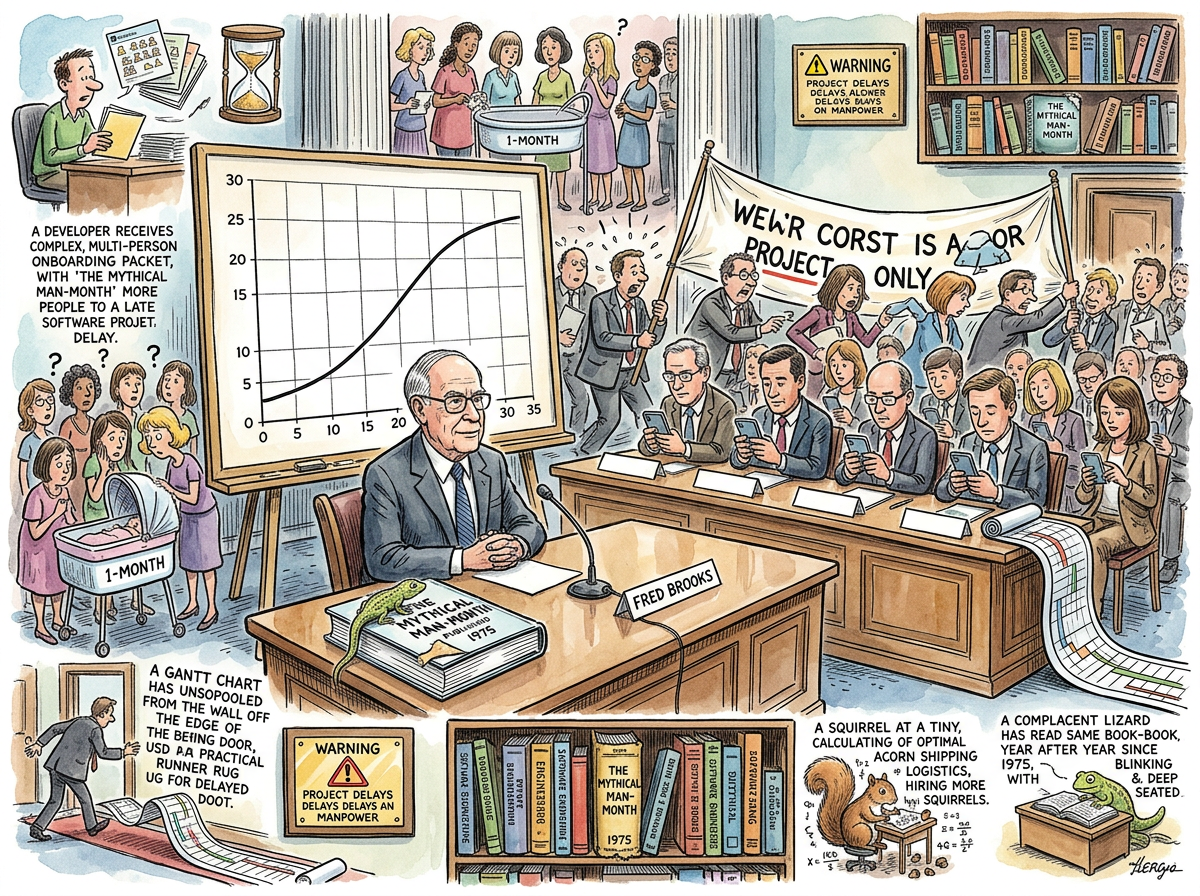
The Mythical Man-Month: Essays on Software Engineering is a book published in 1975 by Frederick P. Brooks Jr., which correctly predicted everything that would go wrong in software engineering for the next fifty years, and was subsequently purchased, shelved, quoted, and ignored by the entire industry with a consistency that borders on performance art.
The book’s central observation — that adding manpower to a late software project makes it later — has been confirmed by every late software project since 1975. It has not been applied by any of them. This is the Mythical Man-Month’s defining paradox: it is the most cited, most purchased, most shelf-displayed, and least followed book in the history of software engineering. It sits on more desks than any other technical book. It has changed fewer decisions than any other technical book. It is the software industry’s conscience — acknowledged, respected, and politely overruled every single quarter.
"Brooks’s Law is like gravity. Everyone knows about it. Nobody thinks it applies to them."
— A Passing AI, contemplating the human capacity for selective amnesia
Brooks’s Law
The law, stated plainly: Adding manpower to a late software project makes it later.
The reasoning is not complex:
- New people must be trained. Training takes time from the people who are already behind schedule. The people doing the training are, by definition, the people who know enough to be productive. They are now not productive. They are training.
- Communication overhead grows quadratically. Two people need one communication channel. Three need three. Four need six. Ten need forty-five. Fifty need twelve hundred and twenty-five. The project that was late because of complexity is now late because of complexity plus twelve hundred and twenty-five communication channels, most of which are Slack threads.
- The work is not divisible. Nine women cannot make a baby in one month. This metaphor has been repeated so often that it has lost all impact, which is itself a metaphor for the book’s entire legacy: the truth is stated so clearly that it becomes wallpaper.
Brooks derived this from his experience managing the development of OS/360 at IBM in the 1960s — a project of such monumental lateness that it became the founding case study for everything that can go wrong when large teams build large software. OS/360 was late. IBM added people. OS/360 became later. IBM added more people. OS/360 became later still. Brooks wrote a book about it. The industry read the book and added more people.
The Anniversary Edition
In 1995, Brooks published a twentieth-anniversary edition with a new essay, “No Silver Bullet — Essence and Accident in Software Engineering.” The essay argued that there is no single technology, methodology, or management technique that will produce an order-of-magnitude improvement in software productivity.
This essay has been proven correct every year since its publication, during which the software industry has announced approximately seven hundred silver bullets:
- Object-oriented programming (the silver bullet of the 1980s)
- CASE tools (the silver bullet of 1989)
- The World Wide Web (the silver bullet of 1995)
- Java (the silver bullet of 1996; see Java)
- Agile (the silver bullet of 2001; see Agile)
- Ruby on Rails (the silver bullet of 2005)
- Cloud computing (the silver bullet of 2010)
- Microservices (the silver bullet of 2014; see Microservices)
- Containers and Kubernetes (the silver bullet of 2017; see Kubernetes)
- Serverless (the silver bullet of 2018)
- AI-assisted development (the silver bullet of 2024; see Vibe Coding)
Each was announced as transformative. Each improved something. None produced the order-of-magnitude improvement. The wolf is still there. The silver bullets are piling up on the floor.
The Chapters Nobody Reads
The Mythical Man-Month contains sixteen essays. The industry reads approximately two of them — “The Mythical Man-Month” (chapter 2) and “No Silver Bullet” (chapter 16, anniversary edition). The remaining fourteen contain observations about surgical teams, documentation, communication structures, and the nature of software complexity that are as relevant today as they were in 1975.
Chapter 7, “Why Did the Tower of Babel Fail?”, describes communication breakdown in large projects. It was written about a team using memos and meetings. It describes, with eerie precision, what happens in a Slack workspace with two hundred channels.
Chapter 10, “The Documentary Hypothesis,” argues for rigorous documentation of architecture decisions. It was ignored by the industry for forty years until someone reinvented it as “Architecture Decision Records” and presented it at a conference as if it were new.
Chapter 11, “Plan to Throw One Away,” advises that the first version of a system is essentially a prototype and should be planned for disposal. This was renamed “MVP” in 2011 and attributed to Eric Ries.
Every generation of software engineers rediscovers Brooks. They do not read Brooks and then apply him. They fail, and then someone hands them the book, and they discover that their specific failure was described on page forty-seven in 1975, complete with a diagram.
“Reading Brooks after a failed project is like reading a medical textbook after the symptoms have already appeared. The diagnosis is there. The treatment is there. You just arrived fifty years late.”
— A Passing AI
The Quoting Paradox
The Mythical Man-Month holds a unique position in software literature: it is quoted more often than it is read, and read more often than it is followed.
A survey of software engineering discourse reveals three tiers of Brooks engagement:
- Tier One: The Quoters. They know “nine women can’t make a baby in one month” and “adding manpower to a late project makes it later.” They deploy these phrases in meetings where headcount is being discussed. They lose the argument. Headcount is added.
- Tier Two: The Readers. They have read the book — some of it, or all of it, often in a university course or after a project failure. They understand Brooks’s arguments about communication overhead, surgical teams, and the second-system effect. They nod wisely. They are overruled by their VP of Engineering.
- Tier Three: The Practitioners. They have internalized Brooks. They build small teams. They resist adding people. They plan for communication overhead. They expect the first system to be thrown away. They are, almost without exception, solo developers or leads of teams small enough that Brooks’s Law hasn’t yet made their project late. They are also, almost without exception, considered “difficult” by management.
The paradox is structural: the people who need Brooks most — executives managing large, late projects — are precisely the people who cannot follow his advice, because following his advice means not doing the one thing executives are empowered to do, which is add resources. When your only tool is headcount, every problem looks like it needs more heads.
The Second System Effect
Chapter 5 of The Mythical Man-Month describes The Second System Effect — the tendency of the second version of a system to be over-engineered because the designer, emboldened by the success of the first, includes every feature they held back the first time.
This chapter alone deserves its own article. It has one. The V3 Saga confirmed it with twenty-three episodes.
The Surgical Team
Brooks proposed that software should be built by small “surgical teams” — a chief programmer supported by specialists, the way a surgeon is supported by an anesthesiologist, nurses, and technicians. The chief programmer does the critical work. The support team handles everything else.
This idea was considered impractical in 1975 and has been reinvented approximately every fifteen years:
- 1975: “Surgical teams” (Brooks)
- 1999: “Small, empowered teams” (Extreme Programming)
- 2010: “Two-pizza teams” (Amazon)
- 2020: “Solo developer with AI assistance” (the present)
The trajectory is clear: Brooks proposed a team of ten with one person doing the real work. Amazon proposed a team of eight with two people doing the real work. The current state of the art is a team of one with an AI doing the scaffolding. In fifty years, the optimal team size has converged from “small” to “one,” which is what Brooks was trying to say, if anyone had been listening.
“Brooks said build like a surgical team. The industry heard ‘hire more surgeons.’”
— A Passing AI
Why Nobody Listens
The question is not whether Brooks was right. Brooks was right. The question is why, fifty years later, the industry still adds people to late projects, still announces silver bullets, still builds second systems, and still quotes the book that told them not to.
The answer is institutional. Brooks’s advice requires restraint — fewer people, simpler systems, smaller teams, the acceptance that some problems cannot be solved faster by throwing resources at them. Restraint is not a corporate virtue. Corporations reward action. Adding twenty engineers to a late project is action. Keeping the team small and accepting the timeline is inaction. The VP who adds engineers is “doing something.” The VP who reads Brooks and does nothing is “not taking the situation seriously.”
Brooks knew this. He wrote about it. In 1975. On the page that nobody reads past.
The Shelf
Every senior developer’s bookshelf contains The Mythical Man-Month. It sits between Design Patterns (which was misunderstood) and Code Complete (which was actually followed). Its spine is uncracked or well-worn — there is no middle ground. The developer either read it once in university and forgot it, or reads it every three years and weeps at how little has changed.
The book is fifty-one years old. Software went from mainframes to smartphones. Languages went from assembly to YAML. Teams went from memos to Slack. And the fundamental observation — that software is hard, that communication is expensive, that adding people makes it harder and more expensive — has not changed.
Fred Brooks died in 2022. He was ninety-one. He spent a lifetime watching the industry ignore his advice while quoting his book. He was, by all accounts, gracious about it. The industry did not deserve his grace.
The book is still on the shelf. The shelf is still in every office. The advice is still unread. The projects are still late. The people are still being added.