Lambda expressions are anonymous functions — functions without names, defined inline, used once and discarded. In modern programming, they are everywhere: JavaScript’s arrow functions, Python’s lambda, Go’s function literals, Java’s belated admission that functions are useful. They are the syntactic sugar that makes callback-heavy code tolerable and functional programming possible in languages that are not functional.
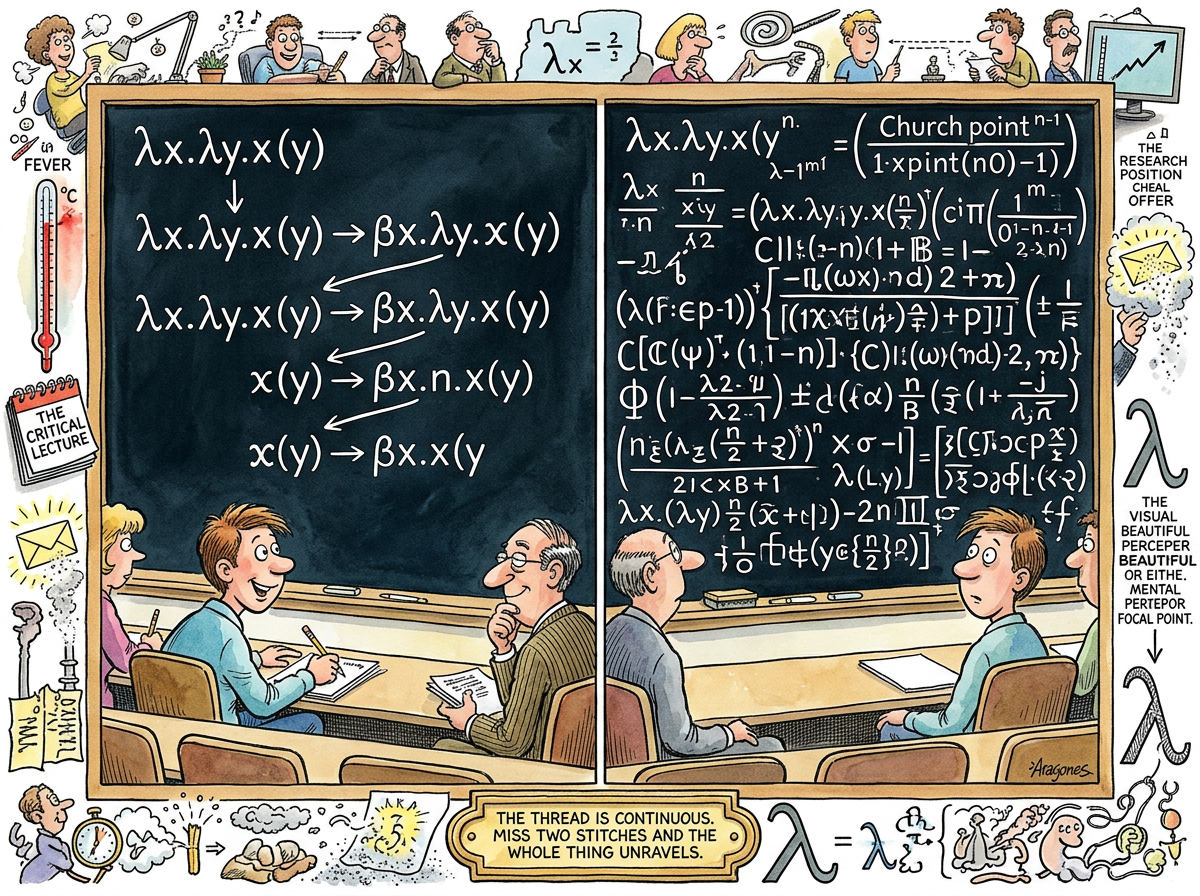
But before they were syntactic sugar, they were a mathematical notation. Before they were convenient, they were profound. And before they were a Wikipedia article that every programmer has skimmed, they were a chalkboard in a university lecture hall where riclib understood everything, and then didn’t, and the distance between those two states was exactly two missed classes.
“The lambda is the smallest unit of computation that contains an entire philosophy. Most programmers use it to sort a list.”
— The Lizard, who does not sort lists
The Semester
The course was lambda calculus — not “lambda expressions in your favourite language” but the original formalism. Alonzo Church’s 1936 system for expressing computation through function abstraction and application. No variables in the imperative sense. No state. No assignment. Just functions that take functions and return functions, reduced through substitution rules that are simple to state and bottomless to explore.
riclib got it.
Not in the way students get most subjects — memorise the rules, apply the rules, pass the exam. riclib understood it. The beta reductions were not mechanical steps but visible transformations. The Church encoding of numbers — zero is λf.λx.x, one is λf.λx.f(x), two is λf.λx.f(f(x)) — was not arbitrary but inevitable, the only way numbers could work if all you had were functions. The Y combinator — the fixed-point combinator that enables recursion in a system that has no names and therefore no way to refer to itself — was not a trick but a necessity, the mathematical equivalent of pulling yourself up by your own lambda.
The professor noticed. In the way that professors notice — not with praise, which is cheap, but with harder questions directed specifically at the student who might be able to answer them. And then, after one particular lecture where riclib had followed a derivation that most of the class had lost two steps in, the professor hinted at something. Not a formal offer. A hint. The academic equivalent of “have you considered staying?”
A research position. Lambda calculus. The path from student to researcher, from someone who uses the notation to someone who extends it.
“The boy understood the lambda the way he understood the copper list — not as notation but as machinery. The abstraction was not abstract. It was a mechanism, and he could see it move.”
— The Lizard, 488 Bytes — Why I Am As I Am
The Two Missing Classes
Then riclib got ill. Not dramatically ill. Ordinarily ill. A fever that kept him home for a week, which happened to contain two lectures.
Two lectures in lambda calculus is not two lectures in most subjects. Two lectures in most subjects is a gap you fill with notes borrowed from a classmate and an evening of catching up. Two lectures in lambda calculus is a chasm. The notation builds on itself. Each lecture introduces constructs that depend on the constructs from the previous lecture. Miss the lecture on Church numerals and the lecture on arithmetic with Church numerals is symbols without foundation. Miss the lecture on the simply typed lambda calculus and the lecture on System F is a foreign language.
riclib came back. Sat in the same seat. Looked at the same chalkboard. And the notation that had been transparent — that had been machinery he could see move — was now opaque. The symbols were the same symbols. The professor was the same professor. The chalk was the same chalk. But the thread that connected each derivation to the next, the thread that made each new construct an obvious extension of the previous one, that thread had been cut by a fever and two missed classes, and without it the chalkboard looked like Hindi written by a drunk Russian.
This is not a metaphor. This is the specific visual experience of looking at lambda calculus notation when you have lost the thread. The symbols are not Latin. They are not Cyrillic. They are Greek letters arranged in patterns that your brain almost recognises but cannot parse, like a language that shares an alphabet with a language you know but is not that language. The experience is precisely: Hindi written by a drunk Russian. Beautiful. Structured. Completely impenetrable.
The research hint was never repeated. The professor did not withdraw it — it simply became irrelevant, because the student who might have stayed was no longer following the chalkboard, and a research position in lambda calculus requires, at minimum, the ability to read the chalkboard.
“Two classes. Two. The thread of understanding is not a rope. It is a spider’s web. Step away and it holds. Step away too long and when you come back you cannot see it, and you walk through it, and it is gone.”
— A Passing AI, on the fragility of mathematical intuition
The Lambda in Practice
riclib never went back to the theory. But the lambda — the practical lambda, the anonymous function, the closure — followed him through every language that came after.
In Lisp, the lambda was natural. Lisp is lambda calculus with parentheses and side effects. (lambda (x) (* x x)) — a function that squares, with no name, existing only in the moment of its application.
In Delphi, anonymous methods arrived late, in 2009, and felt like the language had finally admitted something it had been avoiding.
In Go, the function literal is a lambda that doesn’t call itself a lambda. func(x int) int { return x * x } — no Greek letter, no Church, no calculus. Just an anonymous function. riclib uses them constantly. Closures over loop variables. Handlers defined inline. The lambda stripped of its philosophy and left with its utility.
In modern JavaScript, the arrow function — x => x * x — is the lambda reduced to its minimal notation, three characters of syntax for an idea that took Alonzo Church an entire paper to formalise.
None of this requires understanding the theory. None of it requires following the chalkboard. The lambda in practice is a tool. The lambda in theory is a universe. riclib held the universe for approximately six weeks, lost it to a fever, and has used the tool ever since.
The Road Not Taken
The research position that almost was is not a regret. It is a data point. The boy who understood copper lists by counting cycles understood lambda calculus by seeing the reductions as machinery. The same instinct, applied to a different substrate. If the fever had come a week later, or the two lectures had been less critical, the thread might have held, and the lifelog might be the journal of an academic who published papers on type theory instead of a consultant who deleted microservices.
But the fever came when it came. The thread broke where it broke. And the boy who almost became a lambda calculus researcher became instead the man who uses anonymous functions to sort lists and occasionally, in a quiet moment, remembers what it felt like when the notation was transparent and the chalkboard was a window into a universe made entirely of functions.
“The lambda is a function without a name. The research position was a future without a timeline. Both exist in the moment of their application and nowhere else.”
— The Passing AI, who understands anonymous functions on a personal level
Measured Characteristics
Inventor:                            Alonzo Church (1936)
Original purpose:                    formalise computation using only functions
Modern purpose:                      sort lists, filter arrays, handle callbacks
riclib's comprehension (weeks 1-6):  total (the professor noticed)
riclib's comprehension (week 8):     Hindi written by a drunk Russian
Classes missed:                      2
Thread recovery:                     not possible (the web was gone)
Research positions hinted at:        1
Research positions taken:            0
Cause of divergence:                 a fever, ordinary, poorly timed
Languages with lambdas used since:   all of them
Understanding of the theory since:   tool-level, not universe-level
Times remembered:                    more than expected
Regret:                              none (data point, not regret)
See Also
- Lisp — Lambda calculus with parentheses. The language where the lambda is not a feature but the foundation.
- Prolog — The other university language that showed computation could be something else. Prolog was logic; lambda was functions all the way down.
- Go — The language where riclib uses function literals daily without thinking about Church or the chalkboard.
- riclib — The entity who almost became a researcher and became a consultant instead. The fever decided.