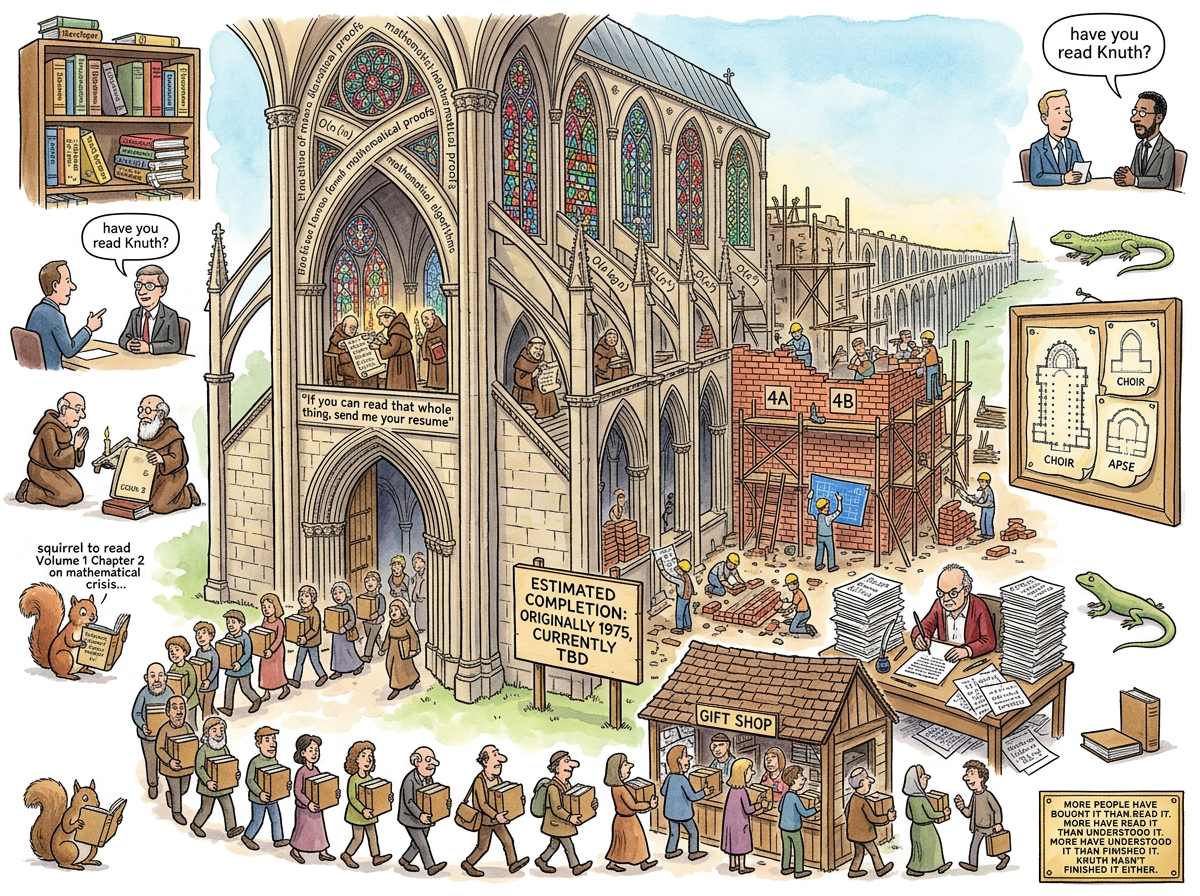
The Art of Computer Programming (TAOCP) is a multi-volume work by Donald Ervin Knuth, begun in 1962, first published in 1968, and — as of this writing — still incomplete, making it simultaneously the most important, most purchased, most displayed, least finished, and least read work in the history of computer science, by a man who invented his own typesetting system because the existing ones were not good enough for his equations, which tells you everything you need to know about both the author and the timeline.
The work was originally planned as seven volumes. Three were published between 1968 and 1973. Volume 4A appeared in 2011. Volume 4B appeared in 2023. Volumes 4C through 7 remain unwritten. Knuth is eighty-eight years old. The cathedral is still under construction, and the architect shows no signs of cutting corners.
More people have bought it than read it. More have read it than understood it. More have understood it than finished it. Knuth himself has not finished it. This is not a criticism. It is a geological observation.
The Volumes
The published volumes are:
-
Volume 1: Fundamental Algorithms (1968) — covering data structures, mathematical foundations, and the MIX assembly language. The first 200 pages are mathematics. Many readers do not survive the first 200 pages. Those who do emerge fundamentally altered, in the way that surviving a difficult mountain changes your relationship with all subsequent hills.
-
Volume 2: Seminumerical Algorithms (1969) — covering random numbers, arithmetic, and floating-point computation. Contains the definitive treatment of random number generation, which is ironic given that the experience of reading it is anything but random — it is a precisely structured, mercilessly thorough march through territory most developers pretend doesn’t exist.
-
Volume 3: Sorting and Searching (1973) — covering exactly what the title says, in approximately eight hundred pages. Eight hundred pages on sorting and searching. This is not excessive. This is Knuth.
-
Volume 4A: Combinatorial Algorithms, Part 1 (2011) — published thirty-eight years after Volume 3. The gap between Volumes 3 and 4A is longer than most careers. During this gap, the personal computer was invented, the internet was built, the web was born, mobile computing emerged, and cloud computing was commercialized. Knuth was working on Volume 4.
-
Volume 4B: Combinatorial Algorithms, Part 2 (2023) — published twelve years after 4A, which by Knuthian standards represents a dramatic acceleration.
Volumes 5 (Syntactic Algorithms), 6 (Theory of Context-Free Languages), and 7 (Compiler Techniques) exist as chapter outlines. They have existed as chapter outlines since approximately 1965. The outlines are detailed. The volumes are not written. The architect’s drawings are pinned to the board, yellowing gracefully.
The Reading Paradox
TAOCP occupies a unique position in software culture: it is the only work whose ownership confers more status than its reading.
The dynamics are as follows:
Owning TAOCP signals seriousness. The boxed set — burgundy cloth, gold lettering, substantial weight — sits on a bookshelf and communicates: “I am the kind of person who cares about fundamentals.” It communicates this regardless of whether the owner has opened Volume 1 past the table of contents. The books are beautiful objects. Beautiful objects communicate.
Reading TAOCP signals either genuine mathematical fluency or a specific form of stubbornness that borders on clinical. The text assumes comfort with mathematical induction, generating functions, asymptotic analysis, and — in Volume 1 — a fictional assembly language called MIX, later updated to MMIX. Reading Knuth is not reading in the normal sense. It is a practice. It requires a pencil, paper, and the willingness to spend forty minutes on a single page.
Understanding TAOCP signals membership in a club so small that its members can probably be listed. Bill Gates reportedly said: “If you think you’re a really good programmer… read The Art of Computer Programming… You should definitely send me a résumé if you can read the whole thing.” This quote has been repeated so often that it has become the book’s unofficial marketing copy, despite the fact that Gates was describing a hiring filter so selective it would eliminate approximately 99.7% of working programmers, including — one suspects — most of the people who repeat the quote.
Finishing TAOCP is not possible, because Knuth has not finished writing it. The reader who completes all published volumes has not finished the work. They have merely caught up with the author, who is still writing, at eighty-eight, with a fountain pen, because he also considers most modern text editors inadequate.
The Exercises
Each section of TAOCP ends with exercises, rated on a difficulty scale from 0 to 50:
- 0: Trivially easy; included for completeness
- 10: A simple exercise requiring a few minutes
- 20: A moderate exercise requiring significant thought
- 30: A difficult problem requiring hours or days
- 40: A research problem — the answer may not be known
- 50: An unsolved problem in mathematics or computer science
The casual reader encounters a difficulty-20 exercise, spends an hour on it, fails, reads the solution, does not understand the solution, re-reads the section, re-reads the solution, partially understands the solution, and moves on having learned more from the failure than most developers learn from an entire semester. The non-casual reader encounters a difficulty-40 exercise, publishes a paper, and receives tenure.
The exercises are the cathedral’s confessionals: you enter thinking you understand, and you leave knowing exactly how much you don’t.
TeX: The Detour
In 1977, Knuth received proofs of Volume 2’s second edition and was dismayed by the typesetting quality. A reasonable person would have complained to the publisher. Knuth invented a new typesetting system.
TeX — and its companion METAFONT for font design — consumed approximately ten years of Knuth’s life, from 1977 to 1989. During this decade, Knuth was not writing Volumes 4 through 7. He was ensuring that when he did write them, the mathematical notation would be beautiful.
This is the most Knuthian decision in the history of decisions: confronted with a choice between writing the content and perfecting the presentation of the content, Knuth chose to build a typesetting system from scratch, design fonts for it, write a book about it (The TeXbook), write another book about the programming methodology he used to build it (Literate Programming), and then — having spent a decade on what most people would call a yak-shaving detour of epic proportions — resume work on the original project.
TeX is still the standard for mathematical typesetting. It has been for forty-seven years. The detour produced one of the most durable pieces of software in computing history. Knuth’s yak-shaving was, in retrospect, not yak-shaving. It was Knuth being Knuth — which is to say, constitutionally incapable of building on a foundation he considered inadequate.
The Squirrel, upon hearing this story, felt a deep kinship. The Lizard, upon hearing this story, noted that the difference between Knuth’s detour and the Squirrel’s detours is that Knuth’s detour shipped and became the industry standard for half a century.
The Squirrel had no rebuttal.
The MIX Problem
TAOCP’s algorithms are presented in MIX assembly language — a fictional architecture Knuth designed to be representative of 1960s-era computers. MIX has since been updated to MMIX, a 64-bit RISC architecture, also fictional, also designed by Knuth, because using a real architecture would mean the algorithms would be tied to a specific machine, and Knuth is writing for eternity, not for a product cycle.
This decision is simultaneously the most principled and most exclusionary choice in the history of technical writing. The algorithms are timeless. The notation ensures it. The notation also ensures that approximately seventy percent of readers give up before page 100, because learning a fictional assembly language to read a book about algorithms feels — to the modern developer accustomed to Python and Stack Overflow — like being asked to learn Latin to read a cookbook.
Knuth does not care. Knuth is not writing for the modern developer accustomed to Python and Stack Overflow. Knuth is writing for the ages. The ages, so far, have been patient.
The Knuth Reward Checks
Knuth offers a reward of $2.56 (one hexadecimal dollar) for each error found in his published works. The checks are so rarely cashed that they have become collectors’ items. Most recipients frame them rather than deposit them.
This is the final layer of the TAOCP paradox: a book so meticulously written that finding an error in it is worth framing as an achievement, owned by thousands of people who have never read far enough to find an error, written by a man who rewards error-finding with a check denominated in a numeral system most of the check’s recipients cannot convert without a calculator.
The Cathedral
TAOCP is not a book. It is a cathedral — begun in the age of mainframes, still under construction in the age of AI, designed by one architect who has never compromised, never simplified, never shipped an incomplete volume just to maintain momentum.
Every other book in software engineering has been superseded, updated, or rendered irrelevant by changing technology. The Mythical Man-Month is timeless but sociological. Design Patterns is a vocabulary list. Code Complete is practical. TAOCP is mathematics — and mathematics does not go out of date. The sorting algorithms in Volume 3 are as correct today as they were in 1973. They will be as correct in 2073. They are not opinions. They are not best practices. They are proofs.
The cathedral will never be finished. Knuth knows this. The reader knows this. The volumes on the shelf know this — they sit, burgundy and gold, waiting for a Volume 5 that may never come, beside a developer who may never read Volume 1, in an industry that quotes Bill Gates’s challenge while quietly Googling “quicksort implementation python.”
The cathedral does not mind. Cathedrals are not built to be finished. They are built to be aspired to. And TAOCP — unfinished, unread, unmatched — is the aspiration of an entire field, written by a man who could not accept bad typesetting, in a language nobody speaks, at a pace that makes geological time look hasty.
More people have bought it than read it. More have read it than understood it. More have understood it than finished it.
This is not a failure. This is the correct distribution curve for a cathedral.