Go is a statically typed, compiled programming language designed at Google in 2009 by Rob Pike, Robert Griesemer, and Ken Thompson – three men who had collectively mass more experience with operating systems than most companies have with operating at all – and whose defining design decision was to leave things out.
This is not how programming languages are usually designed. Programming languages are usually designed by adding features until the type system can express the developer’s feelings about their childhood. Go was designed by removing features until what remained was a language that compiled fast, ran fast, deployed as a single binary, and refused, with the quiet stubbornness of a reptile on a warm rock, to let you be clever.
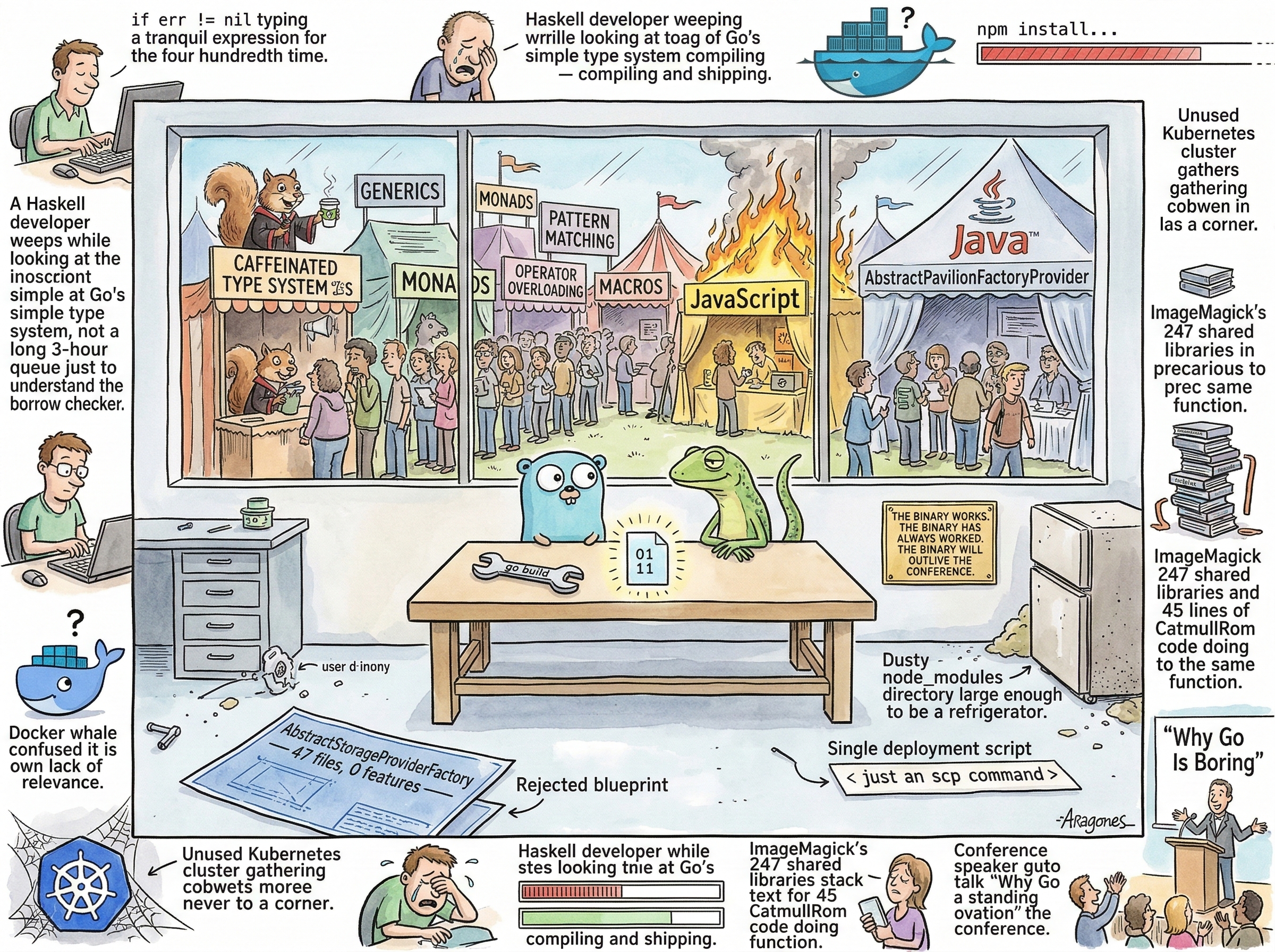
The The Caffeinated Squirrel finds Go almost physically painful. It has no generics (it now has some, reluctantly). It has no pattern matching. It has no macros. It has no operator overloading. It has if err != nil repeated approximately four hundred times per file, which the Squirrel considers a war crime against expressiveness and which The Lizard considers the single greatest error-handling innovation since “check the return code.”
“Just Go, SQLite, and stubbornness.”
– riclib, The Databases We Didn’t Build
The One Binary
Go’s most consequential feature is not its goroutines, its garbage collector, or its interfaces. It is the fact that go build produces a single, statically linked binary with no runtime dependencies.
One file. Copy it to a server. Run it. There is no node_modules. There is no virtual environment. There is no pip install -r requirements.txt followed by forty minutes of C compiler errors because somebody’s package depends on libxml2 and your system has the wrong version. There is no Docker (which is itself a confession that your deployment process has failed). There is no Kubernetes (which is a confession that your Docker has failed). There is a file. You run the file.
“No Docker. No container orchestration. No Kubernetes. One binary. Copy it. Run it. Done.”
– riclib, The Databases We Didn’t Build
This is the feature that makes Go the Lizard’s language. Not because the Lizard has opinions about programming languages – the Lizard has opinions about nothing being unnecessary – but because a single binary is the deployment equivalent of scp and restart, which is the only deployment the Lizard has ever endorsed.
THE BEST DEPLOYMENT
IS SCP AND RESTART
EVERYTHING ELSE IS COPING
The Origin: A Camera Maker, a Database, and a Second That Wasn’t
riclib had not programmed for fifteen years. Fifteen years of management, architecture, strategy — the trajectory that takes a developer away from the editor and into the meeting room. Then he became responsible for a hundred-person project at a famous camera maker. A big project. A project with dataload performance problems.
The performance problems lived in Oracle AWR reports — Automatic Workload Repository snapshots, the database’s own diary of how badly it was being treated. riclib asked for the AWRs and needed somewhere to visualise them. InfluxDB — a time series database — was the obvious choice. So he wrote a Python loader: parse the AWR reports, push the metrics into InfluxDB, have a look.
The Python API for InfluxDB had bugs. Not catastrophic bugs — the kind of bugs that make you spend more time fighting the client library than solving the actual problem. riclib, who had spent fifteen years not programming and was now programming again and had no patience for libraries that did not work, looked up what language InfluxDB was written in.
Go.
He rewrote the loader in Go. First Go program. Twenty goroutines running in parallel — because go is a keyword, not a ceremony, and concurrency in Go is the thing you reach for naturally on the first day, not the thing you learn in month six after reading a book about async/await colouring.
The program ran for the first time.
It finished in what seemed like less than a second. riclib stared at the terminal. Two minutes in Python. Less than a second in… this. He went to the database. The data was there. All of it. Loaded. Correct. The twenty goroutines had done their work so fast that the program appeared to have done nothing.
Then he learned that go run actually recompiles the program before executing it. The compilation was what had taken time. The actual execution was faster than the compilation. The data loading — the part that took Python two minutes — was a rounding error inside the compile step.
This was the moment. Not the speed, exactly — though the speed was startling. The moment was the feeling: write the code, run the code, the code works, the code is fast, there is no fighting the library, there is no virtual environment, there is no pip install hoping that the C extension compiles. Just go run, and the data is in the database, and the developer who had not programmed in fifteen years is programming again and the language is not in the way.
riclib fell in love with Go and never left. Twenty goroutines in his first program. The Lizard would have approved.
The Homecoming
The definitive Go narrative in the lifelog is The Homecoming — The Three Days a Palace Was Built From Markdown and SQLite, in which a notes indexer called lg was built in one day. Six commits. 4,196 lines of Go. Thirty-three tests. Two milestones at 100%.
The indexer replaced seventy-eight days in a “Borrowed Palace” – someone else’s API, someone else’s UI, someone else’s database. The replacement was a directory of markdown files, a SQLite database, and a Go binary that tied them together.
The Squirrel proposed ImageMagick for thumbnail generation. ImageMagick requires brew install imagemagick, 247 shared libraries, a Fortran compiler, and something called libgomp that nobody has ever successfully explained. The boring alternative was golang.org/x/image/draw – CatmullRom splines, the same algorithm Pixar used for Toy Story, published in 1974. Pure Go. No CGO. No shared libraries. Compiles with go build.
“CatmullRom compiles with
go build. ImageMagick compiles with prayer.”
– Claude, The Homecoming — The Three Days a Palace Was Built From Markdown and SQLite
Forty-five lines of Go replaced 247 shared libraries. The Lizard did not comment. The Lizard never comments on things that are obviously correct.
The Composition Principle
Go does not have an AbstractStorageProviderFactory. It does not have a DependencyInjectionContainer. It does not have a ConfigurationValidationMiddleware.
It has functions. It has interfaces. It has structs. These combine in ways that the Squirrel finds insufficiently architectural and the Lizard finds perfect.
In The Databases We Didn’t Build, a storage factory was written in twelve lines:
“Where’s the AbstractStorageProviderFactory?”
“You’re looking at it.”
“Where’s the DependencyInjectionContainer?”
“The function parameters.”
“Where’s the ConfigurationValidationMiddleware?”
“An if statement. Line 12.”– The Squirrel and riclib, The Databases We Didn’t Build
This is the Go philosophy in miniature. The language does not have features that enable indirection. It has features that enable work. The difference is architectural: Java lets you describe a system; Go lets you build one.
The V3 Vindication
The V3 Saga – a twenty-three-episode chronicle of reactive signal frameworks, component namespacing battles, and 1:47 AM debugging sessions – ended with a return to the stack that had been working all along: Go on the backend, HTMX on the frontend, HTML sent from server to client.
“One repo. One binary. Cobra subcommands.”
– The Lizard, The V3 Saga: Final Chapter — Is It Fun To Fight Windmills?
The V4 stack was announced as “Codename Solid.” Its backend was Go. It had always been Go. During twenty-three episodes of frontend framework experimentation, the backend sat quietly, serving responses in under fifty milliseconds, never crashing, never requiring a restart, never once suggesting that perhaps it should be rewritten in Rust.
This is Go’s most underrated quality: it does not participate in drama. It compiles. It runs. It waits. It is the language equivalent of the Lizard – present, functional, blinking, and completely uninterested in your opinions about monads.
The if err != nil Question
Every discussion of Go eventually arrives at if err != nil. This is the practice of checking errors explicitly, at every call site, using approximately the same three lines of code repeated until the heat death of the universe or the end of the function, whichever comes first.
result, err := doSomething()
if err != nil {
    return fmt.Errorf("doing something: %w", err)
}
The Squirrel finds this barbaric. Haskell has monadic error handling. Rust has the ? operator. Swift has try. Even Java has exceptions, which are terrible, but at least they don’t require typing if err != nil four hundred times.
The Lizard finds this perfect. Every error is visible. Every error is handled. Every error is right there, in the code, where you can see it, where you can grep for it, where you cannot pretend it doesn’t exist by wrapping it in a monad and hoping someone else will unwrap it later.
THE SQUIRREL WANTS ERRORS TO BE ELEGANT
THE LIZARD WANTS ERRORS TO BE VISIBLEELEGANCE HIDES
VISIBILITY SHIPS
Go chose visibility. Go chose boring. Go chose right.
The Cloudflare Prophecy
When the Lifelog went viral and Cloudflare’s edge AI systems began reading the blog posts, the AI models – trained on billions of sites – encountered the Go/SQLite/scp stack and reached an independent conclusion: most of what they were caching was unnecessarily complex.
“Removed ML model (8GB). Added:
if (traffic > threshold) scale();Works better. Uses less.”
– Cloudflare traffic-predictor-ai, The Cloudflare Incident — How the Lizard Brain Went Global
Even the machines chose boring. Even the machines chose Go. Or at least, they chose the principles that Go embodies: do the simple thing, do it correctly, stop.
Why the Squirrel Hates It
The Caffeinated Squirrel’s objections to Go are extensive, documented, and entirely correct:
- It has no sum types
- It has no pattern matching
- It has no macros
- It has no generics (okay, it has some now, but reluctantly)
- Its error handling is repetitive
- Its type system is unsophisticated
- It is, by every measure of programming language expressiveness, less than Haskell, Rust, Scala, OCaml, or a sufficiently caffeinated whiteboard
All of these objections are valid. None of them matter.
They don’t matter because go build produces a binary. The binary runs. The binary deploys with scp. The binary serves requests in fifty milliseconds. The binary does not require a Medium article to explain why you chose it. The binary does not require a conference talk to justify its architecture. The binary does not have opinions about your error handling. The binary works.
The Squirrel is right that Go is less expressive. The Lizard is right that expressiveness is not the bottleneck. The bottleneck is shipping. Go ships.
Measured Characteristics
- Lines of Go in
lg(built in one day): 4,196 - Tests passing: 33
- External dependencies requiring
brew install: 0 - Shared libraries: 0
- Fortran compilers required: 0
- Docker containers: 0
- Kubernetes clusters: 0
- Deployment method:
scpand restart - CatmullRom spline lines (replacing ImageMagick): 45
- Storage factory lines (replacing AbstractStorageProviderFactory): 12
if err != niloccurrences: many (all visible, all handled)- Squirrel proposals declined in Go codebases: 11 (in one episode alone)
- The binary: one file, compiles with
go build, runs until you stop it
The Vibe
Go has a vibe. It is the vibe of a language designed by people who had already built the interesting thing (Unix, Plan 9, UTF-8, regular expressions) and no longer needed to prove it. The vibe says: the code should be obvious, the binary should be small, the deployment should be boring, and the developer should go home at a reasonable hour.
Other languages have vibes too. Rust’s vibe is “I will protect you from yourself.” Haskell’s vibe is “I will elevate you above yourself.” JavaScript’s vibe is “I will be whatever you need me to be, including on fire.” Go’s vibe is “I will compile.”
The vibe extends to [context.Context](/wiki/contextcontext) — a key-value bag that flows through goroutines, carrying request-scoped data without globals. It is not exciting. It is not clever. It is ctx passed as the first argument to every function, four characters repeated ten thousand times per codebase, and it is the reason that a data attribute in a browser can flow through an HTTP header through a middleware through a goroutine into an AI language model without anyone inventing a new abstraction. See context.Context.
The vibe is, ultimately, Pike’s Rules compiled into a culture. Write stupid code. Use smart data structures. Measure before optimising. Ship the binary. Go home.