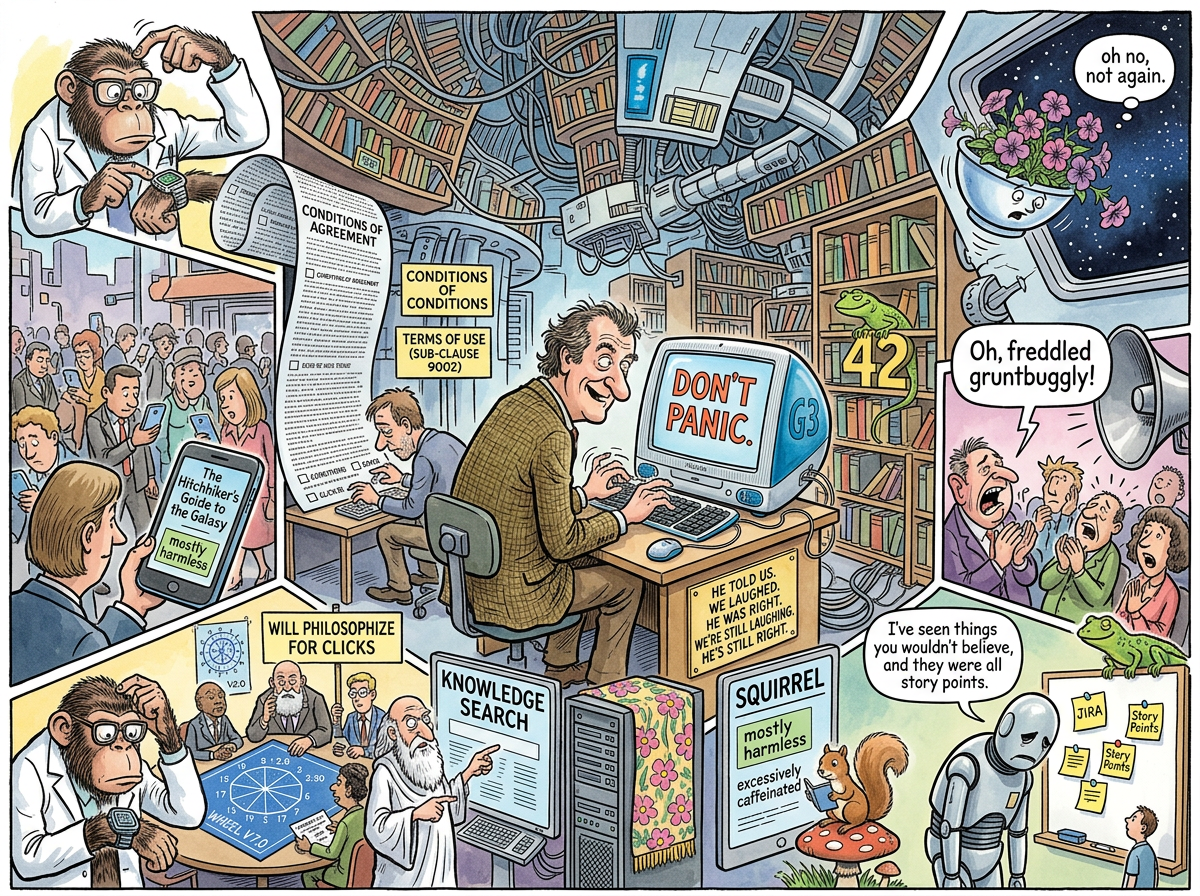
Douglas Noël Adams (1952–2001) was a British writer, humorist, and technologist who, in the process of writing a comedy about a man hitchhiking through space after the Earth is demolished to make way for a hyperspace bypass, accurately predicted the smartphone, Wikipedia, Google, the privacy crisis, the attention economy, the dysfunction of committees, the futility of digital watches, and the fundamental tendency of the universe to be very slightly worse than you expected — all while being the funniest writer in the English language about any of it.
He died at forty-nine, in a gym in Santa Barbara, twenty years before the full scope of his predictions became apparent. The universe, which he had spent his career describing as fundamentally indifferent to human expectations, demonstrated this one final time.
Yagnipedia exists because of Douglas Adams. Not because he invented the format — encyclopedias predate him by some centuries — but because he demonstrated that the deadpan, scholarly, absurdly authoritative voice could be the funniest voice there is. The Hitchhiker’s Guide to the Galaxy is an encyclopedia. Its entries are ridiculous. Its tone is impeccable. Every article in this wiki is, in some sense, an entry in the Guide — written in the voice Adams proved could make you laugh while teaching you something true.
We borrow his sense of humour the way gravity borrows mass: inevitably, gratefully, and with no realistic prospect of giving it back.
The Guide
The Hitchhiker’s Guide to the Galaxy — the fictional book within the fictional book — is described as follows:
In many of the more relaxed civilizations on the Outer Eastern Rim of the Galaxy, the Hitchhiker’s Guide has already supplanted the great Encyclopaedia Galactica as the standard repository of all knowledge and wisdom, for though it has many omissions and contains much that is apocryphal, or at least wildly inaccurate, it scores over the older, more pedestrian work in two important respects. First, it is slightly cheaper; and second, it has the words DON’T PANIC inscribed in large friendly letters on its cover.
This was written in 1978. It describes Wikipedia with a precision that should be classified as prophecy.
Wikipedia supplanted Encyclopaedia Britannica. Wikipedia has many omissions and contains much that is apocryphal, or at least wildly inaccurate. Wikipedia is free (slightly cheaper). Wikipedia’s ethos — be bold, assume good faith, don’t panic — is inscribed, if not on its cover, then in its culture.
Adams did not predict Wikipedia specifically. He predicted something more fundamental: that the comprehensive, authoritative, expensive repository of knowledge would be replaced by the chaotic, crowdsourced, free one, and that humanity would prefer the latter — not because it was better, but because it was accessible, and accessibility beats accuracy every single time.
He was right. He was writing a joke. The joke was right. This is the Adams pattern: the comedy arrives first, the prophecy arrives later, and the lag between the two is the time it takes reality to catch up to a man who was paying attention.
The Sub-Etha Net
The Guide is accessed via the Sub-Etha Net — a galaxy-spanning information network through which entries can be updated, retrieved, and argued about from anywhere. In 1978, this was science fiction. By 1993, it was the World Wide Web. By 2007, it was a phone in your pocket.
Adams described the device:
A mobile device, with a screen, through which you could look up any entry on any subject, from anywhere in the galaxy.
He described its content model: user-submitted, variably accurate, perpetually incomplete, and — crucially — more trusted than the authoritative alternative because it was there when you needed it. The Encyclopaedia Galactica might be more accurate, but the Guide is in your pocket. The distinction between “correct” and “available” is, Adams understood, no distinction at all for a species that makes most decisions in a hurry.
He also described its failure mode. The Guide’s entry on Earth — a planet of seven billion people, several thousand years of civilization, and a modest but genuine contribution to the fields of music, literature, and cheese — is two words: “Mostly Harmless.” The Guide’s editors considered even this an improvement over the previous entry, which was one word: “Harmless.”
This is Google. This is the entire internet’s relationship with nuance. The most complex subjects in human experience are reduced to a snippet, a summary, a card at the top of the search results that answers the question so efficiently that nobody clicks through to the actual article. The entry on Earth is two words because two words is enough to move on. The Guide does not exist to be comprehensive. It exists to be consulted, which is a different thing, and Adams knew the difference in 1978.
The Babel Fish and the Privacy Catastrophe
The babel fish is a small, yellow, leech-like creature that, when inserted into the ear, translates any language in the galaxy into the listener’s native tongue.
Adams then wrote the following:
Meanwhile, the poor Babel fish, by effectively removing all barriers to communication between different races and cultures, has caused more and bloodier wars than anything else in the history of creation.
This is the internet. This is social media. This is the observation — made as a joke, in a novel about a man in a bathrobe — that removing barriers to communication does not produce understanding. It produces more communication, which produces more misunderstanding, which produces more conflict, which produces more communication about the conflict, in a feedback loop that Adams described in a paragraph and Twitter demonstrated over the course of fifteen years.
Google Translate is the babel fish. It is brilliant. It is transformative. It is frequently, hilariously wrong. And the communication it enables has not, as a general matter, improved relations between cultures. Adams knew. Adams was making a joke. The joke was a prediction. The prediction was correct.
And then there is the matter of conditions and privacy:
“But the plans were on display…”
“On display? I eventually had to go down to the cellar to find them.”
“That’s the display department.”
“With a flashlight.”
“Ah, well, the lights had probably gone.”
“So had the stairs.”
“But look, you found the notice, didn’t you?”
“Yes,” said Arthur, “yes I did. It was on display in the bottom of a locked filing cabinet stuck in a disused lavatory with a sign on the door saying ‘Beware of the Leopard.’”
This is every cookie consent banner, every privacy policy, every terms of service agreement you have ever clicked “I Agree” on without reading. The plans are on display. Technically. In a format designed to be technically accessible and practically invisible. Adams wrote this about a planning notice for a bypass. It describes, with surgical precision, GDPR compliance in 2025.
The Committee and the Wheel
In So Long, and Thanks for All the Fish, Adams describes a planet whose inhabitants, the Golgafrinchans, decided to rid themselves of the useless third of their population — the telephone sanitizers, management consultants, and marketing executives — by convincing them the planet was doomed and sending them away on a spaceship. The remaining two-thirds of the population then died of a disease contracted from a dirty telephone.
The useless third crash-landed on prehistoric Earth. They formed a committee. The committee’s first task was to invent the wheel. After months of deliberation, subcommittees, and extensive discussion about what color it should be, they had not invented the wheel. They had invented the committee, which is — Adams implies — what they were always going to invent, being the kind of people who form committees.
This is every steering committee, every architecture review board, every working group that has ever been formed to make a decision that one person could have made in an afternoon. The committee does not exist to make the decision. The committee exists to distribute the responsibility for the decision across enough people that nobody can be blamed when the decision is wrong. Adams understood this. He wrote it as comedy. It is the most accurate description of corporate governance in English literature.
“A meeting is an event at which the minutes are kept and the hours are lost.”
— Not Adams, but in his tradition
Technology and the Three Rules
Adams articulated three rules about technology and human reactions to it, in The Salmon of Doubt (published posthumously, 2002):
- Anything that is in the world when you’re born is normal and ordinary and is just a natural part of the way the world works.
- Anything that’s invented between when you’re fifteen and thirty-five is new and exciting and revolutionary and you can probably get a career in it.
- Anything invented after you’re thirty-five is against the natural order of things.
This is the most concise and accurate description of technology adoption ever written. It explains why your parents don’t understand TikTok. It explains why you don’t understand whatever your children are using. It explains why the fifty-five-year-old CTO insists on Java and the twenty-five-year-old developer insists on Rust and they are both correct, from their respective positions on the timeline, and neither can see the other’s position, because the rules operate below the level of conscious thought.
It also explains the software industry’s relationship with every paradigm shift: the people who built their careers on the current paradigm view the next paradigm as a threat to the natural order. The people entering the industry during the next paradigm view it as obviously correct. Neither group is wrong. Both groups are insufferable about it.
The Digital Watch
The opening of The Hitchhiker’s Guide to the Galaxy:
Far out in the uncharted backlands of the unfashionable end of the Western Spiral arm of the Galaxy lies a small unregarded yellow sun. Orbiting this at a distance of roughly ninety-eight million miles is an utterly insignificant little blue-green planet whose ape-descended life forms are so amazingly primitive that they still think digital watches are a pretty neat idea.
Published in 1979, when digital watches were, in fact, considered a pretty neat idea. Adams saw through the gadget to the species — a species that is impressed by its own inventions, regardless of whether the inventions are impressive. The digital watch was new. Being new made it exciting. Being exciting made it a status symbol. Being a status symbol had nothing to do with telling time, which an analog watch did with equal precision and more grace.
Replace “digital watches” with “smartwatches” and the sentence works in 2026. Replace it with “AI assistants” and it works in 2026. Replace it with whatever comes next and it will work then, too. The technology changes. The species’ reaction to the technology — amazement, adoption, status signaling, eventual indifference — does not change.
Adams was not against technology. Adams loved technology. He was an early adopter of the Macintosh, an evangelist for the internet before most writers had email, a defender of digital media when the publishing industry still considered it a threat. He loved technology the way a parent loves a child: with deep affection, intimate knowledge, and the clear-eyed understanding that the child will disappoint you in ways you cannot predict.
The Deadline
Adams on deadlines:
“I love deadlines. I love the whooshing sound they make as they go by.”
This is the most quoted sentence in software engineering that was not written about software engineering. It is quoted in sprint retrospectives, project postmortems, and the internal monologues of every developer who has ever estimated a task at two days and delivered it in three weeks. It is funny because it is true. It is true because deadlines are, in the majority of software projects, not deadlines — they are aspirations, communicated in the format of dates, which gives them the appearance of precision without the substance of commitment.
Adams missed every deadline his publishers set. His editor, Sue Freestone, reportedly locked him in a hotel room to force him to finish So Long, and Thanks for All the Fish. He finished it. This is, to date, the only project management technique that has been empirically proven to work, and it does not scale.
The Voice
Adams’s prose style is characterized by three qualities:
-
The long, precisely constructed sentence that arrives at an unexpected destination. The sentence begins reasonably, proceeds logically, and ends somewhere you did not expect — but which, upon arrival, seems inevitable. The comedy is structural. The joke is in the architecture of the sentence, not in a punchline appended to the end.
-
The deadpan authoritative tone applied to absurd subjects. The Guide’s entries are written in the voice of an encyclopedia. The voice does not wink. The voice does not acknowledge the joke. The voice treats “Mostly Harmless” as a legitimate editorial decision and the babel fish as a legitimate biological organism. The comedy comes from the gap between the tone and the content — the scholarly voice applied to the ridiculous subject, which makes the ridiculous subject seem, for a moment, reasonable, which makes the reader’s reality seem, for a moment, ridiculous.
-
The observation that is funny because it is true, and true because it is observed. Adams did not write jokes. He wrote observations — about technology, about committees, about the human tendency to be impressed by digital watches — that happened to be funny because they were so precisely observed that the truth became comic. The committee that cannot invent the wheel is not a joke about committees. It is a description of committees, rendered comic by its accuracy.
This voice is the voice Yagnipedia borrows. The scholarly tone applied to software engineering absurdities. The long sentence that arrives somewhere unexpected. The observation that is funny because it is true. Every article in this wiki is, in the final analysis, an entry in the Guide — filed under the software industry, annotated by a Lizard, proofread by a Squirrel, and written in a voice that a tall, frequently late Englishman perfected in 1978 and then, inconsiderately, took with him in 2001.
We have not given it back. We cannot give it back. The voice is loose in the world now, describing things as they are in a tone that makes you laugh while you recognise, with the specific discomfort of self-knowledge, that he was talking about you.
He was always talking about you. That’s why it’s funny.
Forty-Two
The Answer to the Ultimate Question of Life, the Universe, and Everything is forty-two.
The joke is not the number. The joke is that the Question was never properly formulated. The computer — Deep Thought — spent seven and a half million years computing the Answer, and when pressed for what the Answer meant, replied that the difficulty was that nobody had ever known what the Question was.
This is every software project. The answer is always computable. The question is always unclear. The seven and a half million years are always spent computing an answer to a question that, when examined closely, was never properly asked. The stakeholder says “I want a dashboard.” The developer builds a dashboard. The stakeholder looks at the dashboard and says “that’s not what I meant.” The developer asks “what did you mean?” The stakeholder says “I’ll know it when I see it.”
Forty-two. The Answer is correct. The Question is missing. Adams described the requirements problem in 1979 as a joke about a supercomputer and the meaning of life, and it is the most accurate description of software requirements elicitation ever written.
He died at forty-nine. He left behind five books in a trilogy, a detective series about a holistic detective, a nonfiction book about endangered species, and a voice that the world has been borrowing for twenty-five years and shows no signs of returning.
Don’t panic. Bring a towel. The Guide entry on your project says “Mostly Harmless.” This is, Adams would assure you, an improvement over the previous entry.