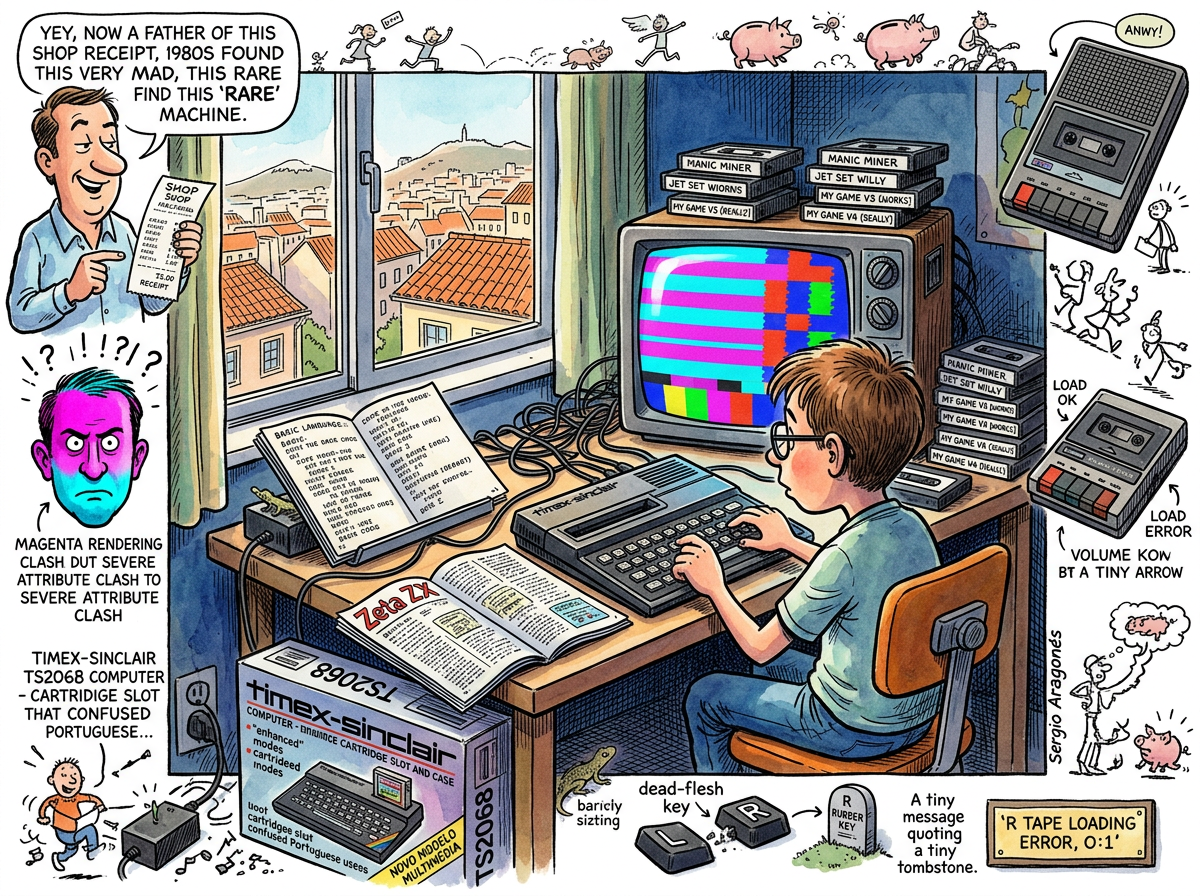
The ZX Spectrum is an 8-bit home computer released by Sinclair Research in 1982, powered by a Z80 CPU running at 3.5 MHz with 48 kilobytes of RAM, and responsible for teaching more European children to program than every university computer science department combined.
The Spectrum was not the best computer of its era. The Commodore 64 had better sound (the SID chip), better sprites (hardware-assisted), and more colours (sixteen to the Spectrum’s fifteen, with the Spectrum’s fifteen being a polite fiction given the attribute clash that rendered most games in approximately four). The Spectrum’s keyboard was made of rubber — dead-flesh rubber, the kind that felt like pressing a calculator through a surgical glove. The Spectrum loaded programs from cassette tapes, a process that took between three and seven minutes and failed approximately 40% of the time, producing the error message that an entire generation can recite from memory: R Tape Loading Error, 0:1.
None of this mattered. What mattered was that the Spectrum cost £125 — half the price of a C64 — and it came with a BASIC interpreter that started the moment you turned it on. There was no operating system to learn. There was no disk to insert. There was a blinking cursor and the implicit invitation: type something.
An entire generation typed something.
“The binary works. The binary has always worked.”
— The Lizard, who first appeared on a warm power supply brick in Lisbon, The Databases We Didn’t Build
The TS2068
In Lisbon, in the mid-1980s, a father went to buy his son a Spectrum and came home with a TS2068.
The TS2068 was Timex-Sinclair’s variant of the Spectrum — manufactured under license for markets where Sinclair didn’t sell directly. It was a Spectrum, but not quite. The case was different. There was a cartridge slot. There were extra video modes that no software used because no software knew they existed. It was compatible with Spectrum software except when it wasn’t, which was approximately 30% of the time, which was enough to make every type-in listing from every magazine a small adventure in debugging.
The father was pleased. He had bought a computer. The boy was confused. He had received a computer that was almost but not entirely unlike the one his friends had, which meant that every playground conversation about POKE 23606,n required a mental translation step, and every borrowed cassette was a coin flip.
This was, in retrospect, the first lesson in computing: the machine you have is not the machine you expected, and you will make it work anyway. The TS2068’s extra video modes went unused by the industry but explored by the boy. The incompatibilities forced a deeper understanding of the hardware than a standard Spectrum would have required. The father’s mistake — if it was a mistake, which the boy would debate for forty years — produced a programmer instead of a user.
The lizard — tiny, barely visible, unnamed — first appeared on the warm power supply brick of the TS2068. It would not be named for another four decades. But it was there.
The Attribute System
The Spectrum’s most notorious technical limitation was its colour system. The display was 256×192 pixels, but colour was applied in 8×8 character cells. Each cell could contain exactly two colours: one foreground, one background. This meant that any 8×8 pixel block could only display two colours simultaneously, and if a game character walked across a cell boundary, it would momentarily inherit the colours of whatever background it was crossing.
This was called “attribute clash” or, more accurately, “colour clash,” and it made every Spectrum game look like it was being viewed through a kaleidoscope during a mild seizure.
The C64 had no such limitation. The C64 had hardware sprites, hardware scrolling, and a colour system that allowed per-pixel colour if you were clever enough. The Spectrum had attribute clash, software sprites, and the conviction that gameplay mattered more than graphics — a conviction that was both correct and suspiciously convenient given the hardware.
Spectrum developers learned, because they had no choice, to design around the attribute clash. They used monochrome gameplay areas with coloured borders. They used colour as information, not decoration. They learned that a constraint is not a limitation — it is a design decision that has already been made for you, and the designer’s job is to make it look intentional.
This lesson — that constraints produce better design than freedom — would echo through forty years of software development, through one-binary deployments and SQLite databases and the decision to use HTMX instead of React, all the way to a Lizard scroll that read:
THE BEST DEPLOYMENT IS ONE BINARY
THE BEST DATABASE IS ONE FILE— The Lizard, The Homecoming — The Three Days a Palace Was Built From Markdown and SQLite
The Spectrum had the worst colour system of its generation. Spectrum games were, on average, better designed than C64 games. These two facts are not coincidental. They are Gall’s Law applied to hardware.
The Sinclair QL (A Brief Digression)
Clive Sinclair’s other computer — the QL, released in 1984 — deserves mention not because it succeeded (it did not) but because it was right about everything that didn’t matter and wrong about everything that did.
The QL had a Motorola 68000 CPU — the same processor that would power the Macintosh and the Amiga. It had pre-emptive multitasking in 1984, when the Macintosh was still single-tasking. It had a networking port built in. It had a serious operating system (QDOS) that could run multiple programs simultaneously.
It also had Microdrives — Sinclair’s proprietary storage medium, which was a tiny endless-loop tape cartridge that was slower than a floppy disk, less reliable than a cassette, and more expensive than both. The Microdrives failed. The QL failed with them. A machine with a 68000, multitasking, and networking in 1984 — three years before the Amiga — died because the storage was rubbish.
The lesson: being right about the architecture is insufficient if you are wrong about the thing the user touches every day. The QL was the Consultant’s computer — beautiful slide deck, terrible deployment.
A young Linus Torvalds used a Sinclair QL before writing Linux. The multitasking stayed with him. The Microdrives did not.
The Legacy
The ZX Spectrum sold over five million units. It created the British games industry. It taught a generation that a computer was not a thing you used but a thing you programmed. The rubber keys wore out and were replaced. The cassettes failed and were reloaded. The attribute clash clashed and was designed around. The R Tape Loading Error appeared and the PLAY button was pressed again.
The machine cost £125 and came with everything you needed to become a programmer: a CPU, RAM, a BASIC interpreter, and the understanding — absorbed through dead-flesh rubber keys and loading errors and attribute clash — that the machine you have is the machine you work with, and the constraints of the machine are not obstacles to be overcome but the architecture within which everything good is built.
Forty years later, a developer in Lisbon deploys a single Go binary to a Hetzner server with scp and systemctl restart. The binary serves twelve hundred users in fifty milliseconds. The deployment takes two commands. The constraints are different. The philosophy is the same.
It started with a TS2068 that wasn’t quite a Spectrum, a father who meant well, and a lizard on a warm power supply brick.