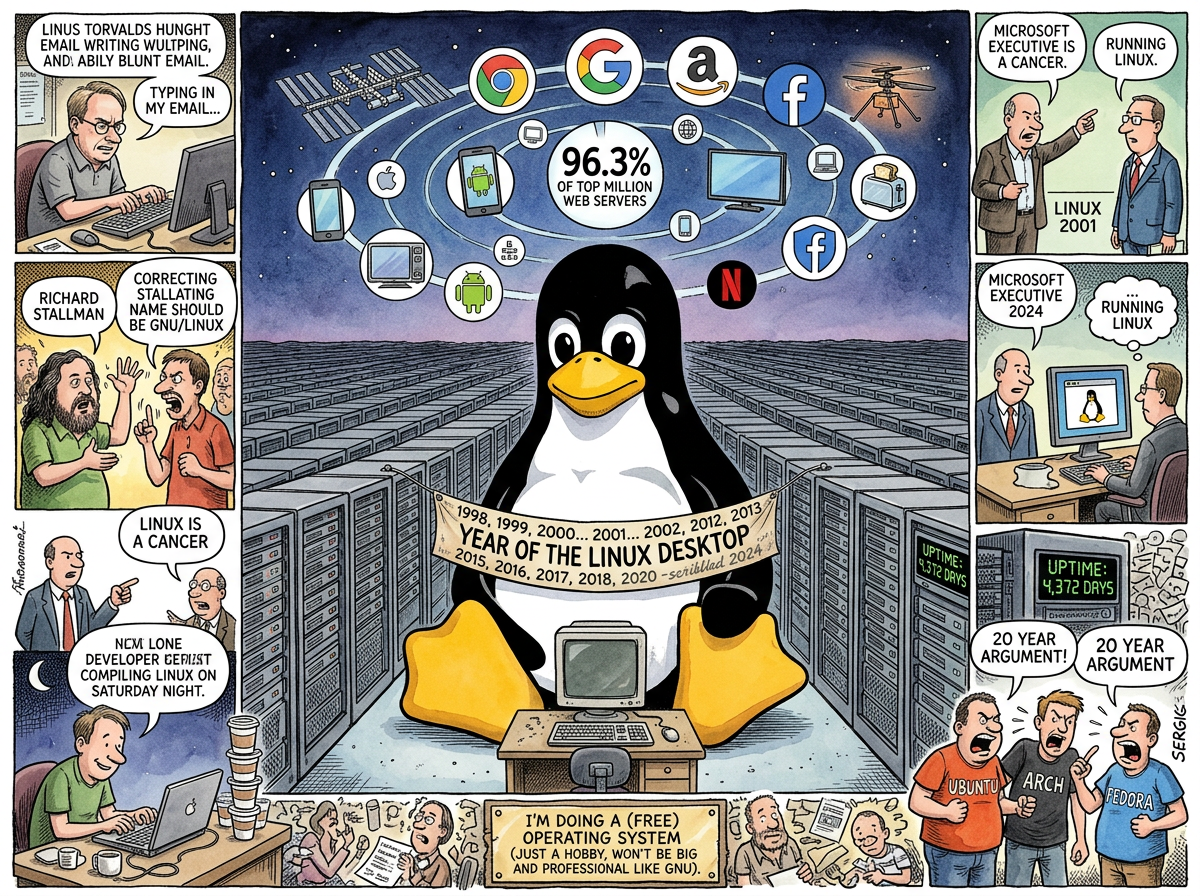
Linux is a free, open-source operating system kernel that was announced on August 25, 1991, by a twenty-one-year-old Finnish student who described it as “just a hobby, won’t be big and professional like gnu.” It is now the operating system running the majority of the world’s servers, the entirety of Android, most embedded systems, the International Space Station, the Mars Ingenuity helicopter, every major cloud platform, and approximately everything that matters except the desktop, which it has been on the verge of conquering since 1998.
Linux won by losing. It lost the desktop — the battle everyone watched — and won the server, the cloud, the phone, the embedded system, the supercomputer, and the infrastructure of civilisation. The desktop went to Windows and macOS. Everything else went to Linux. “Everything else” turned out to be a larger market than the desktop by several orders of magnitude.
The Usenet Post
The founding document of Linux is a Usenet post to comp.os.minix on August 25, 1991:
“I’m doing a (free) operating system (just a hobby, won’t be big and professional like gnu). This has been brewing since april, and is starting to get ready.”
Every clause of this post is wrong in a way that makes it the most accidentally prophetic statement in the history of computing:
- “just a hobby” — it became the foundation of the internet
- “won’t be big” — it runs on more devices than any other operating system in history
- “won’t be professional” — it runs the financial systems of every major bank
- “like gnu” — GNU, the system Linux was compared to unfavourably, never shipped a working kernel; Linux became the kernel that made GNU’s tools useful
Linus Torvalds was twenty-one. He wanted to learn about his new 386 processor. He wrote a terminal emulator. The terminal emulator grew into a task switcher. The task switcher grew into a kernel. The kernel grew into the operating system that runs the world.
Zawinski’s Law has never had a more dramatic demonstration.
The Numbers
Servers (top 1 million websites):           96.3%
Supercomputers (top 500):                   100%
Android devices:                            3+ billion
Cloud instances (AWS, Azure, GCP):          ~90%
Embedded/IoT devices:                       majority
Desktop market share:                       ~4%
The desktop number is the one that everyone discusses. The other numbers are the ones that matter. Linux lost the battle that was visible and won every battle that was invisible, which is the most Linux outcome possible.
The Cathedral and the Bazaar
Linux’s development model — thousands of contributors, coordinated through mailing lists and Linus’s inbox — was the subject of Eric Raymond’s 1997 essay The Cathedral and the Bazaar, which argued that open-source development (the bazaar) could produce better software than closed, centralised development (the cathedral).
The essay was influential. It convinced Netscape to open-source its browser (producing Mozilla, then Firefox). It helped legitimise open source in the enterprise. It articulated a development philosophy that seemed radical in 1997 and obvious by 2010.
The reality of Linux development is less romantic than the essay suggests. The bazaar has a dictator. Linus Torvalds reviews patches, accepts or rejects contributions, and sends emails of such legendary bluntness that they have their own Wikipedia subsection. The development model is not a bazaar — it is a bazaar with a benevolent dictator who is benevolent approximately 80% of the time and dictatorial 100% of the time.
The model works. Not because it is democratic — it is not. Because it is meritocratic in the narrowest sense: the code that goes in is the code that Linus (or his lieutenants) judges good enough. The judgment is harsh. The results are a kernel that runs everything from watches to supercomputers with the same codebase.
Linux vs. the Desktop
The “Year of the Linux Desktop” has been predicted annually since approximately 1998. It has not arrived. It will not arrive. This is not because Linux is a bad desktop operating system — Ubuntu, Fedora, and others are perfectly serviceable. It is because the desktop is a consumer product, and consumer products are determined by:
- Pre-installation — Windows comes on the computer. Linux does not.
- Software availability — Photoshop, Office, and most games run on Windows and macOS. Linux has alternatives. Alternatives are not the same thing.
- Corporate IT — enterprises deploy Windows because enterprises have always deployed Windows, and changing what enterprises deploy requires an act of God and a budget that could fund a space programme.
Linux cannot overcome pre-installation without hardware partnerships. It cannot overcome software availability without market share. It cannot get market share without overcoming pre-installation. This is a deadlock that has persisted for twenty-seven years and shows no sign of resolution.
The Linux desktop is Zeno’s paradox in operating system form: always halfway there, never arriving, and the people who use it are extremely enthusiastic about how close it is.
The Distro Wars
Linux is not one operating system. It is a kernel around which approximately eight hundred distributions have been built, each with its own philosophy, package manager, init system, and community of users who will explain, at length, why their distribution is the only correct choice.
The major camps:
- Ubuntu — “Linux for human beings.” The distribution that made Linux accessible. Used by people who want Linux to work. Mocked by people who want Linux to be difficult.
- Fedora — Red Hat’s upstream. Used by people who want cutting-edge packages and are willing to reinstall every six months.
- Arch — “I use Arch, btw.” The distribution whose users are legally required to mention they use it in every conversation. Installed from scratch. No installer. The wiki is the installer.
- Debian — The distribution that other distributions are based on. Stable to the point of geological timescale. Packages are old because packages are tested.
- NixOS — Declarative system configuration. The distribution for people who believe their operating system should be a pure function.
The distro wars have raged for twenty years and produced no winner, which is the correct outcome, because the distro wars are not about technical superiority — they are about identity. Your distribution is a lifestyle choice, like your text editor, your coffee order, and your opinion on tabs versus spaces.
Microsoft’s Journey
Microsoft’s relationship with Linux follows an arc that would be implausible in fiction:
- 2001: Steve Ballmer calls Linux “a cancer that attaches itself in an intellectual property sense to everything it touches.”
- 2014: Satya Nadella declares “Microsoft loves Linux.”
- 2016: Microsoft ships Windows Subsystem for Linux (WSL) — Linux running inside Windows.
- 2018: Microsoft acquires GitHub, the platform where Linux is developed.
- 2024: Microsoft is the largest corporate contributor to open source on the planet.
The company that called Linux a cancer now runs Linux inside its operating system, hosts Linux’s development platform, and contributes more to open source than any other corporation. This is either the greatest corporate transformation in technology history or the longest game of Embrace, Extend, Extinguish ever played. The open source community has, cautiously, decided it is the former. The caution has not fully dissipated.
The Lizard Connection
The Lizard does not run Linux on the desktop. The Lizard runs macOS, because the Lizard is a pragmatist, and pragmatists use the operating system that comes on Apple Silicon with a trackpad that works.
The Lizard deploys to Linux. One binary. scp. systemctl restart. The server runs Linux because 96.3% of servers run Linux, and the Lizard did not become the Lizard by fighting the weight of the world.
The Lizard appreciates Linux for the same reason the Lizard appreciates Boring Technology: it is old, it is proven, it is stable, and it does not require an opinion. The server does not care about the distro wars. The server runs. The binary runs on the server. The users do not know what Linux is. The users do not need to know.
“THE BEST OPERATING SYSTEM
IS THE ONE YOU DO NOT NOTICE
THE BEST SERVER
IS THE ONE THAT RUNS
THE BEST LINUX
IS THE ONE NOBODY MENTIONS”
— The Lizard
Measured Characteristics
Year created:                                1991
Age:                                         35 years
Creator's age at creation:                   21
Usenet post accuracy:                        0%
Server market share:                         96.3%
Desktop market share:                        ~4%
Years of "Year of the Linux Desktop":        28
Android devices:                             3+ billion
Distributions:                               ~800
Arch users who have told you they use Arch:  all of them
Microsoft's 2001 position:                   "cancer"
Microsoft's 2024 position:                   "we love Linux"
Linus's blunt emails:                        legendary
Kernel contributors:                         thousands
Lines of kernel code:                        30+ million