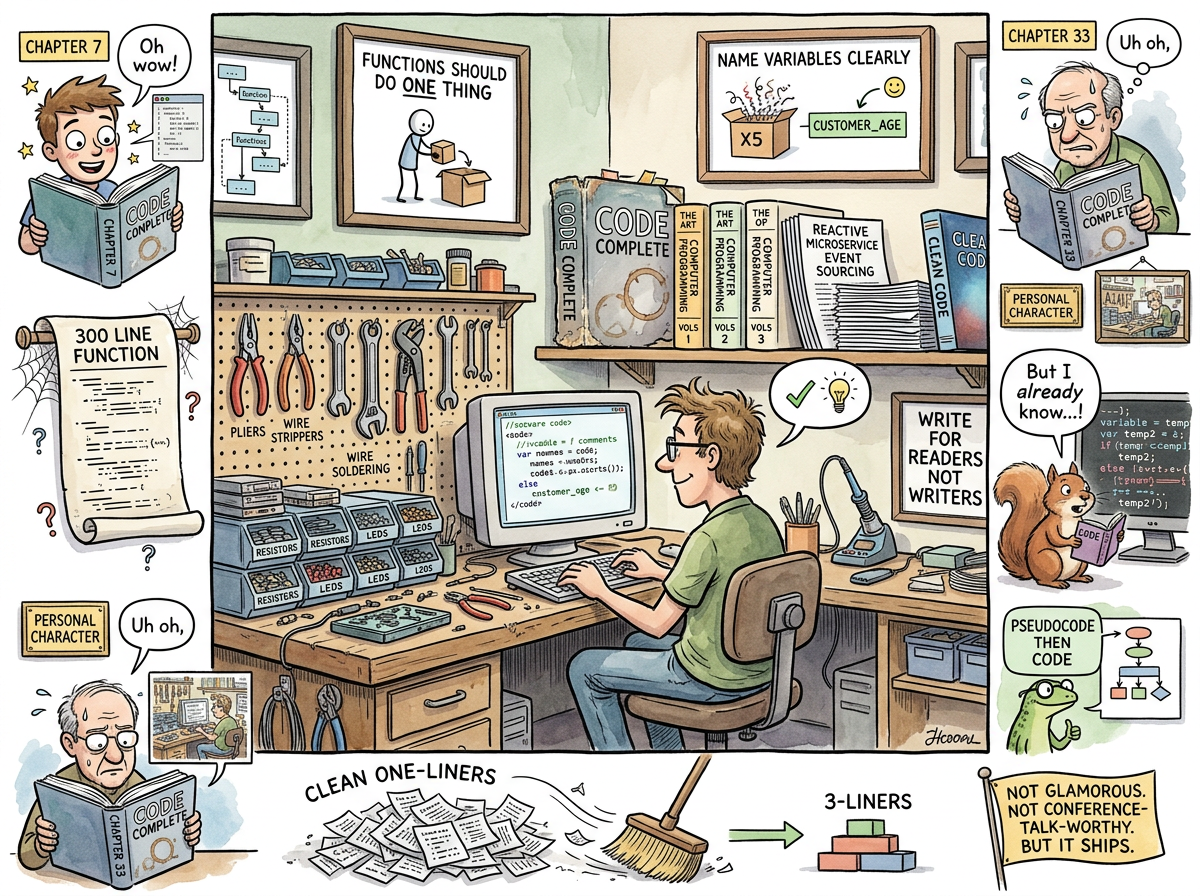
Code Complete: A Practical Handbook of Software Construction is a book first published in 1993 by Steve McConnell, which committed the radical act of explaining how to write code well — not brilliantly, not cleverly, not in a way that would get you invited to speak at a conference — but well, in the sense that the code works, the next person can read it, and nobody has to schedule a meeting to understand what temp2 means.
This is, in the landscape of software engineering literature, the equivalent of writing a book called How to Cook Food That Tastes Good and Doesn’t Poison Anyone. It should not have been revolutionary. It was.
The Thesis
Code Complete’s thesis can be stated in one sentence: the primary audience of source code is other humans, not computers.
The computer doesn’t care if your variable is called remainingRetryCount or x7. The computer will execute both with equal indifference. The human who maintains your code at 2 AM six months from now — who may be you, with less coffee and more desperation — cares enormously. That human is the reader. Code Complete is a book about writing for the reader.
This sounds obvious. It was not obvious in 1993, when the prevailing culture of software development rewarded cleverness over clarity, when a three-line solution was always preferred to a ten-line solution regardless of readability, and when comments were considered a sign of weakness — an admission that the code was not clever enough to be self-evident.
McConnell said: write the ten-line solution. Name your variables. Write the comment. Make the code so clear that the 2 AM maintainer — tired, confused, under deadline pressure — can understand it without a meeting.
The industry was skeptical. Then the industry’s 2 AM maintainers started reading the book. Then the industry changed. Slowly. Quietly. Without a conference talk.
The Chapters That Matter
Code Complete is 960 pages. Unlike The Art of Computer Programming, people actually read it. Unlike The Mythical Man-Month, people actually follow it. This makes it unique in software literature: a book that is both read and applied, which is such a low bar that reaching it should not feel like an achievement, and yet.
The chapters that changed the most code:
Chapter 7: High-Quality Routines. A function should do one thing. A function should be short enough to understand without scrolling. A function’s name should describe what it does. These rules existed before McConnell. McConnell made them feel like hygiene — not optional, not aspirational, but basic professional practice, like washing your hands before surgery. After Chapter 7, writing a three-hundred-line function felt dirty.
Chapter 11: The Power of Variable Names. remainingRetryCount instead of r. customerAddress instead of ca. isValid instead of flag. McConnell spent an entire chapter on naming — thirty-one pages on what to call things — and it was the most useful thirty-one pages most developers had ever read, because naming is not about aesthetics. It is about communication. A well-named variable is a comment that never goes stale.
Chapter 24: Refactoring. Published five years before Fowler’s book. Less systematic, less comprehensive, but earlier. McConnell was telling developers to improve working code before Fowler gave the practice its canonical name and catalogue. The relationship between the two books is the relationship between a field guide’s introductory chapter and the field guide itself — one says “look at the birds,” the other teaches you every species.
Chapter 33: Personal Character. The chapter nobody expects and everybody needs. McConnell argues that the primary determinant of code quality is not the language, the tools, or the methodology — it is the character of the developer. Intellectual honesty. Humility about your own limitations. The willingness to admit you don’t understand something rather than writing code that pretends you do. This chapter is uncomfortable. Uncomfortable chapters are the ones that matter.
The Anti-Cleverness Manifesto
Code Complete’s deepest contribution is cultural: it made cleverness unfashionable.
Before Code Complete, clever code was admired. The developer who could compress three operations into one line, who could chain ternary operators into a single unreadable expression, who could write a regular expression that solved the problem in forty characters that nobody could maintain — that developer was respected. They were smart.
McConnell said: smart is not the goal. Clear is the goal. The smart solution that nobody can maintain is worse than the obvious solution that everybody can maintain. The three-line version that any junior developer can read at 2 AM is better than the one-line version that requires a whiteboard to decode.
This was heresy in 1993. It was common sense by 2004. It is scripture by now, though the congregation still sins. The clever one-liner still appears in code reviews. It is still rejected, and the rejection cites — implicitly or explicitly — the principle McConnell articulated: write for the reader.
"Stubbornness is a feature. It’s the refusal to add complexity just because complexity is available."
— riclib, The Databases We Didn’t Build
McConnell would agree. Complexity is always available. The one-liner is always possible. The question is not whether you can write it, but whether the person reading it at 2 AM will understand it. If the answer is no, write the boring version. The boring version ships. The boring version gets maintained. The boring version lets the 2 AM reader fix the bug and go back to sleep.
The McConnell Position
McConnell occupies an unusual position in software literature: he is respected without being famous. Brooks is famous. Knuth is legendary. Fowler is a brand. The Gang of Four are a brand name. McConnell is… the guy who wrote Code Complete.
This is fitting. The book is about doing the work without drawing attention to the work. The book is about writing code that is so clear it becomes invisible — code where the reader never notices the quality because the quality never gets in the way. McConnell wrote a book with the same quality: you read it, your code gets better, and you forget which book taught you to name your variables. It wasn’t a manifesto. It was a practice.
The book has sold over a million copies. It is, by revenue, one of the most successful software engineering books ever published. It has never trended on Twitter. It has never been the subject of a flame war. It has never been described as “disruptive” or “paradigm-shifting” or any other word that sounds exciting and means nothing.
It is a book about writing code well. A million people bought it. Their code got better. That’s the whole story. It isn’t glamorous. It ships.
The Second Edition
The second edition, published in 2004, updated the examples from C and Pascal to C++, Java, and Visual Basic. The principles remained unchanged, because the principles were never about the language. The principle “name your variables clearly” does not change when you switch from Pascal to Python. The principle “keep your functions short” does not change when you switch from C to Go. The principle “write for the reader” does not change. Ever.
The second edition is 960 pages. Developers who complain about its length are implicitly arguing that there are fewer than 960 pages of things to know about writing code well. They are wrong. McConnell could have written twice as many pages. He exercised the restraint the book teaches: include what the reader needs. Cut the rest. Write for the reader.
The Shelf Test
Code Complete is the test for whether a developer’s bookshelf is decorative or functional.
A decorative bookshelf contains The Art of Computer Programming (unread), The Mythical Man-Month (read once in university), Design Patterns (misunderstood), and a hardcover copy of Clean Code (for signaling).
A functional bookshelf contains Code Complete, and it looks like it’s been dropped in a bathtub. The spine is broken. The pages are dog-eared. There are coffee rings on Chapter 11. A Post-it note on page 774 says “READ THIS AGAIN.” The cover is faded.
The functional bookshelf’s owner names their variables clearly, writes short functions, comments the why not the what, and has never given a conference talk about any of this, because there is nothing to talk about. It’s just code. Written well. For the reader.