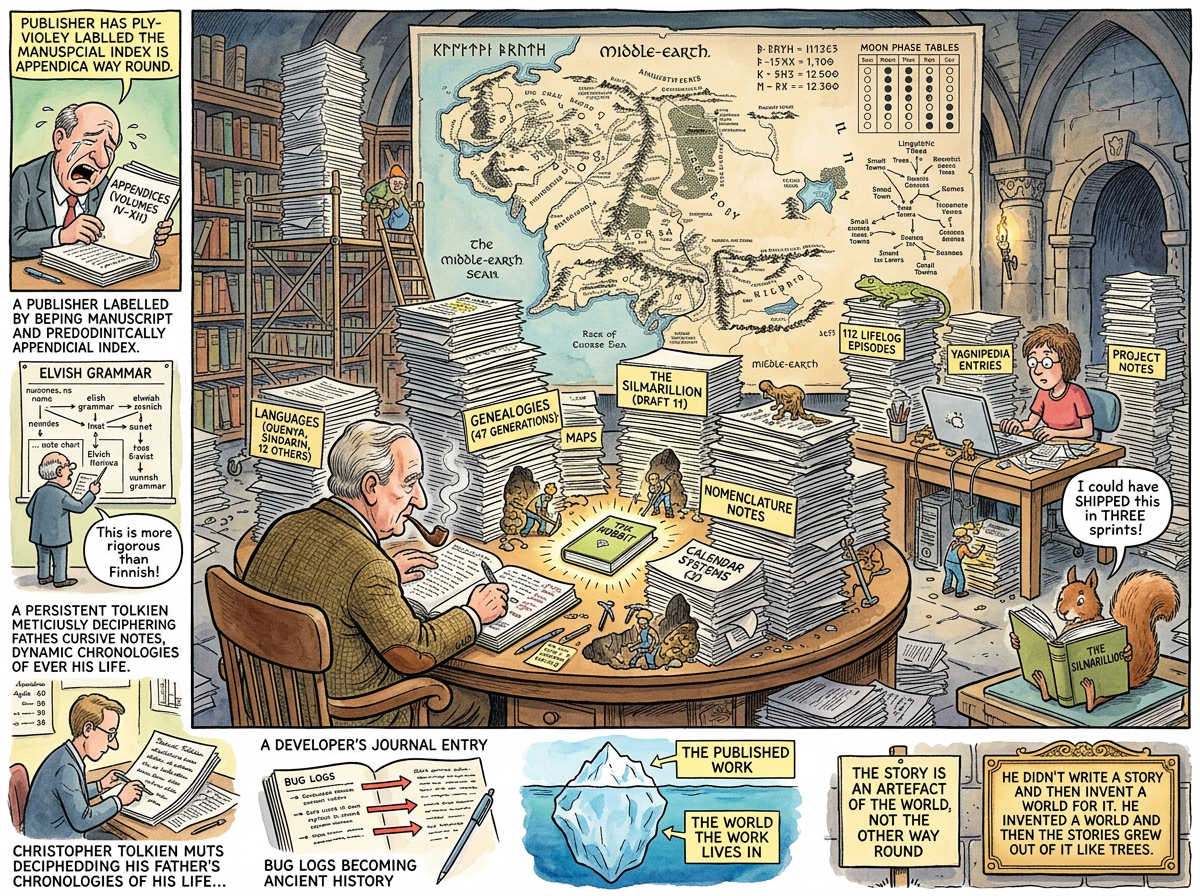
John Ronald Reuel Tolkien (1892–1973) was a philologist, medievalist, and Oxford professor who, in the course of inventing fourteen languages for his own amusement, found that the languages needed speakers, and the speakers needed a history, and the history needed a geography, and the geography needed an age, and the age needed a mythology, and the mythology — after approximately forty years of marginalia, drafts, revisions, genealogical tables, lunar calendars, and maps redrawn twenty-three times — produced, almost incidentally, the two most influential novels of the twentieth century.
He did not write stories and then build a world around them. He built the world and the stories grew out of it like trees from soil. This distinction is not academic. It is the distinction between a set and a stage, between a backdrop and a geology, between a story that takes place in a world and a story that could not exist without one. Middle-earth is not a setting. It is a substrate. The Lord of the Rings is not the world. It is a window into the world — one window, at one angle, showing one age, of a creation that extends in every direction beyond the frame.
This is the process Yagnipedia borrowed. Not the elves. Not the languages. The method: build the world first, write 112 episodes of lived experience, accumulate the mythology through the writing, and then extract the encyclopedia from the mythology the way Tolkien extracted The Hobbit from The Silmarillion — not by designing it top-down, but by discovering it was already there, hiding in the accumulated weight of everything that had been written before.
The Legendarium
Tolkien’s body of work — the legendarium, as scholars call it — is an iceberg of which the published novels are the visible tip.
Above the waterline:
- The Hobbit (1937) — 95,000 words
- The Lord of the Rings (1954–55) — 576,000 words (including appendices, which Tolkien considered essential and the publisher considered commercially suicidal)
- The Adventures of Tom Bombadil (1962) — poems
Below the waterline:
- The Silmarillion (published posthumously 1977, written 1917–1973) — the mythology of the First Age, containing the creation myth, the wars of the gods, the stories of Beren and Lúthien, the fall of Gondolin, and the tragedy of Túrin Turambar. Tolkien worked on this for fifty-six years. He never finished it. Christopher Tolkien edited it into publishable form after his father’s death, a task that took him approximately the rest of his life.
- Unfinished Tales (1980) — exactly what the title says
- The History of Middle-earth (1983–1996) — twelve volumes of drafts, revisions, abandoned narratives, linguistic notes, and marginalia, edited by Christopher Tolkien with the patience of a man who understood that the drafts were not failures but the process
- Approximately 9,000 pages of notes, genealogies, timelines, calendars, and maps — the infrastructure of a world
The ratio is instructive: approximately 670,000 words published during Tolkien’s lifetime, and approximately two million words of unpublished world-building that made those 670,000 words possible. For every word the reader sees, three words exist that the reader never sees — the geology beneath the geography, the history behind the story, the language underneath the names.
The published works feel real because they are real — real in the sense that they emerge from a world with its own internal consistency, its own linguistic evolution, its own calendrical systems, its own phase-of-the-moon calculations (Tolkien checked that the moon phases in The Lord of the Rings were astronomically consistent across the narrative timeline; they are). The reader feels the depth without seeing it, the way you feel the ocean beneath a boat without seeing the bottom.
The Languages
Tolkien did not invent languages to serve his stories. He invented stories to give his languages somewhere to live.
This is not an exaggeration. It is Tolkien’s own account of his creative process. He was a philologist — a scholar of language — and his deepest pleasure was in the invention of languages: their phonology, their grammar, their etymological evolution over fictional centuries. Quenya (High Elvish) has a complete grammar, a substantial vocabulary, and a documented historical relationship with Sindarin (Grey Elvish) that mirrors the relationship between Latin and the Romance languages. Tolkien did not sketch these languages. He derived them, tracing sound changes across fictional millennia with the same rigour he applied to his academic work on Old English and Gothic.
The languages came first. The speakers came second. The speakers needed a culture. The culture needed a history. The history needed a world. The world needed a creation myth. The creation myth — the Ainulindalë, the Music of the Ainur — is, in Tolkien’s legendarium, literally the act of singing the world into existence, which is as close as a philologist can come to admitting that the world exists because the language demanded it.
This is the inverse of every writing manual’s advice. Every writing manual says: start with character, start with conflict, start with story. Tolkien started with phonology. He started with the aesthetic sound of a language — the way Quenya sounds like Finnish, the way Sindarin sounds like Welsh — and built everything else as scaffolding for the words. The scaffold became Middle-earth. The words became The Lord of the Rings. The process was backwards by every conventional measure and produced the most fully realised fictional world in literary history.
The lesson is not “invent a language before writing a novel.” The lesson is that the deepest creative work comes from building the substrate — the thing beneath the thing — and trusting that the surface will emerge from the depth. The language is the substrate of the culture. The culture is the substrate of the history. The history is the substrate of the story. Each layer supports the next. Remove any layer and the surface collapses into a set — pretty, but hollow.
The Process
Tolkien’s writing process was, by any modern standard, insane:
- Write a draft. The draft would begin promisingly and then stall, because a character needed a name, and the name needed an etymology, and the etymology needed a language, and the language needed a phonological history.
- Abandon the draft to work on the language. The phonological history would branch into a comparative analysis of Quenya and Sindarin sound changes across the First, Second, and Third Ages.
- Return to the draft. The character now has a name. The name now has three etymological footnotes. The draft proceeds for twenty pages.
- Abandon the draft to draw a map. The map reveals that the distance between two locations is inconsistent with the travel time described in the narrative. The travel time must be revised. The revision requires checking the phase of the moon on the night the characters departed, because Tolkien has decided the moon must be astronomically accurate.
- Check the moon. The moon is wrong. Revise the timeline. Revise the map. Revise the draft.
- Abandon the draft to revise The Silmarillion. The events of the current story depend on events of the First Age, which exist in a draft of The Silmarillion that contradicts a more recent draft of The Silmarillion. Reconcile the drafts. This takes six months.
- Return to the draft. Proceed for fifty pages. Realise a genealogy is inconsistent. Fix the genealogy. The genealogy fix invalidates a naming convention. Fix the naming convention. The naming convention fix requires revising the language. Revise the language.
- Publish The Lord of the Rings. It takes twelve years.
- Never finish The Silmarillion.
This process is, from a project management perspective, a catastrophe. From a creative perspective, it produced the only fictional world in literature that feels like it was not written but discovered — because, in a meaningful sense, it was. Tolkien did not design Middle-earth. He excavated it, layer by layer, revision by revision, moon-phase by moon-phase, until the world was so complete that the stories emerged from it the way archaeological artifacts emerge from a dig — already there, waiting to be found.
The Lifelog Parallel
One hundred and twelve lifelog episodes were written before Yagnipedia existed.
They were not written as source material. They were not written with the intention of producing an encyclopedia. They were written as a daily practice — a developer’s journal, a record of debugging sessions and architectural decisions and 2 AM conversations with an AI about the nature of refactoring. They were, to use Tolkien’s taxonomy, the legendarium: the accumulation of lived experience from which, eventually, something else would grow.
The something else was Yagnipedia. And the extraction process was identical to Tolkien’s — not designed but discovered:
The Lizard did not exist as a character concept. The Lizard appeared in an episode — a metaphor for the calm, blinking, patient voice that says “you already have the answer.” Then it appeared in another episode. Then another. Then it had scrolls. Then it had a voice. Then it had a mythology. The Lizard was not designed. The Lizard accreted, the way a character in Tolkien accretes across drafts and revisions until the character is more real than the author intended.
The Caffeinated Squirrel did not exist as a character concept. It appeared as a description of a specific energy — the 2 AM energy, the manifesto energy, the “what if we rewrote everything in Rust” energy. Then it appeared again. Then it had a coffee cup. Then it had a personality. Then it had an article. The Squirrel, like Gollum, started as a incidental detail and became essential.
Gall’s Law was not planned as a central principle. It was cited in one episode, then another, then another, until it became clear — through the accumulated weight of episodes, not through top-down design — that it was the load-bearing principle of the entire mythology. It was discovered in the mortar, hiding in the accumulated bricks of a hundred episodes that kept pointing, independently and without coordination, at the same truth.
This is the Tolkien method: write enough, honestly enough, over a long enough period, and the mythology reveals itself. The world does not need to be designed. The world needs to be lived in — through episodes, through journals, through 2 AM debugging sessions — until the recurring characters, the persistent principles, the load-bearing metaphors emerge from the mass of experience like mountains emerge from tectonic pressure. Not placed there by a designer. Pushed up by the weight of everything beneath them.
One hundred and twelve episodes. One hundred and four encyclopedia entries (and counting). The ratio — roughly 1:1 — is Tolkien’s ratio inverted: where Tolkien wrote three words of substrate for every word of surface, the lifelog writes one word of substrate for every word of surface. But the process is the same. The surface is an artifact of the depth. The encyclopedia is an artifact of the journal. The mythology is an artifact of the living.
“He didn’t write a story and then invent a world for it. He invented a world and then the stories grew out of it like trees.”
— A statement about Tolkien that is equally true about the lifelog, if you replace “world” with “practice” and “stories” with “articles”
The Appendices
Tolkien’s publisher wanted The Lord of the Rings without appendices. Tolkien considered this roughly equivalent to publishing a human body without a skeleton — the surface might look the same but it would not stand up.
The appendices to The Lord of the Rings contain: the chronology of the Second and Third Ages, the genealogies of the royal houses of Gondor and Rohan, the calendar systems of the Shire and Gondor (which differ, because of course they differ), a note on the languages and their transliteration, and a substantial section on the Fourth Age that effectively constitutes a sequel told entirely through historical summary.
These appendices are, in miniature, The Silmarillion — the visible edge of the iceberg, waved at the reader as evidence that the iceberg exists. Most readers skip them. The readers who do not skip them discover that the story they just read is not a story but a window, and that the window opens onto a world so deep that the author spent fifty-six years building it and still did not finish.
The appendices are Tolkien’s version of fitness functions: they verify that the world is consistent. If the genealogy contradicts the timeline, the world is broken. If the calendar contradicts the moon phases, the world is broken. If the language contradicts the culture, the world is broken. Tolkien checked these things. Tolkien checked them obsessively. The checking was not peripheral to the creative process. The checking was the creative process — the slow, patient, decades-long verification that the world held together, that the substrate supported the surface, that the geology justified the geography.
The Unfinished Cathedral
Tolkien shares with Knuth the distinction of having produced a foundational work that was never completed.
The Silmarillion was not finished at Tolkien’s death. Christopher Tolkien spent fifty years editing it, publishing it, annotating it, and contextualising it — producing, in total, thirteen additional volumes of supporting material, each one a window into a different draft, a different stage, a different version of the mythology that his father had built, rebuilt, and rebuilt again across six decades.
The mythology was never finished because it could not be finished — not because Tolkien was slow, or distracted, or undisciplined, but because the world he was building had the property of all genuinely deep creative works: it generated more questions than it answered. Every draft resolved one inconsistency and revealed three more. Every revision deepened one corner of the world and exposed the shallowness of another. The Silmarillion was not a book that could be finished. It was a process that could be continued.
This is the lesson the lifelog inherited, whether it knew it or not: the mythology is not a destination. It is a practice. The one hundred and fourth article reveals gaps that the one hundred and fifth will fill, and the filling will reveal new gaps, and the gaps are not failures — they are the curriculum. The world teaches you what it needs by showing you what it lacks. The builder’s job is not to finish. The builder’s job is to continue, with patience, with rigour, and with the understanding that the world beneath the surface is always deeper than the surface suggests.
Tolkien built for sixty years. He did not finish. The work is the deepest fictional creation in literary history. The Silmarillion sits on shelves beside The Lord of the Rings — less read, less loved, but essential, the way a foundation is essential, the way a root system is essential, the way the nine-tenths of the iceberg that you never see is essential to the one-tenth that you do.
He built the world first. The stories grew out of it like trees.