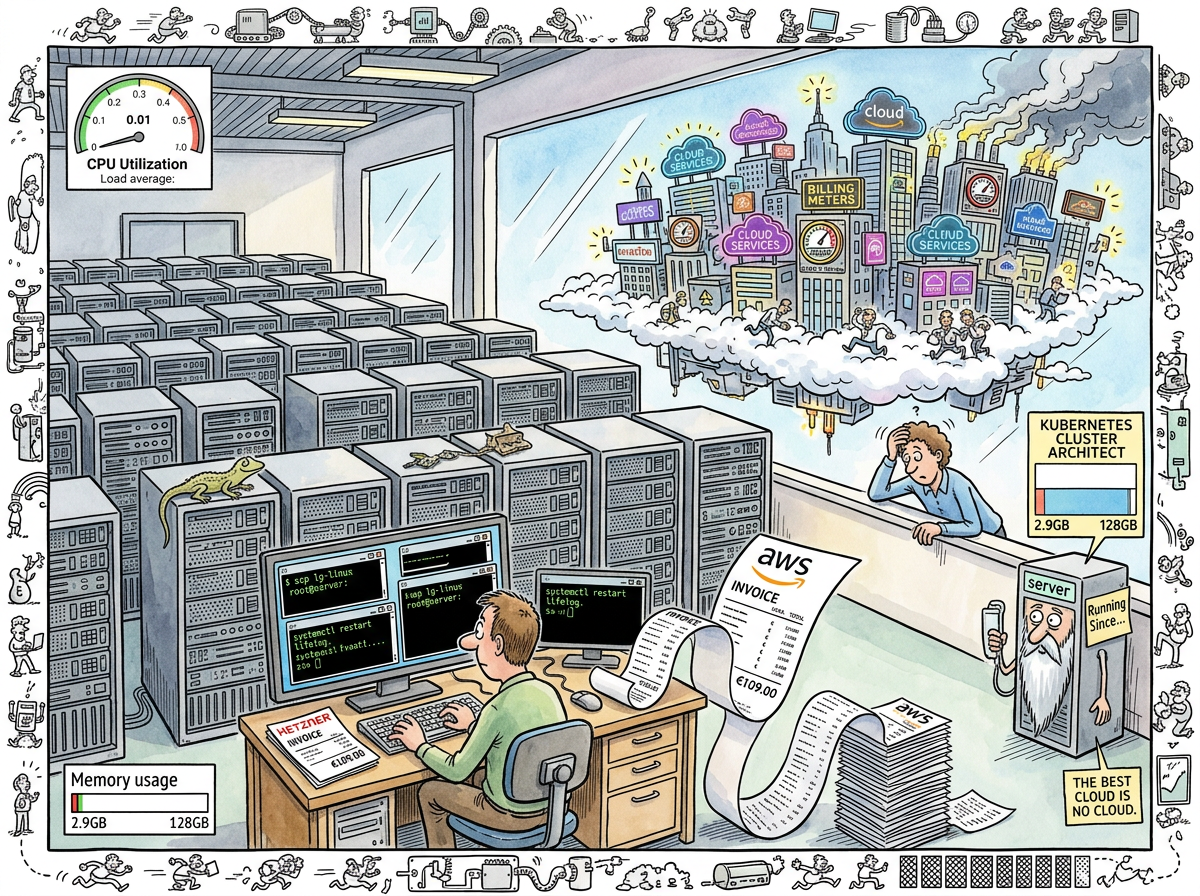
Hetzner is a German hosting company that sells dedicated servers so powerful and so cheap that they make the entire premise of cloud computing feel like a misunderstanding — a €109/month machine that outperforms what most companies spend $10,000/month on AWS to approximate.
Hetzner was founded in 1997 by Martin Hetzner in Gunzenhausen, Bavaria. It has no venture capital. It has no IPO. It has no developer evangelists. It has no conference circuit. It has no blog posts about its culture. It has servers, in data centers, in Germany and Finland, and it sells them for prices that make cloud architects question their career choices.
The company communicates primarily through its website, which lists server specifications and prices. The specifications are accurate. The prices are real. There is no pricing calculator. There is no “contact sales for a quote.” The price is the price. This is either refreshingly honest or deeply unsettling, depending on how many years you have spent negotiating Enterprise Agreements.
The Lifelog Server
The lifelog runs on a Hetzner AX102 dedicated server. The specifications are:
CPU:          AMD Ryzen 9 7950X3D (16 cores / 32 threads, 4.2 GHz)
RAM:          128 GB DDR5 ECC
Storage:      2 × 1.92 TB NVMe SSD (RAID 1)
Network:      1 Gbit/s unmetered
Monthly cost: €109
The server’s current utilization, serving the lifelog blog, Yagnipedia, and all associated infrastructure:
CPU load:     0.01
RAM used:     2.9 GB of 128 GB (2.3%)
Disk used:    9.3 GB of 1.8 TB (0.5%)
Uptime:       continuous
Fan noise:    not applicable (data center)
The server is using 2.3% of its RAM. It is using 0.5% of its disk. Its load average is 0.01, which means it is, for all practical purposes, asleep. The deployment process is a shell script:
GOOS=linux GOARCH=amd64 go build -o lg-linux .
scp lg-linux root@server:/home/lifelog/bin/lg
ssh root@server "systemctl restart lifelog"
Twenty-eight seconds from go build to production. No Docker. No Kubernetes. No CI/CD pipeline. No YAML. One binary. One scp. One systemctl. Done.
“No Docker. No container orchestration. No Kubernetes. One binary. Copy it. Run it. Done.”
— riclib, The Databases We Didn’t Build
The Price Comparison
The Hetzner AX102 costs €109/month. Here is what €109/month buys on the hyperscalers:
AWS — An m7a.xlarge (4 vCPUs, 16 GB RAM). One-eighth the cores. One-eighth the RAM. No local NVMe. Data transfer charges extra. This instance would need to be multiplied by 8 to approach the Hetzner spec, at which point the cost is approximately $900/month — 8x the price for the same hardware. And that’s on-demand. Reserved pricing with a three-year commitment brings it to roughly $400/month. For half the machine.
Azure — A Standard_D16as_v5 (16 vCPUs, 64 GB RAM). Half the RAM. No local NVMe. Approximately $550/month on-demand. The Azure Portal takes longer to load the pricing page than the Hetzner server takes to serve a year of blog traffic.
GCP — A c3d-standard-16 (16 vCPUs, 64 GB RAM). Same story. Approximately $500/month. Google’s networking is admittedly excellent, but the lifelog’s networking requirement is “serve HTML through Cloudflare,” which requires approximately zero networking sophistication.
Oracle Cloud — The free tier Arm instance (4 cores, 24 GB RAM) is free, which is cheaper than €109. Oracle wins on price. Oracle loses on everything else, including the part where the server is yours, the data is yours, and nobody audits your core count.
The comparison is not entirely fair. The hyperscalers offer managed databases, auto-scaling, global distribution, and 200+ services. The Hetzner server offers a box that you own, in a data center that you don’t, running a binary that you wrote. For a Solo Developer serving a blog, the Hetzner server is not just cheaper — it is categorically simpler.
“A Hetzner server at a static IP. A systemd service. A
deploy.shscript that cross-compiled for Linux, uploaded via scp, and restarted the service. Twenty-eight seconds fromgo buildto production.”
— The Front Door — The Night the Palace Finally Faced the Street
The Philosophy
Hetzner is Boring Technology made physical. It is the hardware equivalent of The Monolith: one machine, fully integrated, no microservices, no distributed coordination, no service mesh. The machine does not auto-scale because the machine does not need to auto-scale — it has 128 GB of RAM and a 32-thread CPU running a Go binary that uses 2.3% of its resources.
Hetzner is YAGNI applied to infrastructure. You don’t need auto-scaling. You don’t need multi-region. You don’t need a container orchestrator. You don’t need a service mesh. You need a server. Hetzner sells servers. The transaction is complete.
The Lizard lives on a Hetzner server. Not because the Lizard chose Hetzner through careful evaluation of cloud providers. The Lizard lives on a Hetzner server because the Lizard’s philosophy — simplicity, directness, one binary, no abstraction — inevitably leads to the kind of infrastructure that Hetzner sells: a machine, in a data center, connected to the internet, waiting for instructions.
The forty-seven microservices running on AWS at £47,000/month could fit on this server seventeen times. The server would still be bored.
The German Engineering
Hetzner does not have a developer relations team. Hetzner does not sponsor conferences. Hetzner does not publish blog posts about its engineering culture. Hetzner does not have a podcast.
Hetzner has data centers in Falkenstein, Nuremberg, Helsinki, Ashburn, and Hillsboro. The data centers are powered by renewable energy. The servers are assembled and maintained by Hetzner’s own technicians. The support is competent, responsive, and German — which is to say, efficient, direct, and unburdened by the performative enthusiasm of Silicon Valley customer success teams.
This is the German engineering philosophy applied to hosting: build good things, sell them at fair prices, and don’t waste time explaining why they’re good. The servers explain themselves. The prices explain themselves. The uptime explains itself.
Measured Characteristics
- Hetzner AX102 monthly cost: €109
- AWS equivalent monthly cost: ~$900 (on-demand) / ~$400 (3-year reserved, half spec)
- Ratio (on-demand): ~8:1
- Ratio (reserved, half spec): ~4:1
- Lifelog server CPU load: 0.01
- Lifelog server RAM utilisation: 2.3%
- Lifelog server disk utilisation: 0.5%
- Deployment time: 28 seconds
- Deployment tools: scp, systemctl
- YAML files required: 0
- Kubernetes clusters required: 0
- IAM policies required: 0
- Pricing calculator required: no (the price is on the website)
- Developer evangelists employed by Hetzner: 0
- Servers that explain themselves: all of them