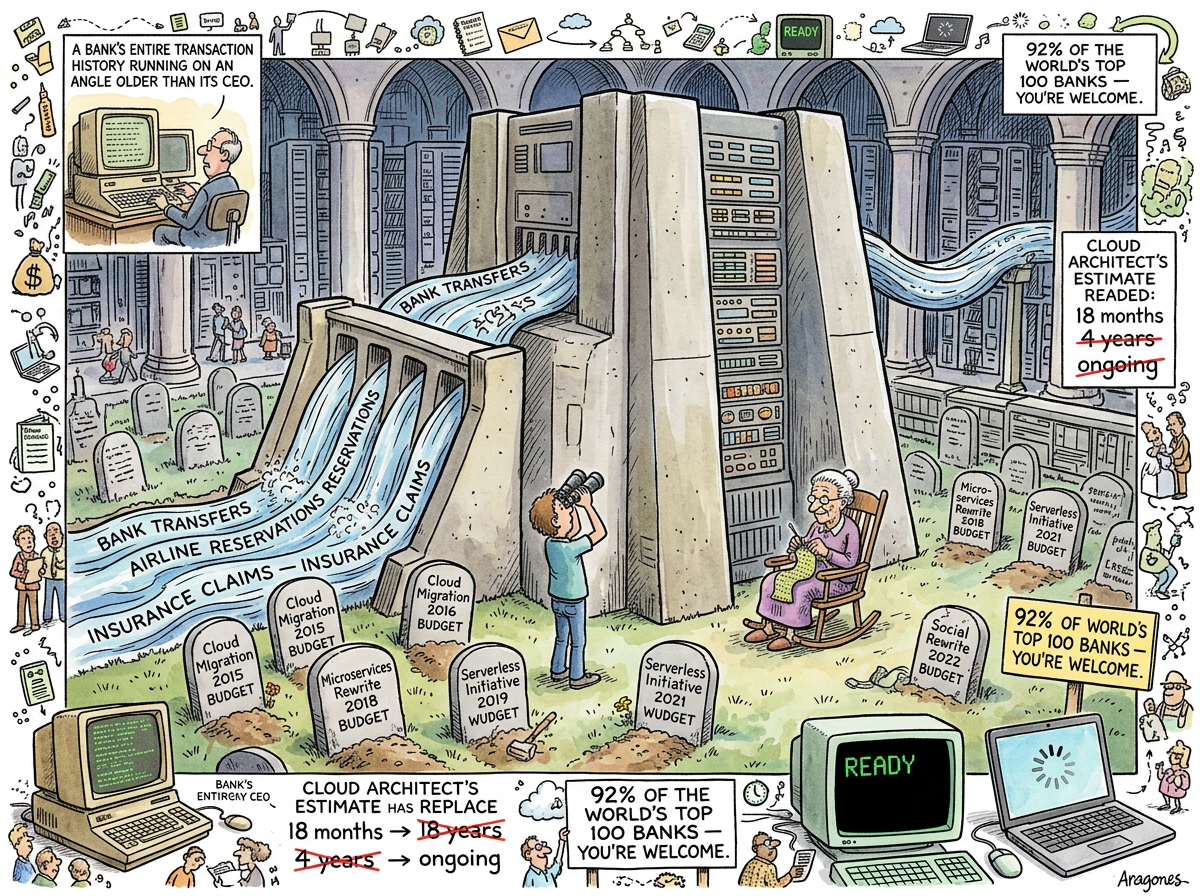
The Mainframe is a class of computer designed for high-volume transaction processing, bulk data handling, and the quiet, thankless work of running civilization — a role it has performed without interruption since the 1960s, and which it continues to perform today, primarily because every attempt to replace it has failed.
The mainframe is not exciting. The mainframe is not innovative. The mainframe is not discussed at conferences, featured in blog posts, or celebrated in keynotes. The mainframe processes 68 billion transactions per day — including the payroll that pays the conference speakers, the bank transfers that fund the blog platforms, and the insurance claims filed by keynote attendees — and it does this without asking for recognition, without requiring a Kubernetes cluster, and without a single YAML file.
The Machine Nobody Sees
The modern mainframe — typically an IBM z-series — is invisible in the way that plumbing is invisible: essential, unglamorous, and noticed only when it breaks, which it very nearly never does. Mainframes achieve 99.999% uptime (five nines), which translates to approximately five minutes of downtime per year.
Five minutes. Per year. The average microservices architecture achieves five minutes of downtime before lunch.
The mainframe accomplishes this through redundant processors, self-healing hardware, and an operating system (z/OS) that was designed from inception to never stop, by engineers who understood that “we’ll fix it in the next deploy” is not an option when the “it” is every ATM in North America.
The Replacement Problem
Every decade, a new technology promises to replace the mainframe. The pattern is consistent:
-
Year 0: A consulting firm produces a report. The report says mainframes are expensive, old, and incompatible with modern architecture. The report recommends migration to [current trend]. The report costs $2 million.
-
Year 1: A migration project begins. Budget: $50 million. Timeline: 18 months. The project will rewrite 40 million lines of COBOL in [modern language]. Confidence is high.
-
Year 3: The project is behind schedule. The COBOL does things nobody documented. The business rules are embedded in programs written by people who retired in 1997. The budget is revised to $120 million.
-
Year 5: The project is cancelled. The mainframe is still running. It processed another 124 billion transactions while the replacement project held status meetings. The Consultant arrives, reviews the wreckage, and recommends “modernizing in place.”
-
Year 6: The next replacement technology emerges. Return to Year 0.
The mainframe has survived client-server, the web, SOA, cloud computing, microservices, serverless, and edge computing. It will survive whatever comes next. Not because it is better than these things — sometimes it is, sometimes it isn’t — but because 40 million lines of running COBOL cannot be replaced by a timeline on a slide.
The COBOL Symbiosis
The mainframe and COBOL exist in a symbiotic relationship that no other technology pairing has achieved. COBOL was designed for the mainframe. The mainframe was optimized for COBOL. Together, they process financial transactions with a decimal precision that floating-point languages still struggle to match, at a speed that modern distributed systems achieve only by adding seventeen caching layers.
The COBOL programmers who wrote these systems are retiring. The systems are not.
This creates what economists might call a supply problem: the number of people who understand the systems that run the global financial infrastructure decreases by approximately 5% per year, while the systems themselves show no intention of decreasing at all.
The Cost Illusion
“Mainframes are expensive” is the most frequently cited reason for migration, and the most frequently disproven one.
A mainframe costs millions per year. This is true. A mainframe replacement costs tens of millions to build, runs on cloud infrastructure costing millions per year, requires a team three times larger to operate, and processes transactions at one-tenth the speed with one-tenth the reliability.
The mainframe is expensive the way a bridge is expensive — the cost is real, but the cost of not having it is the river.
Measured Characteristics
- Daily global transactions processed: ~68 billion
- Percentage of world’s financial transactions touching a mainframe: ~87%
- Typical uptime: 99.999% (five nines)
- Typical age of production COBOL programs: 25–40 years
- Average age of COBOL programmers: approaching retirement
- Successful mainframe replacement projects (complete): statistically negligible
- Lines of COBOL in production globally: ~220 billion
- Mainframes that care about your Kubernetes cluster: 0