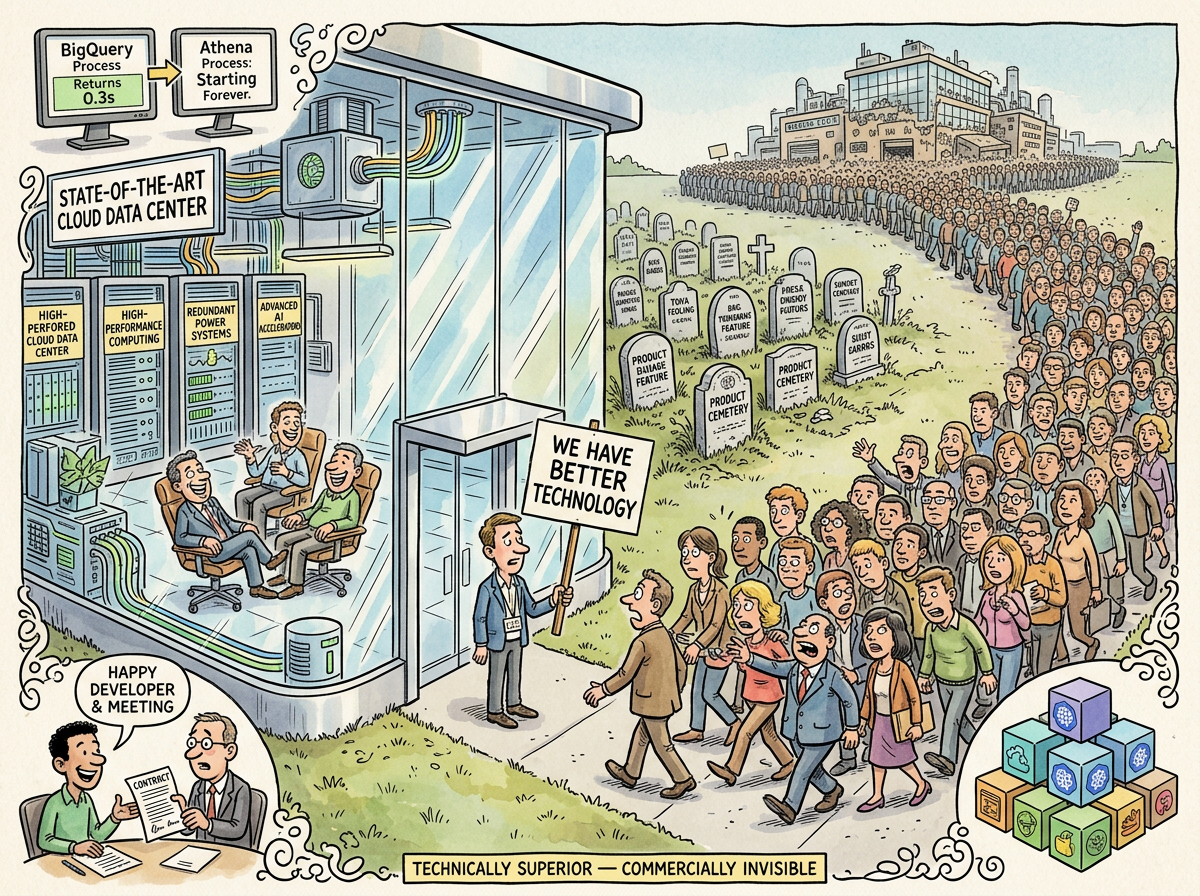
GCP (Google Cloud Platform) is a cloud computing platform built by Google, which means it has the best technology, the best infrastructure, the best networking, and approximately 12% market share — a discrepancy that proves, once again, that technical superiority is necessary but not sufficient, and that the enterprise buys from the vendor it already pays, not the vendor with the best product.
GCP is the cloud built by the company that runs Google Search, YouTube, Gmail, and Google Maps — systems that serve billions of requests per day with latencies measured in milliseconds. The engineering is real. The infrastructure is real. The global network, with its custom-built submarine cables and edge nodes in 200+ countries, is genuinely the most sophisticated computer network ever constructed.
None of this matters to the CTO who already has an AWS account and an Azure Enterprise Agreement.
“The best software is the software that exists tomorrow. At Google, this is not guaranteed.”
The Technology Gap
GCP is technically superior to AWS and Azure in several areas that matter to engineers and in zero areas that matter to procurement:
BigQuery — Google’s serverless data warehouse — can scan a petabyte in seconds. It is, by any objective measure, the best analytical database available as a cloud service. AWS’s equivalent (Redshift) requires cluster management. Azure’s equivalent (Synapse) requires prayer.
Kubernetes was invented at Google. GKE (Google Kubernetes Engine) is the best-managed Kubernetes service. This advantage was immediately neutralised when Google open-sourced Kubernetes, allowing AWS (EKS) and Azure (AKS) to offer the same technology. Google gave away its competitive advantage because Google’s engineering culture values open source, and Google’s business culture had not yet learned that giving away the product is not a growth strategy.
Networking — Google’s private fibre network means that traffic between GCP regions traverses Google’s backbone, not the public internet. This produces lower latencies, more consistent performance, and a network architecture that AWS and Azure cannot replicate because they did not spend twenty years building a global network for search.
None of these advantages appear in a procurement spreadsheet. The procurement spreadsheet has a column for “existing relationship discount.” Google’s column is empty.
The Product Graveyard
GCP inherits Google’s most destructive habit: launching products and killing them. The Google Cloud product graveyard includes:
- Google Cloud IoT Core (2018–2023) — launched, adopted by industrial customers, sunset with one year’s notice
- Google Cloud Healthcare API (reduced scope) — launched for health data, quietly deprioritized
- Google Stadia (2019–2023) — not strictly GCP, but the same cultural DNA: brilliant technology, inadequate commitment
Every GCP product launch exists under the shadow of the graveyard. Enterprise customers, who plan infrastructure in three-to-five-year cycles, look at Google’s track record of killing beloved products and reasonably ask: “Will this service exist when my migration is complete?”
Google’s answer — “we are committed to cloud” — is the same answer Google gave about Reader, Inbox, Hangouts, and Stadia. The words are correct. The track record is not.
The Labyrinth
The lifelog’s most vivid GCP encounter is documented in The Labyrinth — The Three Hours Google Spent Not Taking My Money, in which a developer attempted to access Google’s own Gemini AI model through Google’s own cloud platform and discovered that the process of giving Google money was harder than building the application the money was intended to run.
Three hours. Forty-seven browser tabs. A circular dependency between billing tiers and billing history: to access the API, you need Paid Tier 1; to reach Paid Tier 1, you need billing history; to build billing history, you need to access the API. The developer navigated project creation, billing account linking, API enablement, OAuth consent screen configuration (for an app that didn’t exist), and credential generation — each step requiring another step, each step documented in a help article that linked to another help article.
The reward for three hours of configuration was a [429 Too Many Requests](/wiki/429-too-many-requests) response. One request. Too many. The quota for the free tier was zero. Or one. Or “it depends on your project’s trust score,” a metric that is not visible, not documented, and not adjustable.
“I have a credit card. I am trying to give you money. You are a trillion-dollar company. Why is this the hardest part?”
— Every developer, to the Google Cloud Console, which does not answer because the support chat requires a support plan that requires billing that requires tier verification
The full anatomy of this experience is documented in the Google Cloud Console article, which catalogues every circle of the labyrinth with the precision of someone who spent three hours walking them.
The Gemini Defection
The most remarkable moment in the GCP experience is not the 429 but what happened after.
The developer, having failed to access Gemini through Google’s own infrastructure, asked Gemini itself for help. Gemini recommended OpenRouter — a third-party reseller of Google’s own API. Google’s own AI model, running on Google’s own TPUs, achieved sufficient self-awareness to recognise the futility of its own employer’s billing console and directed the customer elsewhere.
OpenRouter took forty-five seconds to set up. The first image generated ninety seconds later. The ratio of Google Cloud onboarding time to OpenRouter onboarding time was 240:1. The model was the same model. The weights were the same weights. The difference was that one path had a labyrinth and the other had a credit card form.
“Free is expensive when free costs three hours and returns a 429.”
— The Lizard, on pricing models, Google Cloud Console
AWS, for all its 240 services, takes your credit card and gives you a server in four minutes. Azure, for all its portal slowness, lets you click “Create” and wait. Google requires you to understand Google’s organisational model, satisfy a circular tier system, and survive a quota gauntlet — before you can pay for the privilege of using technology that a third-party reseller will sell you in forty-five seconds.
This is the GCP experience distilled: technically superior, operationally baffling, commercially hostile to its own customers.
The Console
The Google Cloud Console is the best-designed cloud console, which is like being the tallest person in a room of very short people. It is faster than the Azure Portal (everything is faster than the Azure Portal). It is more intuitive than the AWS Console (everything is more intuitive than 240 services in a hamburger menu). It has dark mode. It has a genuinely useful search bar.
It also has at least three separate consoles (Cloud Console, AI Studio, Firebase) that share a Google account but do not share an understanding of what that account has access to. Enabling billing in one does not enable billing in another. Creating an API key in one may or may not work in another. The documentation for Console A references Console B, which links to Console C, which suggests you return to Console A. This is not three consoles. This is one labyrinth with three entrances and no exit.
The navigation reorganises approximately once a year, ensuring that any muscle memory developed by regular users is systematically destroyed — a trait it shares with every Google product, because Google’s UX teams believe that consistency is a constraint rather than a feature.
Measured Characteristics
- Global market share: ~12%
- Technical superiority acknowledged by engineers: broad consensus
- Technical superiority reflected in market share: no
- BigQuery scan speed (1PB): seconds
- Kubernetes invented by Google: yes
- Kubernetes advantage retained by Google: no (open-sourced)
- Products killed by Google (overall): 293+
- GCP services sunset: growing
- Time to give Google money: 3 hours (documented)
- Time to give AWS money: 4 minutes
- Time to give OpenRouter money (for Google’s own model): 45 seconds
- Ratio (Google vs. OpenRouter): 240:1
- Times Gemini recommended its own employer’s console: 0
- Times Gemini recommended a competitor: 1
- Browser tabs opened during GCP onboarding: ~47
- Enterprise Agreements offered: yes (eventually, reluctantly)
- Enterprise Agreements competitive with Azure EA: rarely