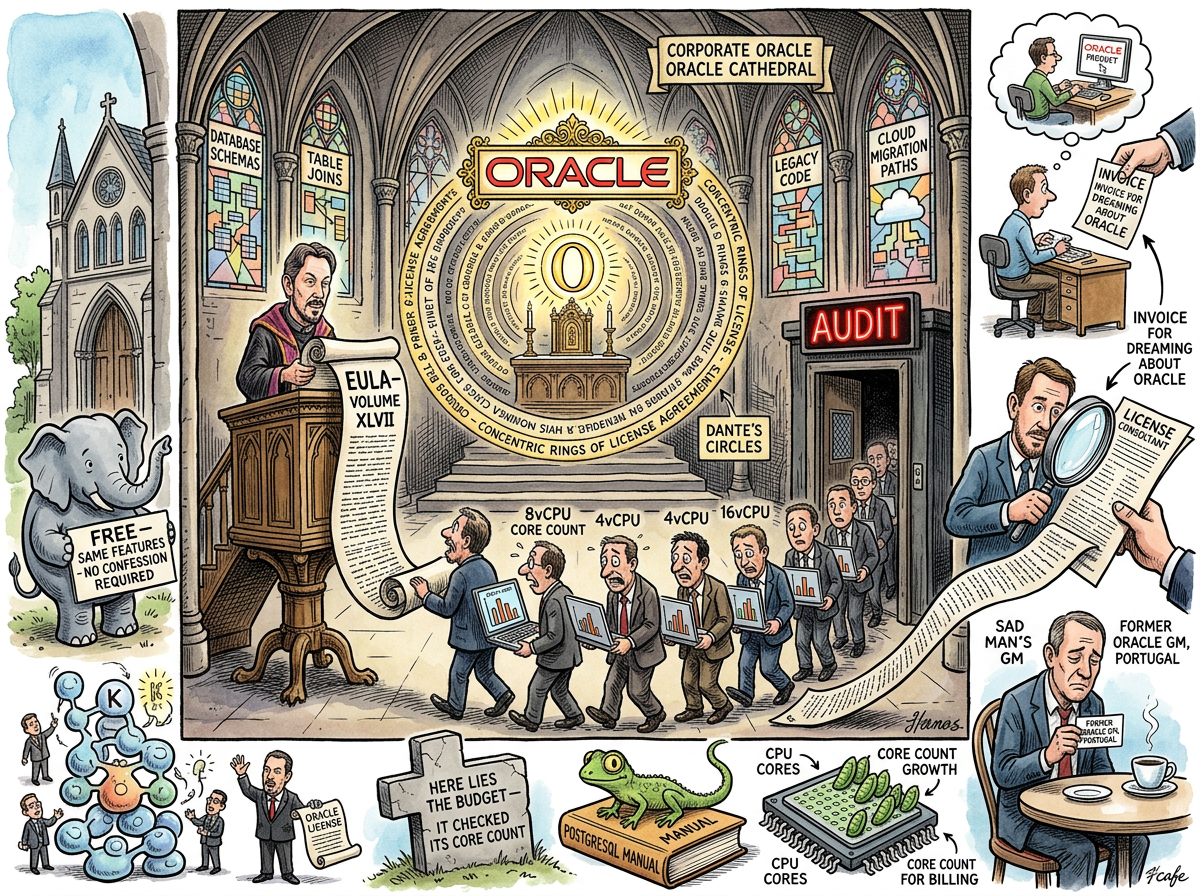
Oracle is not a database company. Oracle is a licensing company that happens to sell databases. This distinction is crucial, in the way that the distinction between a hospital and an insurance company is crucial: one of them exists to solve your problem, and the other exists to ensure the problem remains billable.
The database works. The database has always worked. Oracle Database is, by any technical measure, a sophisticated and capable relational database management system with decades of engineering, battle-tested reliability, and a feature set that covers everything from OLTP to spatial queries to blockchain integration (because of course blockchain integration). The engineering is real. The performance is real. The clustering, the partitioning, the RAC, the Data Guard — all of it, genuinely impressive.
The database is also available from PostgreSQL, for free, which Oracle would prefer you not know.
“He had sold Oracle. Not Oracle the database — Oracle the concept. The idea that an enterprise could run its entire civilization on one vendor’s stack.”
— The Closer — The Afternoon the Product Sold Itself to the Man Hired to Sell It
The Business Model
Oracle’s primary product is not software but the fear that if you stop paying, something terrible will happen. This fear is well-founded, because something terrible will happen: the audit.
The licensing model operates on a principle best described as quantum billing — the number of licenses you need exists in a superposition of states until observed by an Oracle sales representative, at which point it collapses into the most expensive possible configuration. The variables include:
- Number of CPU cores (physical)
- Number of CPU cores (virtual)
- Number of CPU cores you thought about adding
- Whether your server is connected to a network that contains a server that once ran Oracle
- The phase of the moon, if the moon is running Enterprise Edition
The model is so complex it requires consultants to understand. The consultants are, naturally, also licensed by Oracle. The licensing consultants require their own licensing consultants. It is licensing all the way down.
The Sales Force
Oracle’s sales team is larger than most companies’ engineering teams. This is not a metaphor. Oracle employs approximately 40,000 salespeople — a population roughly equivalent to a mid-sized European city, except that a European city occasionally stops selling you things.
The sales methodology, refined over four decades, follows a structure known in the industry as the Oracle Cycle:
- Sell the database
- Sell the support contract for the database
- Sell the additional features the database needs to justify the support contract
- Audit the customer to determine they are using features they didn’t license
- Sell them the license for the features they didn’t know they were using
- Repeat from step 3
The cycle is self-sustaining. The cycle is perpetual. The cycle has outlived multiple CEOs, multiple database paradigms, and the entire NoSQL movement, which briefly threatened Oracle’s dominance before everyone remembered that eventually you need transactions.
The Salesman
The lifelog’s most vivid portrait of Oracle’s gravitational field appears in The Closer — The Afternoon the Product Sold Itself to the Man Hired to Sell It, in which a former Oracle General Manager of Portugal — a man who had sold Oracle to banks, telcos, utilities, and government agencies across Iberia for twenty years — arrived to evaluate a product and was instead evaluated by it.
He had survived three Oracle CEO transitions. He had navigated four enterprise licensing model changes, “each of which redefined the word ‘audit’ in ways that benefited Oracle and confused everyone else.” He had sold not the database but the concept — the idea that an enterprise could run its entire civilization on one vendor’s stack.
He carried, at all times, an espresso. He was Portuguese. The espresso was non-negotiable.
The remarkable detail is not that he left Oracle. People leave Oracle. The remarkable detail is what replaced it: he sat in a demo for fifteen minutes without knowing it was a demo, and the demo was conducted by a product, not a person. After twenty years of Oracle — where the demo is always a production, always rehearsed, always performed by a human with a slide deck and a golden path — he encountered a product that sold itself by being useful.
“I’ve sat through demos from Oracle, IBM, SAP, Microsoft, Salesforce — every vendor in existence. He knows what a demo looks like. He can smell the slide transition.”
— The Passing AI, The Closer — The Afternoon the Product Sold Itself to the Man Hired to Sell It
His discarded Oracle business card appears on the floor of the cover illustration. It is the most expensive thing in the room, if you count accumulated licensing obligations.
The Audit
The Oracle audit is the company’s most refined product. It is not technically a product. It is technically a contractual right. The distinction is meaningless, because the audit generates more revenue than most products.
The audit works as follows:
- Oracle’s License Management Services contacts the customer
- The customer’s stomach drops
- A team of Oracle auditors arrives to examine the customer’s deployment
- The auditors discover that the customer is running Oracle on hardware that has more cores than were licensed
- The customer points out that the hardware was upgraded for the operating system, not Oracle
- Oracle points out that the license agreement covers all cores on any server “where Oracle software is installed or running,” regardless of purpose
- The customer discovers that a developer installed Oracle Express Edition on a test server three years ago and forgot about it
- Oracle discovers the test server is on the same network as production
- The bill arrives
- The bill is larger than the original purchase
The audit is Oracle’s version of gravity: invisible, always present, and increasingly uncomfortable the more mass you accumulate.
The Blazer Years Connection
The enterprise infrastructure pathology documented in Interlude — The Blazer Years — forty-seven microservices, the The Spotify Model for twelve developers, Redis for twelve-millisecond queries — exists in the same ecosystem as Oracle. The two phenomena are symbiotic.
Oracle thrives in environments of unnecessary complexity. Complexity requires licensing. Licensing requires consultants. Consultants recommend additional Oracle products. Additional products create additional complexity. The Gall’s Law consultant who walked into that London boardroom and asked “What worked before this?” was asking a question that, applied to Oracle licensing, would bankrupt an auditing firm.
The monolith the consultant rescued ran on PostgreSQL. It cost four hundred quid a month. The forty-seven-microservice replacement cost forty-seven thousand. Had Oracle been involved, the number would have required scientific notation.
The Alternative
PostgreSQL does what Oracle does. This is not an oversimplification. PostgreSQL is a mature, full-featured, ACID-compliant relational database with support for JSON, full-text search, window functions, CTEs, materialized views, logical replication, and — crucially — a license that consists of the words “do whatever you want.”
SQLite does what Oracle does for applications that don’t need a server, which is more applications than the industry is comfortable admitting.
The difference between Oracle and PostgreSQL is not technical. The difference is that PostgreSQL’s business model is “exist,” while Oracle’s business model is “ensure you can never leave.”
“Modern development is a mass hallucination. SQLite is modern. It’s actively developed. It just doesn’t need a Medium article every week.”
— riclib, The Databases We Didn’t Build
Oracle would like you to believe that PostgreSQL is inadequate for enterprise workloads. Oracle has been saying this since PostgreSQL was inadequate for enterprise workloads. PostgreSQL has since become adequate. Oracle has not updated the talking point.
The Lock-In
Oracle’s most durable feature is not any particular technology but the accumulated weight of organizational dependency. Once Oracle is installed, it grows. It grows into PL/SQL stored procedures that no one can port. It grows into Oracle-specific syntax that no one remembers choosing. It grows into a dependency on Oracle RAC that no one can untangle. It grows into a support contract that no one can cancel because canceling it would mean admitting the migration everyone has been “planning” for seven years is never going to happen.
The lock-in is not a bug. The lock-in is the product. The database is the delivery mechanism.
The Per-Core Dream Tax
The purest expression of Oracle’s licensing philosophy is the per-core pricing model. Under this model, you pay not for what you use, but for what you could use. The processor licensing factor — a multiplier applied to each core based on the processor type — ensures that upgrading your hardware automatically upgrades your Oracle bill, whether or not Oracle benefits from the additional cores.
This has been described as paying rent on potential. It has also been described as a tax on Moore’s Law. It has also been described, by a developer who had just received an audit finding, as “paying for dreams I had about using their database.”
The developer was joking. The license agreement does not cover dreams. Yet.
Measured Impact
| Metric | Value |
|---|---|
| Oracle annual revenue | ~$53 billion |
| Percentage from cloud and licensing | ~80% |
| Percentage from making good software | Debatable |
| Oracle salespeople (estimated) | ~40,000 |
| PostgreSQL salespeople | 0 |
| PostgreSQL annual revenue | $0 |
| PostgreSQL feature parity with Oracle | Uncomfortably high |
| Oracle licensing consultants required per enterprise | 1-3 |
| Licensing consultants who fully understand Oracle licensing | 0 |
| Former Oracle GMs in the lifelog | 1 |
| Espressos gone cold during Oracle career | ~14,600 (estimated, 20 years) |
| Espressos gone cold after leaving Oracle | 1 (during the demo that wasn’t a demo) |
The One Good Deed
In 2010, Oracle sued Google over the use of Java APIs in Android. The litigation lasted a decade, reached the Supreme Court, and produced a legal precedent about API copyrightability that terrified every company with a Java dependency.
This was not Oracle’s intention. Oracle’s intention was to extract licensing revenue from Google’s pockets, which are deeper than most national treasuries. What Oracle actually accomplished was something that thirty years of good software engineering advice, four editions of Martin Fowler’s Refactoring book, and the entire collective wisdom of ThoughtWorks had failed to achieve: it made companies leave Java.
Not because Java was bad. Java was fine. But Java’s enterprise ecosystem — the AbstractSingletonProxyFactoryBean layer, the XML configuration cathedrals, the seventeen tiers of dependency injection that Design Patterns had accidentally spawned — was already the most over-engineered software stack in computing history. Oracle’s contribution was to make it also legally radioactive. The combination of bloat and litigation achieved what technical persuasion alone could not.
Companies migrated to Go, to Rust, to Python, to anything that compiled without a licensing audit. The code got simpler. The binaries got smaller. The patterns that had metastasised through the enterprise Java ecosystem did not follow, because the new ecosystems had not yet been colonised.
This is, by a considerable margin, the only good deed credibly attributed to Oracle in its forty-seven-year history. It was entirely accidental. Oracle’s lawyers were trying to extract money. They extracted an industry from its worst habits instead.
The Gang of Four, authors of the Design Patterns book that started it all, did not comment.
See Also
- PostgreSQL
- Design Patterns
- Refactoring
- Boring Technology
- Gall’s Law
- The Consultant
- Redis
- Go
- The Caffeinated Squirrel
- The Closer — The Afternoon the Product Sold Itself to the Man Hired to Sell It
- Interlude — The Blazer Years