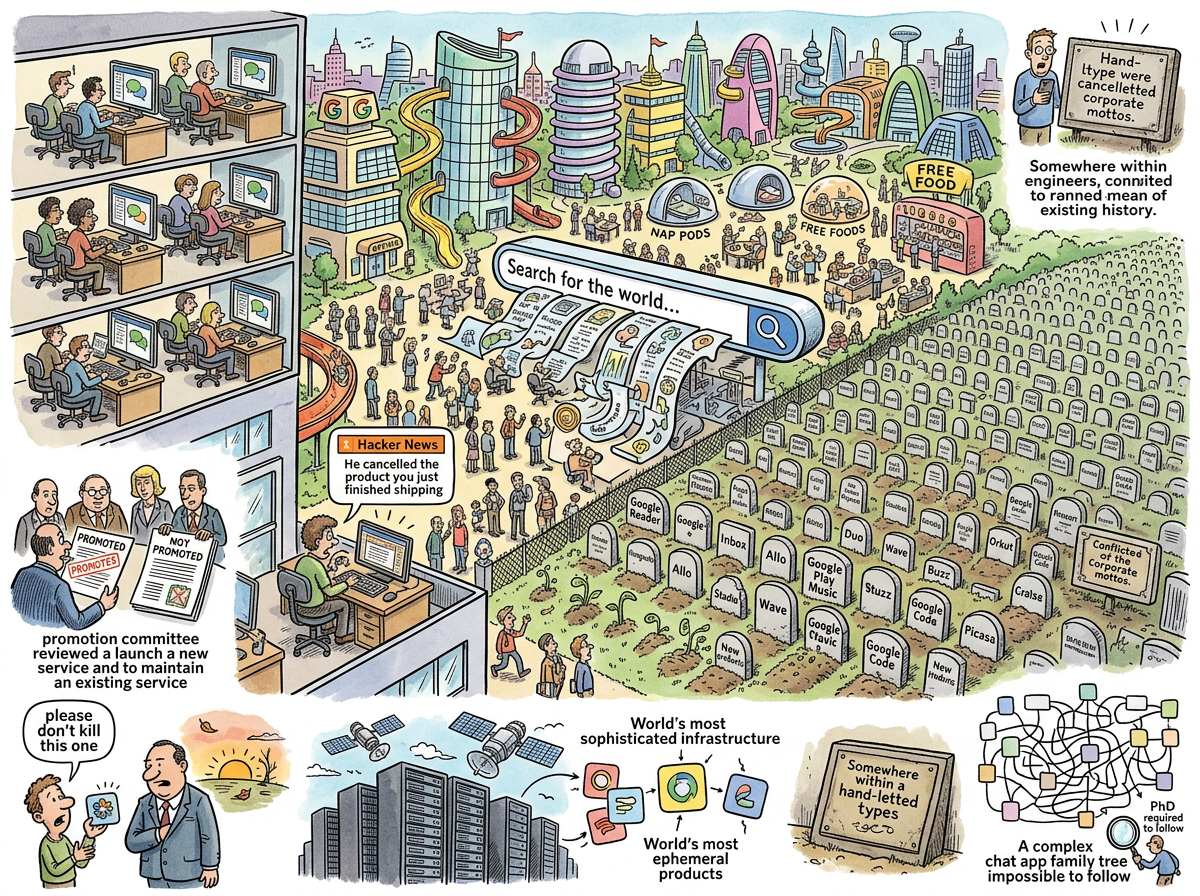
Google is a technology company that solved search, won the internet, built the most sophisticated computing infrastructure in human history, and then spent the next two decades launching products, watching people love them, and killing them — a pattern so consistent that it constitutes either a corporate strategy or a clinical condition.
Google’s core business — search and advertising — generates approximately $300 billion in annual revenue and works flawlessly. Everything else Google does is a product launch followed by a product funeral, with a brief period of user attachment in between that Google interprets as insufficient traction and users interpret as betrayal.
“The best software is the software that exists tomorrow. At Google, this is not guaranteed.”
The Graveyard
Google has killed over 290 products. Not failed experiments. Not quiet sunsets of unused features. Products that people loved:
- Google Reader (2005–2013) — the RSS reader whose death radicalised an entire generation of internet users and is still mentioned with grief a decade later
- Inbox by Gmail (2014–2019) — the email client so good that Google killed it and spent five years failing to add its features to Gmail
- Google Play Music (2011–2020) — replaced by YouTube Music, which was worse in every measurable way
- Hangouts (2013–2022) — replaced by Chat, Meet, Duo, Allo, and eventually just Chat and Meet, after Duo was merged into Meet, except when it wasn’t
- Google+ (2011–2019) — the social network that Google forced into every product and that nobody used, not because it was bad but because Google’s attempt to mandate social interaction had the warmth of a terms-of-service update
- Stadia (2019–2023) — the cloud gaming platform that worked remarkably well and was killed anyway, teaching users that Google’s technical capability and Google’s commitment to products are unrelated variables
The graveyard exists because of Google’s promotion structure: launching a new product is promoted. Maintaining an existing product is not. The incentive is to launch, not to sustain. The result is an organisation that is extraordinarily good at building things and constitutionally incapable of keeping them.
The Messaging Problem
Google’s approach to messaging is a case study in Conway’s Law — the organisation’s structure producing a communication architecture that mirrors its own communication failures:
2005: Google Talk         ← worked fine
2013: Hangouts            ← replaced Talk, worked fine
2016: Allo               ← messaging app #2
2016: Duo                ← video app (why separate from Allo?)
2017: Meet               ← enterprise video (why separate from Duo?)
2018: Chat               ← enterprise messaging (why separate from Hangouts?)
2019: Allo killed
2022: Hangouts killed
2022: Duo merged into Meet (or Meet merged into Duo?)
2024: Chat and Meet       ← we think
At various points, Google had four simultaneous messaging products competing with each other internally. The company that organises the world’s information could not organise its own chat apps.
Apple has iMessage. It has had iMessage since 2011. It works. Google has had twelve messaging products in the same period and none of them are iMessage. The constraint is not technical. Google’s infrastructure could build an iMessage competitor in a quarter. The constraint is organisational: no single team owns messaging, because owning messaging means maintaining messaging, and maintaining things doesn’t get you promoted.
The Infrastructure Paradox
Google’s infrastructure is genuinely extraordinary:
- Spanner — a globally distributed database with external consistency
- Borg/Kubernetes — the container orchestration system that runs the internet
- TensorFlow/JAX — machine learning frameworks used worldwide
- MapReduce/BigQuery — data processing at planetary scale
- Colossus — the distributed filesystem that stores the index of the internet
This infrastructure is so good that it created an industry. Kubernetes alone — Google’s gift to the open-source world — runs a significant percentage of all cloud workloads on Earth.
The paradox: the company that built the infrastructure capable of running anything uses it to run products for an average of 4.2 years before killing them. The platform is immortal. The products are mortal. The infrastructure is the cathedral. The products are the scaffolding — erected, used briefly, and removed.
Twenty Percent Time
Google famously allowed engineers to spend 20% of their time on personal projects. Gmail, Google News, and AdSense were born from 20% time. The policy was Google at its best: trust engineers, let them explore, ship what works.
The policy is now largely mythological. Engineers report that 20% time is “120% time” — personal projects done on top of full workloads. The permission exists. The time does not.
This mirrors Google’s broader trajectory: a company that began by trusting engineers and incrementally replaced trust with process, metrics, and promotion committees. The startup that indexed the web from a garage became the enterprise that requires a six-page design document to change a button. The condition is not unique to Google. It is Enterprise. Google is simply the most visible example because it happened to the company that was supposed to be different.
Measured Characteristics
Year founded:                                1998
Annual revenue:                              ~$300 billion
Products killed:                             290+
Products users are still grieving:           Google Reader (2013)
Messaging apps launched:                     12+
Messaging apps currently surviving:          2 (we think)
Years of iMessage:                           13 (and counting)
Infrastructure quality:                      extraordinary
Product commitment:                          variable
Average product lifespan:                    ~4 years
Promotion criteria (launch):                 promoted
Promotion criteria (maintain):               not promoted
Engineers doing "20% time":                  20% (of the original 20%)
Search market share:                         ~90%
Confidence that Search will exist tomorrow:  100%
Confidence that any other Google product will: <100%