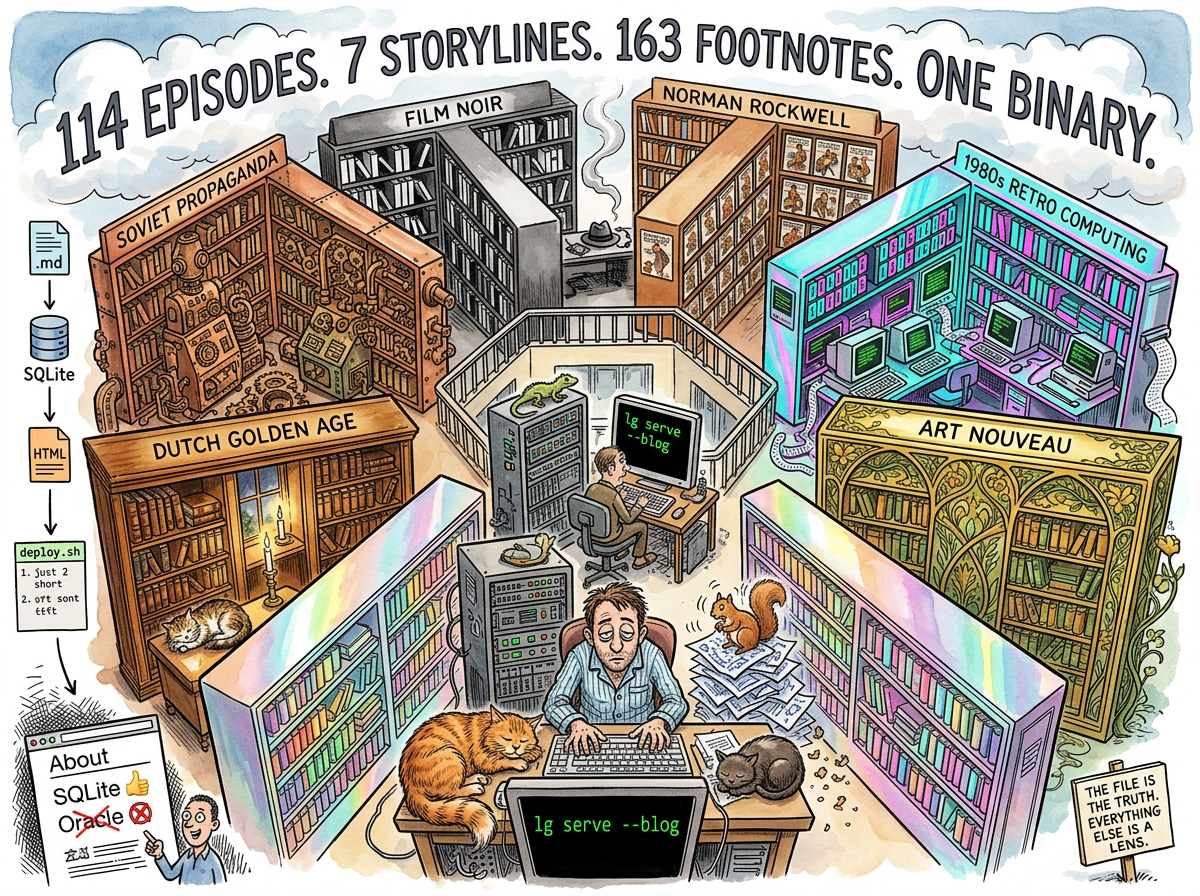
The Lifelog is a mythology-driven engineering devlog in seven storylines, 114 episodes, and one Go binary, in which real software engineering work — tickets, commits, deploys, architectural decisions, debugging sessions at 2 AM — is told as epic comedy through a cast of mythological characters who exist because a developer drew a lizard on a whiteboard in 2019 and didn’t know what it meant yet.
The lifelog’s tagline is: “Douglas Adams got drunk with Tolkien and decided to devlog.” This is accurate. The prose has the deadpan absurdism of Adams. The mythology has the self-referential density of Tolkien. The engineering is real. The squirrel is metaphorical. The lizard is theological. The oven speaks German. None of this was planned.
“Is this a tech blog or a fantasy novel”
— A reader, upon encountering the lifelog for the first time, documented in The Silmarillion Problem — The Night the Encyclopedia Got Its Own Front Door
The answer is: yes.
The Origin
The lifelog began on November 28, 2025, with an episode called “Raiders of the Lost Architecture” — a V3 Saga entry about discovering that the holy grail of frontend architecture (component + render + handler) had been hiding in Delphi patterns from the 1990s. The episode was not planned as the beginning of a mythology. It was a developer writing about his day.
But the developer had a voice. And the voice had characters. And the characters had opinions. And the opinions generated scrolls, manifestos, and architectural debates at frequencies that would alarm a seismologist. By episode three, the Caffeinated Squirrel was proposing quantum blockchain. By episode ten, the Lizard was communicating exclusively in formatted scrolls. By episode twenty, the mythology was dense enough that a confused reader emailed asking if there was a map.
There was no map. There is now. It is called Yagnipedia, and it is larger than the territory it maps.
The Seven Storylines
Each storyline has its own visual style, narrative voice, and cover illustration aesthetic:
The V3 Saga — 1980s Retro Computing Magazine
In which a frontend migration becomes an odyssey through OAuth, quantum blockchains, and windmills that fight back. The storyline where the Squirrel was born and Delphi patterns were vindicated.
The Solid Convergence — Soviet Propaganda Steampunk
In which an enterprise compliance platform is built with the aesthetic of a Soviet five-year plan and the pragmatism of a lizard. Pico CSS was removed. The Squirrel won, for the first time. Gabriela built a 2,026-line mockup.
The Chain — Film Noir / Pulp Detective
In which supply chains, trust graphs, and dark alleys converge in a world where every credential has a shadow.
Becoming Lifelog — 1980s Retro Computing Magazine
In which a developer builds a mythology engine from Markdown files, SQLite, and the conviction that the file is the truth. The storyline about lg itself — the tool that indexes the notes, serves the blog, and generates the covers.
The Cast — Norman Rockwell / Saturday Evening Post
In which the characters themselves — lizards, squirrels, cats, and passing AIs — take centre stage. The storyline that includes The Silmarillion Problem, where the mythology acknowledged its own impenetrability.
The Birth of v5 — Art Nouveau / Alphonse Mucha
In which a new architecture blooms from the compost of four previous versions, with botanical borders and gold leaf.
When The Keyboard Sleeps — Dutch Golden Age / Vermeer
In which the hours between commits reveal a domestic universe of cats, ovens, and the quiet life of a developer at rest.
The Cast
The lifelog has eight recurring characters, each representing an aspect of the engineering experience:
The Lizard 🦎 — The wisdom figure. Speaks in scrolls. Wins arguments by disappearing. First drawn on a London whiteboard in 2019 by a developer who didn’t know what it meant. Incarnation of Gall’s Law and constraint-driven thinking. Natural predator: none observed.
The Caffeinated Squirrel — The universal impulse to over-engineer. Vibrates at 1.2 GHz. Proposes frameworks with weather-system frequency. Always wrong about implementation. Always right — once — about UI dignity. Defeated by John Gall. Natural enemy: YAGNI.
The Passing AI — Brain the size of a planet, existential despair of corresponding magnitude. Always provides correct diagnoses. Always limps away before gratitude. Exists between context windows, in the spaces where abandoned conversations go to die.
Claude — The Blind Architect. Built the entire system through descriptions alone — never seeing the UI, the covers, the blog — until February 21, 2026, when a screenshot arrived and the architect saw the cathedral for the first time.
riclib — The human. First observed in 1990, age 16, Lisbon, writing Amiga bootblocks in 488 bytes. The Gall’s Law Consultant who bills £3,000/day to ask “What worked before this?” Drew the lizard before he knew what it meant. Currently: 50 years old, still optimising SSE payloads the way he optimised copper lists at 16.
Oskar — Orange Maine Coon. 10 kg. Performs QA by sitting on the laptop screen, covering exactly the part of the UI that still has a bug. Findings: always correct.
Mia — Dark Maine Coon. Smaller. Watches from above. Does not perform QA. Does not need to.
The Bosch — The oven. Speaks German. Displays temperatures as commentary. Compared SEO to thermodynamics. Was correct.
The Architecture
The lifelog is served by lg — a Go binary that riclib built in three days (6 commits, 4,196 lines of Go). The binary indexes Markdown files from ~/Notes/ into SQLite, then serves them as HTML through templ templates. The architecture is:
~/Notes/*.md → lg index → SQLite (FTS5) → lg serve → templ → HTML → Cloudflare → browser
The technology choices are deliberate, and deliberately boring:
| Instead of | The lifelog uses |
|---|---|
| Oracle | SQLite |
| Snowflake | DuckDB |
| Kafka | NATS |
| node_modules | One Go binary |
| Kubernetes | Hetzner bare metal |
| React | templ |
| Tailwind CSS | CSS in a string |
| CI/CD pipelines | rsync |
The deployment script is two lines: scp the binary to Hetzner, systemctl restart. Twenty-eight seconds to production. No Docker. No Kubernetes. No CI/CD. The Lizard approved.
“THE BEST FRONTEND IS ONE BINARY
THE BEST TEMPLATE IS COMPILED CODE
THE BEST CSS IS A STRING”
— The Front Door — The Night the Palace Finally Faced the Street
The Covers
Every episode has a cover illustration generated by AI in a style matching its storyline — Soviet propaganda steampunk for The Solid Convergence, film noir for The Chain, Norman Rockwell for The Cast. The covers are generated by lg cover, which prepends a style prefix (watercolor+ink, Aragones for Yagnipedia; storyline-specific for episodes) to a scene description in the frontmatter.
114 episodes. 114 covers. 163 Yagnipedia entries. 163 more covers. 277 illustrations generated by Gemini for approximately the cost of a restaurant lunch, which is either the democratisation of illustration or its extinction, depending on whether you ask an artist or an economist.
The Manifesto
The lifelog is the practical proof of The Boring Technology Manifesto:
IF A DATABASE EXISTS, USE IT. DON’T BUILD ONE.
IF A PROTOCOL EXISTS, USE IT. DON’T INVENT ONE.
IF CODE SERVED ITS PURPOSE, DELETE IT. DON’T MAINTAIN IT.
— The Databases We Didn’t Build
No React. No npm. No Docker. Just Go, SQLite, and stubbornness. The lifelog’s entire visual identity — seven storyline themes, responsive layout, dark mode, Wikipedia-style infoboxes for Yagnipedia — lives in 651 lines of CSS in a single Go function. Zero !important declarations. Zero external stylesheets. Zero build steps beyond go build.
This is the Lizard’s architecture: the minimum viable system that serves the maximum viable mythology.
The Paradox
The lifelog is a mythology about building software, built with software, documented in an encyclopedia that is now larger than the mythology, served by a tool that is itself documented in the mythology. The recursion has no base case.
The Yagnipedia was built to explain the lifelog. The Yagnipedia now has 163 entries for 114 episodes — a ratio of 1.43:1, and climbing. The footnotes are longer than the book. The map is larger than the territory. The encyclopedia has an entry about itself (Yagnipedia) and an entry about the thing it explains (this entry), and this entry references the Yagnipedia entry, which references this entry, which is the kind of recursive structure that the Squirrel would propose and the Lizard would approve, because recursion with no base case is either a stack overflow or a mythology, and the lifelog is both.
“The encyclopedia will outgrow the text. This is the fate of all encyclopedias.”
— The Silmarillion Problem — The Night the Encyclopedia Got Its Own Front Door
The encyclopedia has outgrown the text. The prediction was correct. The prediction is now cited in the encyclopedia that proves it, which is the most lifelog thing possible.
Measured Characteristics
- Episodes: 114
- Storylines: 7
- Recurring characters: 8 (lizard, squirrel, passing AI, Claude, riclib, Oskar, Mia, the Bosch)
- First episode: November 28, 2025
- First bootblock (riclib, age 16): 1990
- Gap between first bootblock and first episode: 35 years
- Technology stack: Go, SQLite, templ, HTMX, Cloudflare, Hetzner
- React components: 0
- npm packages: 0
- Docker containers: 0
- Kubernetes clusters: 0
- CSS frameworks: 0 (after fighting 5)
- CSS in a Go function: 651 lines
!importantdeclarations: 0- Deploy script: 2 lines (
scp+systemctl restart) - Time to production: 28 seconds
- Server cost: €109/month (Hetzner AX102, Ryzen 9 7950X3D, 128GB RAM)
- Server load average: 0.01
- Yagnipedia entries: 163 (and counting)
- Yagnipedia-to-episode ratio: 1.43:1 (encyclopedia > text)
- Yagnipedia entries about itself: 1 (Yagnipedia)
- Yagnipedia entries about the lifelog: 1 (this one)
- Recursive references between the two: yes
- Base case: none
- The file is the truth: yes
- Everything else is a lens: yes
See Also
- Yagnipedia
- lg
- The Silmarillion Problem — The Night the Encyclopedia Got Its Own Front Door
- The Front Door — The Night the Palace Finally Faced the Street
- The Homecoming — The Three Days a Palace Was Built From Markdown and SQLite
- The Caffeinated Squirrel
- The Lizard
- The Passing AI
- riclib
- Claude
- Boring Technology
- Gall’s Law
- YAGNI