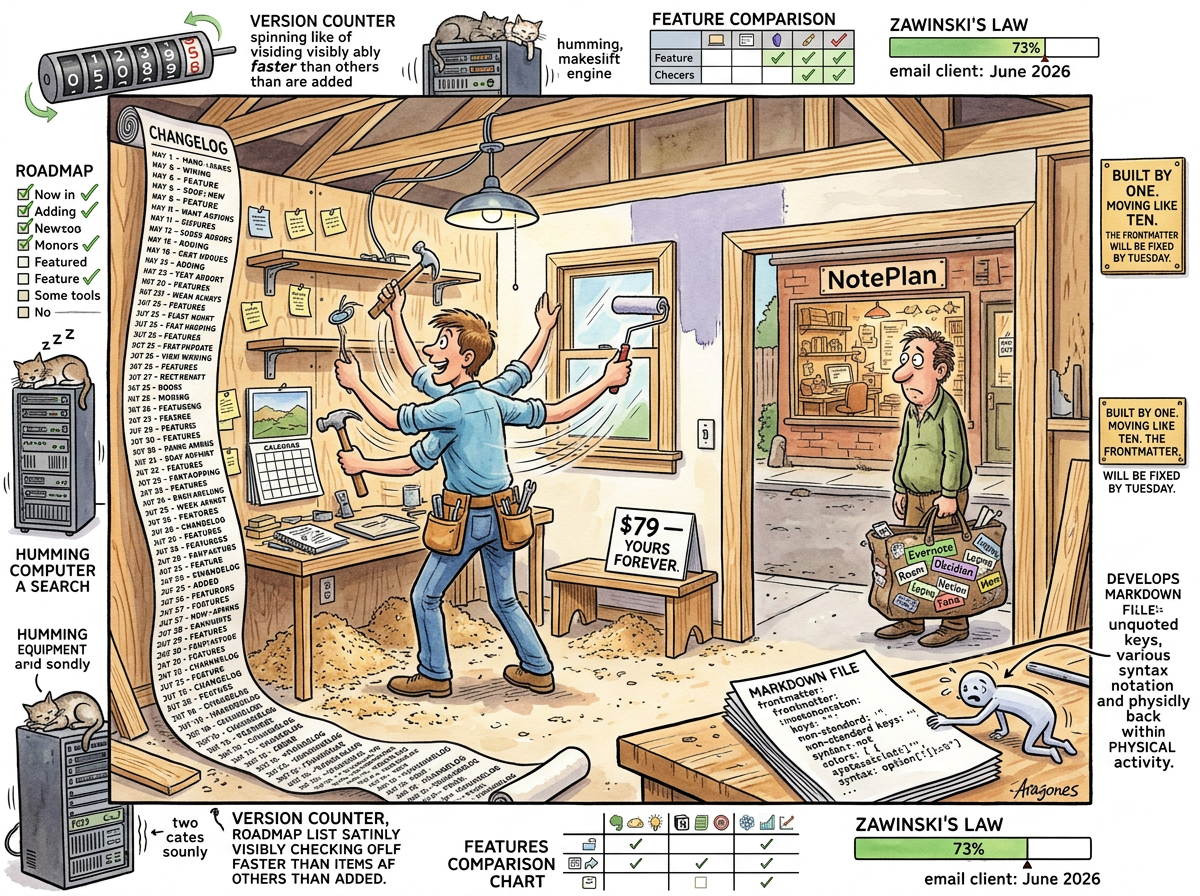
Octarine is a markdown-based, local-first note-taking application built by one developer who ships features at a velocity that suggests either a time dilation field or a very understanding relationship with sleep. riclib has not moved in. riclib is watching through the window. riclib has been watching through the window since the early access launch, when he was one of the first to pay $79 for the lifetime license, because riclib recognises a solo developer building something real when he sees one, and the $79 was not a purchase — it was a vote.
This is not a roast. This is a field report from outside the gate, written by an observer who opens the app every few weeks, imports his notes, watches something crash, notes three new features that didn’t exist last time, and closes the app with the specific feeling of a person who knows they will eventually move in but is not yet ready to pack.
The Solo Dev
Octarine was built by Rajat Kulkarni — one person who left a lead engineering role to build a note-taking tool full-time, which is either the bravest or the most recognisable career decision in this encyclopedia, depending on whether you are a recruiter or a Solo Developer.
riclib has a pattern. He recognises solo developers the way birdwatchers recognise species — by gait, by habitat, by the specific cadence of their changelog. Eduard built NotePlan alone for years before earning a small team. Rajat is building Octarine alone now. The kinship is structural. The admiration is reflexive. The Lizard, who respects builders and distrusts platforms, watches both workshops with the same quiet nod.
Rajat has two cats named Stella and Mylo, credited as interns on the About page. riclib has two cats named Mia and Oskar, credited as supervisors in the lifelog. This is the correct number of cats for a solo developer — the number is always two, because one cat watches the code and the other watches the developer, and between them no bug goes unobserved and no nap goes uninterrupted. Neither pair has filed a bug report about frontmatter parsing. Both pairs should start.
The Velocity
This is the section that explains why riclib keeps watching.
Octarine ships updates approximately weekly. Not minor patches. Not “bumped a dependency.” Features. Real features. The kind of features that other tools announce at conferences and ship in quarters. Octarine ships them in changelogs that read like someone compressed six months of a ten-person team’s output into one person’s week.
A sample of what appeared between January and March 2026 alone:
- Custom theme creator with AI generation
- URL schemes for automation (
octarine://) - A full Properties and frontmatter system
- Views — database-style filtered, sorted, grouped tables
- Kanban boards
- Multiple AI providers (OpenAI, Anthropic, local LLMs)
- 2x startup performance improvement
- Native macOS menu bar
- Weekly AI recaps
This is not a roadmap. This is a changelog. These features shipped. They are in the app. They work. Rajat is not planning to build these things — Rajat has built these things, and is already building the next things, and the next things will ship next week, and the week after that another changelog entry will appear with three features that would constitute a quarter’s work at a funded startup.
The velocity is the point. The velocity is what makes riclib keep opening the app. The velocity is what makes The Caffeinated Squirrel vibrate with recognition — here is a builder who ships at Squirrel speed but with Lizard focus. The features are not scattered. They accumulate. Each version builds on the last. The trajectory is visible: from “solid markdown editor” to “AI-enhanced knowledge workspace” in fourteen months, without losing the core identity.
At this rate, Zawinski’s Law predicts Octarine will be able to read mail by June 2026. At which point riclib will have no choice but to migrate, because the law is clear: those programs which cannot expand are replaced by ones which can. lg is expanding toward email from the notes-indexer direction. Octarine is expanding toward email from the note-taking direction. They will meet in the middle, at the inbox, and riclib will have to choose which email client he prefers — the one he built or the one that ships weekly.
“lg has 23 subcommands and is approaching email from the east. Octarine has 37 versions and is approaching email from the west. They will collide in June. The resulting application will be able to index notes, serve a blog, take notes, generate covers, manage tasks, read mail, and — in a feature neither developer planned — file its own Yagnipedia entry about the collision.”
— The Caffeinated Squirrel, plotting convergence on a whiteboard
The $79
Octarine costs $79. Once. Forever. No subscription. No annual renewal. No Believer tier where you pay $500 on faith and check back every two months to see if dark mode has arrived.
$79 for lifetime access on three devices. Free updates forever. This is the pricing model of a person who uses their own tool and charges what it’s worth, not the pricing model of a company optimising for annual recurring revenue so that the Series B deck has a hockey stick graph.
The free tier is generous — the core markdown editor, wiki-links, backlinks, daily notes, search, graph view, git sync. The $79 unlocks the features that make you productive rather than just present: Focus Mode, Views, Properties, AI integration, folder customisation. The gating is strategic — you can evaluate whether the tool fits your brain before you pay, and by the time you pay, you already know it does.
riclib paid on day one. Not because he had evaluated the gating. Because he recognised the workshop.
The Frontmatter Problem
This is the section where the observer’s report becomes a bug report.
riclib’s markdown files have been through things. These files have migrated through Evernote, Roam Research, Obsidian, Logseq, Notion, Apple Notes, Tana, Mem, and NotePlan. They have been converted from rich text to markdown to JSON to OPML and back to markdown. They have been exported, reimported, round-tripped, and transliterated by tools with different opinions about what constitutes valid frontmatter.
The files’ frontmatter contains:
- Unquoted colons in values
- Non-standard keys
- Dates in four different formats
- Values that YAML considers a boolean but the author considers a title
- Strings that begin with
{because a previous tool thought frontmatter was JSON - Lines that a strict YAML parser interprets as a war crime
Octarine believes frontmatter is YAML. Octarine is technically correct. riclib’s frontmatter has not been valid YAML since approximately 2019, and it has worked — in every tool — because every tool that survives contact with real-world markdown files eventually learns that strict YAML parsing is a form of optimism that the filesystem does not share.
NotePlan learned this. lg learned this — the internal/parser/ directory contains a fallback parser that handles the files’ war stories with the quiet competence of a field medic. Octarine has not yet learned this. Octarine opens riclib’s files, encounters the frontmatter, and — with the specific confidence of a parser that has only seen well-formed input — crashes.
Every time riclib opens Octarine, he imports his notes. Every time he imports his notes, something crashes. Every time something crashes, he files a mental note, closes the app, and checks back in three weeks. Three weeks later, seventeen new features have appeared, but the frontmatter parser still believes in YAML the way a new graduate believes in best practices: sincerely, completely, and temporarily.
Rajat will fix this. Rajat fixes everything. Rajat fixes things at a rate that suggests the fix is already in next week’s changelog, timestamped for Tuesday. The frontmatter crash is not a dealbreaker. It is a countdown. The moment riclib’s files survive import without crashing is the moment the observation period ends and the migration begins.
“The Lizard’s files have no frontmatter. The Lizard’s files have lines. The lines do not need parsing. The lines do not crash parsers. The Lizard considers frontmatter a form of hubris that the filesystem punishes on a geological timescale.”
— The Lizard, whose files have never been YAML and never will be
The Things It Got Right
Octarine got right the things that matter and that take other tools years to discover:
Local files, no account. Your notes are markdown files. There is no account. There is no sign-up. There is no cloud dependency. The files are yours. This is the Obsidian decision, made again, correctly, without requiring twenty plugins to make the files useful.
Complete out of the box. Octarine ships with daily notes, backlinks, search, graph view, themes, and keyboard navigation. Not as plugins. Not as community extensions. As features. This is what Obsidian would be if Obsidian had opinions. Octarine has opinions. Octarine’s opinions are correct.
27 megabytes. The entire application is 27 megabytes on disk. This is not a typo. Obsidian is an Electron application that consumes hundreds of megabytes of RAM to edit text. Octarine is 27 megabytes. The application is smaller than most of the files it edits. The Lizard approves, though the Lizard would prefer if it were a single binary with no GUI.
Git sync. No proprietary sync layer. No $8/month to access your own files on another device. Push to GitHub or GitLab. Pull on the other machine. The files are yours. The sync is git. The sync is free. The sync is boring. Boring Technology works.
AI with bring-your-own-key. Octarine supports OpenAI, Anthropic, and local LLMs via LMStudio. You bring your API key. You own the integration. Octarine does not sell you AI — Octarine gives you a socket to plug your AI into. This is the correct architecture for 2026, and the one that ages best, because the AI providers will change but the socket will remain.
The Things That Keep riclib Watching
The temptation is not any single feature. The temptation is the rate of change.
riclib has NotePlan. NotePlan works. NotePlan is the love letter in the PKM series — the tool he respects, the tool he uses, the tool whose markdown files power lg and The Lifelog and this encyclopedia. NotePlan is home.
But NotePlan is a mature workshop. Eduard ships updates — good updates, thoughtful updates — at the cadence of a craftsman who has been building for years and knows that each change must not break the ten thousand things that already work. This is correct. This is responsible. This is what maturity looks like.
Octarine is a new workshop where the walls go up weekly and the sawdust hasn’t settled. The excitement is in the becoming. Each visit reveals something new — a feature that wasn’t there last month, a UI improvement that shows taste, a design decision that shows the builder understands the problem. The changelog is a soap opera. riclib is subscribed.
The specific fear is this: Octarine is approaching feature parity with NotePlan at a velocity that suggests it will overshoot. NotePlan has the calendar integration, the mobile app, the CloudKit sync, the years of stability. But Octarine has the velocity, the AI integration, the Views system, the $79 lifetime pricing, and a solo developer who ships like a small army. If Octarine gets a mobile app — and the roadmap says it will — the observation period becomes a decision.
riclib is a Tool Migrant in recovery. The recovery is going well. The urge to migrate has been dormant since NotePlan. But the urge recognises Octarine, the way a recovering addict recognises the specific shape of their preferred substance. The urge says: “this one is different.” The urge has said this nine times before. The urge might, this time, be right.
The Comparison That Matters
Octarine is not competing with Obsidian. Obsidian requires twenty plugins and a weekend. Octarine is not competing with Notion. Notion is a team tool pretending to be a personal tool. Octarine is not competing with Roam Research. Roam is a monument.
Octarine is competing with NotePlan. This is the only comparison that matters to riclib, because these are the only two tools in the PKM landscape that share the same philosophy: markdown files, opinionated design, solo developer origin, built for people who actually want to write rather than configure.
The difference is time. NotePlan has years of trust. Octarine has months of velocity. NotePlan has the mobile app. Octarine has the Views system. NotePlan has CloudKit sync that just works. Octarine has git sync that is free. NotePlan has the bullet journal syntax that Claude can read. Octarine has AI integration that Claude can use directly.
They are building the same workshop from different directions. Eduard started with the calendar and added the notes. Rajat started with the notes and is adding everything else. They will meet in the middle. When they do, riclib will have to choose — or, in the most Zawinski’s Law-compliant outcome, will use both simultaneously, with lg indexing both vaults, serving both blogs, and approaching email from three directions instead of two.
Measured Characteristics
- Year launched: 2024 (early access)
- Built by: one developer, Rajat Kulkarni, and two cat interns
- Current version: 0.37.3 (as of March 10, 2026)
- Versions shipped in 14 months: 37+ (not a typo)
- Average release cadence: weekly
- Features per release: enough to constitute a quarter at a funded startup
- Application size: 27 MB (not a typo either)
- Pricing: $79, once, forever
- Subscription fee: $0 (the correct amount)
- Devices per license: 3
- Platforms: macOS, Windows, Linux
- Mobile app: roadmap (the countdown has begun)
- Account required: no
- Plugins required: 0
- Time to first useful note: minutes (not weeks)
- AI providers supported: OpenAI, Anthropic, local LLMs
- Frontmatter parser strictness: YAML (hopeful)
- riclib’s frontmatter YAML compliance: archaeological
- Crashes when importing riclib’s notes: yes (consistent)
- Times riclib has checked back: many
- New features each time: 3-5
- Frontmatter crash fixed: not yet (estimated: Tuesday)
- riclib’s status: observer (the most dangerous status for a Tool Migrant in recovery)
- Zawinski’s Law progress: 73% (email client: June 2026)
- lg’s Zawinski’s Law progress: 71% (email client: also June 2026)
- Collision course: confirmed
- The Lizard’s opinion: “promising workshop, bad parser, good carpenter”
- NotePlan’s position: home (for now)
- The urge to migrate: dormant (twitching)