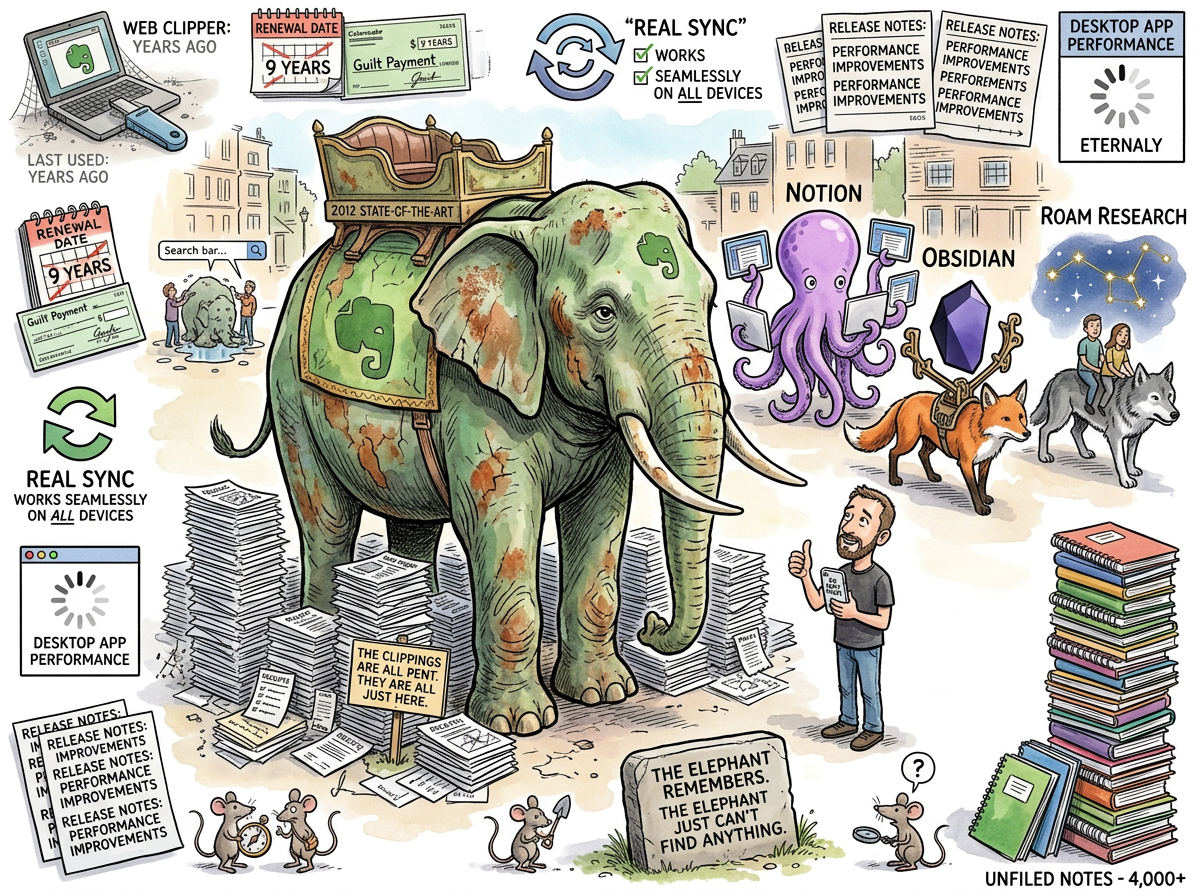
Evernote is the note-taking application that proved two things simultaneously: that people desperately wanted a digital place to put their thoughts, and that having a digital place to put your thoughts does not mean you will ever find them again.
Evernote was first. Not technically first — there were note-taking applications before 2008 — but culturally first. Evernote was the app that made “capture everything” a lifestyle. The web clipper. The document scanner. The handwriting recognition. The cross-platform sync that actually worked, on every device, without configuring a git repository, which in 2010 was not a given but a miracle.
The elephant remembered everything. The elephant just couldn’t find anything. And the elephant, over time, forgot how to run.
The Golden Age
This section is not ironic. Evernote’s golden age — roughly 2008 to 2014 — was genuinely golden.
Consider what Evernote offered in 2010: a note-taking application that synced across your phone, your tablet, your laptop, and the web, instantly, reliably, and without requiring you to understand what sync meant. You wrote a note on your computer. It appeared on your phone. This sounds trivial now. In 2010, on an iPhone 4 that did not yet support copy and paste, this was sorcery.
A person who was there used Evernote in those early years and will admit, quietly and only among trusted friends, that it was the closest he ever came to the platonic ideal of a note-taking tool. It was a text file that existed everywhere. It opened on any device. It didn’t require git pull. It didn’t require a plugin. It didn’t require configuring anything. You opened it. You typed. The elephant remembered.
For a developer whose alternative was a git repository that needed to be pulled on every device — an operation that is straightforward on a laptop, tolerable on a tablet, and a form of penance on an iPhone 4 — Evernote was not just convenient. It was the first time digital notes felt as portable as paper.
The web clipper was revolutionary. See an article? Clip it. See a recipe? Clip it. See a PDF? Clip it. The clipper understood web pages, simplified them, and filed them. The result was a digital archive that grew effortlessly, which was the promise, and grew without bound, which was the problem, but in the golden age nobody noticed because the archive was still small enough to feel like a library rather than a landfill.
Evernote, in its prime, had 100 million users. One hundred million people trusted the elephant with their thoughts. The elephant was worthy of that trust. For a while.
The Stagnation
Then nothing happened. For a very long time.
The stagnation was not sudden. It was geological. Evernote did not break — it calcified. Feature by feature, update by update, the application that had been nimble in 2010 became sluggish by 2014, arthritic by 2016, and actively hostile to its users by 2018.
You could smell the Technical Debt from miles away. The desktop application — once fast, simple, and focused — gained weight with every release. Loading times increased. The editor, which had never been great, remained not great while competitors shipped editors that were great. The interface accumulated layers of complexity like sedimentary rock, each layer representing a product manager’s quarterly OKR, none removable, all load-bearing in the sense that removing them would require refactoring code that nobody understood anymore because the people who wrote it had left for the companies building the competitors.
The release notes told the story. Quarter after quarter: “Performance improvements.” “Bug fixes.” “Stability enhancements.” The holy trinity of release notes that mean “we are not building new things because we are trying to stop the old things from collapsing.” This continued for years. The elephant was not evolving. The elephant was undergoing structural repair while still carrying passengers.
The Electron rewrite — Evernote’s decision to rebuild the desktop app in web technologies — was the moment the technical debt became visible to users. The old app was slow but familiar. The new app was slow and unfamiliar. Features disappeared. Features reappeared in different places. Features that had worked for a decade broke in ways that suggested nobody had tested them, which suggested nobody had used them, which was probably true, because the engineers were using Notion.
The Capture Trap
Evernote’s fundamental architectural decision was also its fundamental philosophical error: capture is easy, retrieval is hard, and Evernote optimised entirely for capture.
The web clipper captured everything. The email-to-Evernote feature captured everything. The document scanner captured everything. The handwriting recognition captured everything. The result was a database that grew at the rate of the user’s curiosity, which is exponential, while the user’s ability to organise grew at the rate of the user’s discipline, which is zero.
The average Evernote power user had 4,000 to 10,000 notes. The average Evernote power user could find approximately 50 of them. The rest existed in the database the way archaeological artifacts exist in the earth — present, preserved, and inaccessible without excavation.
Evernote’s search was functional. Evernote’s search was not the problem. The problem was that searching requires knowing what you’re looking for, and the Hoarder (see Personal Knowledge Management) does not know what they are looking for because they clipped everything without reading it. The web clipper was an automated forgetting machine: it transferred information from the browser, where the user might have read it, to Evernote, where the user definitely would not.
The elephant remembered everything. The user remembered nothing. The gap between the two is Evernote’s entire business model.
The Departure
A person who would rather not discuss the full timeline left Evernote for Roam Research. The promise of bidirectional links, networked thought, and a tool that connected ideas instead of merely storing them was irresistible. The graph would surface what the folders buried. The links would find what the search missed. The daily note would replace the infinite notebook. It was the future.
It was also, as history has recorded, the beginning of a rabbit hole.
The rabbit hole went from Roam to Obsidian to Logseq to Tana to Reflect to Routine to Things 3 to NotePlan to Apple Notes to Capacities and back — a migration path so long and winding that mapping it requires a dedicated section in the Personal Knowledge Management article and a quantum wiki-link to protect the identity of the person involved.
The rabbit hole ended, years later, with text files. Markdown files in a folder, indexed by a search tool the person built himself, maintained by an AI he taught to write notes. The endpoint of the most elaborate PKM journey in recorded history was grep with extra steps — which is what Evernote approximated in 2010, minus the AI, minus the self-built indexer, minus the years of migration, and plus a sync layer that worked on an iPhone 4 without copy paste.
The person in question will never admit in public, for fear of the PKM crowd, that leaving Evernote was the beginning of a six-year detour that ended exactly where Evernote started: files, synced, searchable. The only difference is that now the files are maintained by Claude and the search engine serves a satirical encyclopedia. Whether this represents progress is a question the person chooses not to examine too closely.
The Acquisition
Evernote was acquired by Bending Spoons in 2022. Bending Spoons is an Italian software company known for acquiring consumer apps and optimising them for profitability, which is a polite way of saying “reducing costs and increasing prices.”
The acquisition followed the standard playbook: layoffs (most of the staff), price increases (the free tier became nearly unusable), and a renewed focus on “core functionality” (the features that remained after the layoffs). The elephant, already slow, was put on a diet.
The Evernote that exists today is a functional note-taking application. It syncs. It searches. It clips web pages. It does what it did in 2010, more or less, for more money, with fewer people, under different ownership. It is not dead. It is not thriving. It is maintained — the way a building is maintained when the owners are deciding whether to renovate or demolish.
What Evernote Got Right
Evernote solved the problem before anyone else understood it was a problem: your notes should be on every device, always, without thinking about it. The sync worked. The capture worked. The cross-platform experience worked. In 2010, when “cloud” was still a buzzword and not an infrastructure, Evernote was cloud-native in the way that mattered: it was there, on every screen, with your stuff.
The elephant earned its metaphor. Elephants remember. Evernote remembered. The problem was never memory. The problem was recall — and recall, it turns out, requires structure that Evernote never provided and that no amount of notebooks, tags, and stacks could substitute for.
But the core insight — that notes should be portable, synced, and universally accessible — was correct in 2008 and remains correct in 2026. Every tool that followed Evernote is, in some sense, a response to Evernote. Roam responded with structure. Obsidian responded with ownership. Notion responded with flexibility. All of them owe the elephant a debt they rarely acknowledge.
“Evernote was a filing cabinet that synced. The Lizard has a filing cabinet that does not sync. The Lizard does not have an iPhone. The comparison is unfair. Evernote was good. The Lizard is merely eternal.”
— The Lizard, acknowledging that not everyone has a single terminal and a single desk
Measured Characteristics
- Year launched: 2008
- Peak users: 200+ million
- Current users: fewer (exact number: a corporate secret, which tells you something)
- The insight that was correct: notes should be everywhere, always
- Years the insight held: 6 (2008-2014)
- Years of stagnation: 8+ (2014-2022)
- Release notes reading “performance improvements”: approximately all of them
- Web clips per average user: thousands
- Web clips retrieved per average user: dozens
- Retrieval rate: ~1% (better than a landfill, worse than a library)
- Technical debt visibility: olfactory (you could smell it)
- Electron rewrite reception: the elephant learned to swim by being thrown in the ocean
- Evernote alternatives tried by one specific person after leaving: 9
- Years spent in the PKM rabbit hole: 6
- Endpoint of the rabbit hole: text files (where Evernote started)
- Will the person admit this publicly: absolutely not
- The elephant’s memory: perfect
- The elephant’s recall: the problem
- The elephant’s legacy: everything that came after