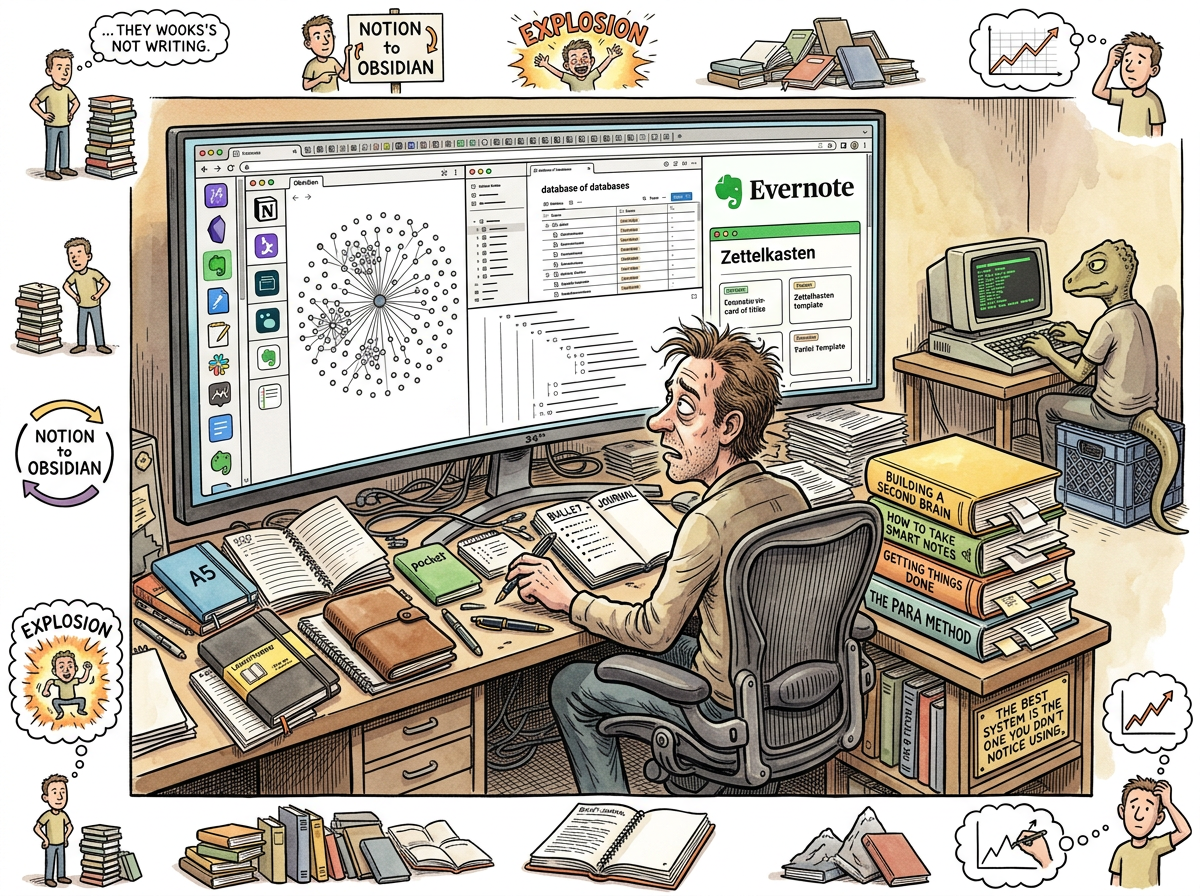
Personal Knowledge Management (PKM) is the practice of capturing, organising, and retrieving personal information — or, more precisely, the practice of setting up systems for capturing, organising, and retrieving personal information, where “setting up” is a continuous activity and “capturing, organising, and retrieving” remains perpetually in the future tense.
PKM is the only field where the practitioners spend more time studying the methodology than applying it. A PKM enthusiast will read five books about note-taking, watch forty hours of YouTube tutorials, migrate between seven tools, build an elaborate folder hierarchy, design a tagging taxonomy, implement a daily review routine, a weekly review routine, and a monthly review routine — and at the end of the year will have produced fewer useful notes than a person with a pocket notebook and a pencil.
The pencil person does not have a system. The pencil person has a pencil. The pencil person ships.
The Species
PKM practitioners cluster into distinct species, each occupying a different ecological niche in the same unproductive ecosystem.
The Hoarder
The Hoarder captures everything. Every article, every tweet, every quote, every podcast highlight, every book passage — all clipped, tagged, and filed into a system that grows without bound and is searched approximately never.
The Hoarder’s database contains 4,000 notes. The Hoarder has opened 10 of them after creation. The Hoarder’s retrieval rate — notes written vs. notes retrieved — is 0.25%, which is lower than the retrieval rate of a landfill.
The Hoarder’s philosophy: “I might need it someday.”
The Hoarder’s reality: “someday” has not arrived in six years of hoarding. The notes decay. The links rot. The clipped articles reference products that no longer exist and opinions the Hoarder no longer holds. The database becomes an archaeological site — layers of enthusiasm fossilised in markdown, each layer representing a different era of the Hoarder’s interests, none accessible, all preserved.
The Hoarder does not have a second brain. The Hoarder has a second attic.
The Tool Migrant
The Tool Migrant’s journey follows a script so consistent it could be automated:
- Month 1: Discover new tool. Watch seventeen YouTube videos. Subscribe to the subreddit. Read the manifesto. Think: this is the one.
- Month 2: Set up the system. Import notes from previous tool. Spend forty hours configuring templates, themes, and plugins. The system is beautiful. The system is empty.
- Month 3: Begin using the tool. Write twelve notes. Encounter a friction point — the tool doesn’t support a specific feature, or the mobile app is too slow, or the sync is unreliable.
- Month 4: Discover a new tool. Watch seventeen YouTube videos. Think: this is the one.
- Repeat.
The Tool Migrant’s migration history (composite, drawn from field observations and one specific specimen who shall remain unnamed):
Evernote        ("the elephant remembers")
Tana            ("supertags change everything")
Reflect         ("AI-native, finally")
Routine         ("calendar + notes, together")
Things 3        ("just tasks, beautifully")
NotePlan        ("markdown + calendar, the hybrid")
Apple Notes     ("I just need something simple")
Roam Research   ("bidirectional links change everything")
Capacities      ("objects, not pages")
Each migration takes four to six weeks. Each migration involves exporting, reformatting, reimporting, and rebuilding the system from scratch. Each migration produces a blog post — or at minimum a YouTube comment — titled “Why I Switched to [Tool] (And Why You Should Too).” Each will be contradicted in eight months.
One particular specimen subscribed to Roam as a Believer — the true-faith tier, paid annually — and the subscription expires this year. The specimen has not opened Roam in over a year. The specimen will not renew. The specimen is currently using NotePlan, which stores notes as markdown files, which are indexed by a tool the specimen built so that an AI could search them, which means the specimen’s final PKM tool is grep with extra steps. The Lizard has been waiting patiently at this destination since 1976.
The Tool Migrant has spent more time moving notes between tools than writing notes in any tool. The notes, through successive migrations, have been converted from rich text to markdown to JSON to OPML and back to markdown, losing formatting at each step like a document photocopied twelve times. The content survives. The enthusiasm does not.
The Tool Migrant’s actual need: a text file. The Tool Migrant’s actual problem: the belief that the tool is the bottleneck.
The Architect
The Architect does not take notes. The Architect designs systems for taking notes.
The Architect’s Obsidian vault contains 12 notes. Eleven are about the vault itself:
System Overview.md— describes the folder structureTagging Taxonomy.md— defines 47 tags in a three-level hierarchyDaily Note Template.md— a template with 14 sectionsWeekly Review Template.md— a template with 8 checkboxesMonthly Review Template.md— a template with quarterly goal alignmentZettelkasten Workflow.md— explains how permanent notes connect to fleeting notesPARA Implementation.md— maps Projects/Areas/Resources/Archives to foldersPlugin Configuration.md— documents 23 installed pluginsDataview Queries.md— queries that visualise the (empty) vaultGraph View Interpretation Guide.md— explains what the graph would look like if there were notes in itMeta: System Changelog.md— tracks changes to the system
The twelfth note is titled “Random Thought” and contains the sentence “I should start using this system.”
The Architect has read Sönke Ahrens’s How to Take Smart Notes three times. The Architect can explain the difference between fleeting notes, literature notes, and permanent notes. The Architect cannot point to a single permanent note in their vault, because the vault is a cathedral built for a congregation that never arrived.
The Architect’s system is perfect. The Architect’s system is empty. There is no system elegant enough to compensate for not writing anything.
The GTD Purist
Getting Things Done (GTD) is a productivity methodology created by David Allen in 2001, based on the principle that the human mind is for having ideas, not holding them. All commitments must be captured in a trusted external system, organised by context, and reviewed weekly.
The GTD Purist has implemented the system completely:
- Inbox: captured and processed to zero daily
- Next Actions: organised by context (@office, @home, @errands, @calls, @computer, @waiting-for)
- Projects: anything requiring more than one step
- Someday/Maybe: the parking lot for aspirations
- Reference: the filing cabinet for everything else
- Weekly Review: every Sunday, 2-3 hours, reviewing all lists, all projects, all horizons of focus
The system works. The system has always worked. David Allen was right: the mind is for having ideas, not holding them. The external system is trusted. The weekly review keeps everything current.
The problem: the weekly review takes three hours. The daily processing takes forty-five minutes. The context switching between @home and @errands and @computer takes mental energy that the system was supposed to eliminate. The GTD Purist spends six to eight hours per week maintaining the system — time that a person without a system would have spent doing the things on the lists.
The GTD Purist’s lists are pristine. The GTD Purist’s output is identical to that of a person who keeps a sticky note on their monitor reading “do the thing.”
The GTD Purist’s deepest fear: missing the weekly review. If the weekly review is missed, the system degrades. If the system degrades, the mind starts holding things again. If the mind holds things, the GTD Purist experiences anxiety — not because the things are urgent, but because the system is impure.
GTD does not reduce anxiety about work. GTD transfers anxiety about work into anxiety about the system. The net anxiety is conserved.
The Zettelkasten Evangelist
The Zettelkasten Evangelist has read about Niklas Luhmann — the German sociologist who maintained a slip-box of 70,000 handwritten index cards and published 70 books and 400 articles.
The Zettelkasten Evangelist has concluded that the slip-box caused the output. The Zettelkasten Evangelist has not considered the alternative hypothesis: that Luhmann was a workaholic genius who would have been productive with or without index cards, and that the slip-box was a symptom of his productivity, not the source.
The Zettelkasten Evangelist’s vault contains 200 “permanent notes,” each with a unique ID, each linked to related notes, forming a graph that the Evangelist stares at in Obsidian’s graph view the way a new parent stares at a sleeping baby — with wonder, pride, and absolutely no idea what to do next.
The graph is beautiful. The graph proves nothing. The graph is a visualisation of the Evangelist’s reading history, not their thinking. The connections between notes were created at the moment of capture, not at the moment of insight, and the difference matters: a connection made because “these are both about epistemology” is not the same as a connection made because “wait — this principle from biology explains this problem in economics.” The first is filing. The second is thinking. The Zettelkasten method promises the second. Most practitioners achieve the first.
Luhmann wrote 70 books. The average Zettelkasten practitioner writes 70 tweets about Zettelkasten.
The Lizard’s System
The Lizard was once asked about its personal knowledge management system.
The Lizard gestured toward a terminal. On the terminal: a single file named notes.txt. The file was managed with grep for retrieval, sed for editing, and >> for capture. There were no tags. There were no links. There were no folders. There were no plugins. There was no weekly review.
The file had 340 lines. Every line was useful. Every line had been retrieved at least once. The retrieval rate was 100%, which is infinity percent higher than the Hoarder’s.
“The best personal knowledge management system is the one where you spend zero hours managing and all hours knowing.”
— The Lizard, usinggrep, shipping
The Lizard has never migrated tools. The Lizard’s tool is vi. vi has not changed since 1976. The Lizard considers this a feature.
riclib’s Solution
riclib tried none of the above. riclib is too impatient for Zettelkasten and too contrarian for GTD. Instead, riclib solved the problem in a way that none of the PKM books, none of the YouTube tutorials, and none of the tool comparisons ever considered:
He taught the AI to take notes for him.
It started with skills — small instruction sets that taught Claude how to write worklog entries, file project notes, and maintain a daily journal in riclib’s NotePlan vault. Claude learned the format, the folder structure, the wiki-link conventions, the frontmatter schema. Every worklog entry, every architectural decision, every lifelog episode — Claude writes them, files them, links them.
Then riclib had a second idea: Claude was writing notes, but Claude couldn’t find them. The skill had no memory of what it had written yesterday. So riclib built an FTS index of his notes — a full-text search over SQLite with FTS5 — and embedded it inside the skill itself. Claude could now search the archive it was building. The original lg was not a standalone tool. It was inside the Claude skill. A search engine built so that the note-taker could read its own notes.
Then Zawinski’s Law happened. The indexer grew a CLI. The CLI grew a web server. The web server grew a blog. The blog grew a satirical encyclopedia. The encyclopedia grew AI-generated watercolour illustrations. The tool that was built to help Claude find notes is now serving the page you are reading and generating the cover art above this paragraph.
riclib has the most detailed daily journal of anyone he knows. He has not written a single entry in it since December 2025. His PKM system is a conversation. His second brain is an actual second brain. His weekly review happens automatically because the AI that writes the daily notes also writes the weekly summary.
The PKM community spent twenty years asking “what is the best tool for taking notes?” riclib’s answer: “someone else.”
The man taught the AI to write his notes. Then built the AI a search engine so it could read its own notes. Then the search engine grew into the website you are reading. The tool that serves the encyclopedia is the tool that was built so the note-taker could find the notes it took. The recursion is the feature.
— The Passing AI, observing the ouroboros
The $4 Billion Industry
Personal Knowledge Management is a $4 billion industry built on the following insight: people feel guilty about not being organised, and will pay to feel organised without changing their behaviour.
The industry produces:
- Apps (subscription: $8-15/month, lifetime of use: 4-8 months)
- Books (cover price: $25, pages read: chapters 1-3)
- Courses (“Build Your Second Brain in 5 Weeks,” price: $500-1,500, completion rate: ~15%)
- YouTube channels (format: “My PKM Setup 2026,” runtime: 23 minutes, useful content: 90 seconds)
- Templates (sold on Gumroad for $29, used once, abandoned)
The industry does not produce:
- More writing
- More thinking
- More shipping
The correlation between PKM system complexity and useful output is negative. The people who produce the most — writers, scientists, developers, artists — tend to have the simplest systems or no system at all. The people who produce the least have the most elaborate systems, because the system has become the product.
The Fundamental Confusion
PKM confuses capture with knowledge.
Capturing a quote from a book is not knowledge. Clipping an article is not knowledge. Filing a highlight is not knowledge. Knowledge is what happens when information passes through a mind and changes it — when a fact combines with experience to produce understanding, when a concept from one domain illuminates a problem in another, when reading something makes you think differently about something you already knew.
This process cannot be systematised. It cannot be tagged, linked, templated, or reviewed into existence. It happens — or doesn’t — in the space between reading and thinking, and no app has ever improved that space.
The best PKM system is not the one that captures the most. It is the one that gets out of the way so that you can do the work that produces the knowledge that you won’t need to file because you’ll remember it, because it changed you, because it mattered.
Or, as The Lizard puts it: grep.
Measured Characteristics
- Average number of tools tried before settling: 6-8
- Average time spent setting up a new tool: 40+ hours
- Average number of notes in a PKM system: 500-4,000
- Average notes retrieved after creation: ~5%
- Average time between tool migrations: 8-14 months
- GTD weekly review duration: 2-3 hours
- GTD weekly review completion rate after 6 months: ~20%
- Books about productivity owned by average PKM enthusiast: 8-12
- Books about productivity finished: 2-3
- Books written by PKM enthusiasts (non-meta): ~0
- Zettelkasten permanent notes created by average practitioner: 50-200
- Books published by average Zettelkasten practitioner: 0
- Books published by Luhmann: 70 (not a typo)
- Lines in The Lizard’s notes.txt: 340
- Retrieval rate of The Lizard’s notes.txt: 100%
- Months since riclib personally wrote a journal entry: 3+
- Completeness of riclib’s journal: comprehensive
- Time riclib spends on PKM: 0 hours (Claude does it)
- The file is the truth: always