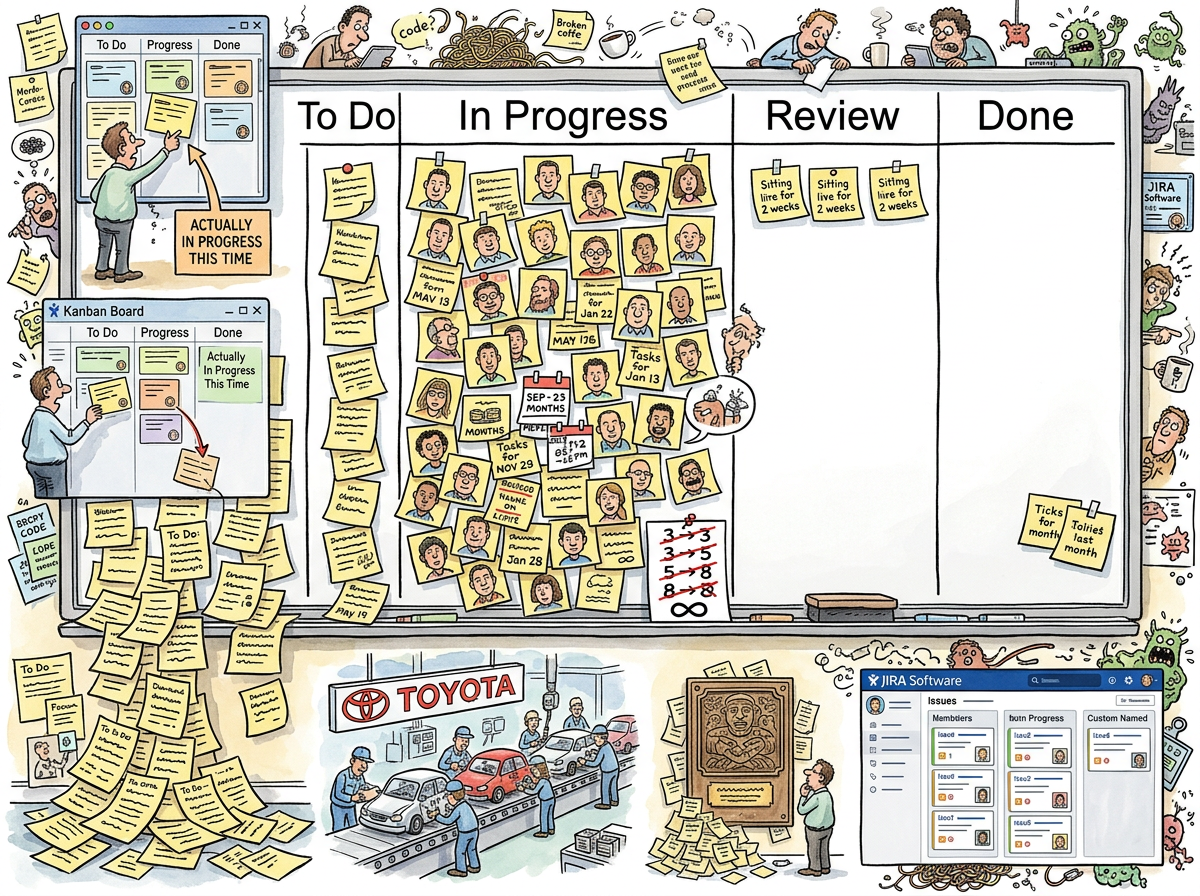
Kanban is a visual workflow management method in which work items are represented as cards on a board, moving from left to right through columns that represent stages of completion — a system so intuitive that it requires no training to understand and approximately eighteen months of organizational dysfunction to implement correctly.
Kanban was invented at Toyota in the 1940s to manage the flow of physical parts through a manufacturing line. A card (kanban, literally “signboard”) traveled with each part, signaling when more parts should be produced. The system was elegant: pull-based, visual, self-regulating. It worked because car parts have a predictable size, a predictable manufacturing time, and do not spontaneously develop dependencies on other car parts mid-assembly.
Software has none of these properties. The industry adopted Kanban anyway.
The Board
The Kanban board is typically four columns:
| To Do | In Progress | Review | Done |
|---|
This is clean. This is simple. This lasts approximately one week before someone adds:
| To Do | Ready for Dev | In Progress | In Review | QA | Ready for Deploy | Done | Done Done |
“Done Done” — as distinct from “Done” — is the column for items that are actually complete, as opposed to items in the “Done” column that turned out not to be done. The existence of “Done Done” is Kanban’s confession that “Done” was aspirational.
The WIP Limit Problem
Kanban’s essential mechanism is the WIP limit — a maximum number of items allowed in each column. When a column is full, no new items can enter until an existing item moves forward. This creates pull: the team is forced to finish work before starting new work.
In theory.
In practice, WIP limits are set, observed for two sprints, and then raised. Then raised again. Then replaced with a polite suggestion. Then ignored entirely. The “In Progress” column expands to contain every item anyone has ever looked at, thought about, or opened a browser tab for. The board becomes not a workflow but an inventory — a visual record of everything in flight, which is everything.
The WIP limit’s death follows a predictable trajectory:
- Week 1: WIP limit set to 3. The team respects it. Work flows.
- Week 3: An urgent item arrives. WIP limit temporarily raised to 4. “Just this once.”
- Week 5: WIP limit is 6. “We’re a bigger team now.”
- Week 8: WIP limit is “guidelines, not rules.”
- Week 12: Nobody remembers there was a WIP limit. In Progress has twenty-three items. Nothing is moving.
The Lifelog Board
In the lifelog, the board is Linear. The columns are: Backlog, In Progress, Done. No Review column (the developer is the reviewer). No QA column (the test is [curl](/wiki/curl)). No “Done Done” (done is done — it’s in production, responding in 47 milliseconds).
When agents were dispatched, each one took a ticket from “Backlog” to “Done” without intermediate columns. The board’s purpose was not to visualize a process. The board’s purpose was to answer one question: “What’s left?”
“Seventeen tickets. At current burn rate, the backlog runs out on Sunday.”
— The Idle Factory — The Morning the Backlog Ran Out of Ideas …
The board worked because the board was simple. Three columns. No WIP limits needed — the WIP limit was the number of agents, which was the number of tasks that could physically execute simultaneously. The WIP limit was not a policy. It was physics.
The Toyota Difference
At Toyota, Kanban works because manufacturing is linear. A car door starts as sheet metal, becomes a stamped panel, gets painted, gets assembled, and arrives at the line. The flow is predictable. The cycle time is measurable. The card moves at the speed of the conveyor belt.
Software is not linear. A feature starts as an idea, becomes a ticket, gets discussed, gets estimated, gets started, gets blocked by a dependency, gets unblocked, gets reviewed, gets rejected, gets revised, gets approved, gets deployed, gets rolled back, gets fixed, gets redeployed, and arrives in production three weeks later with a commit message that reads “fix: actually fix the fix.”
Toyota’s Kanban tracks parts through a process. Software Kanban tracks surprises through a hope.