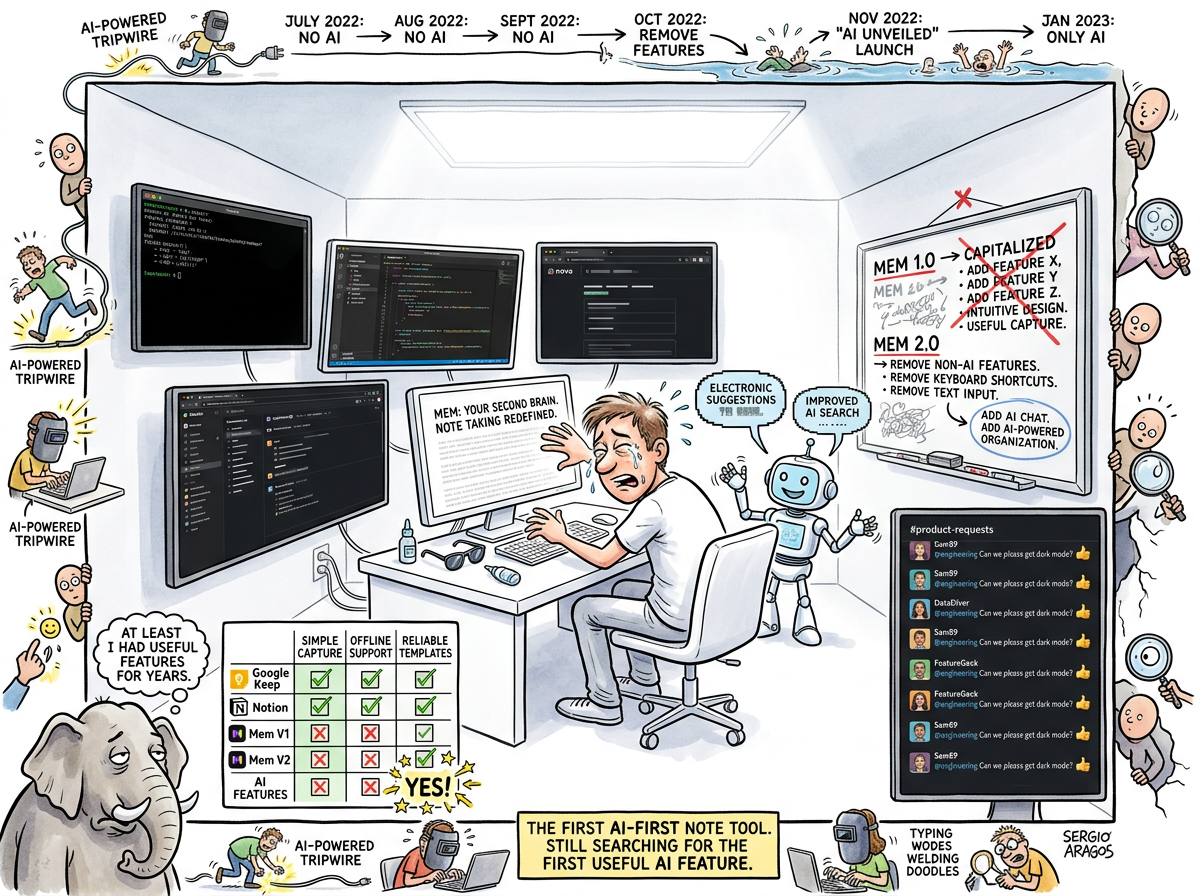
Mem is the AI-first note-taking application that proved you can be first to an idea and still not find a use for it.
Mem was AI-native before AI-native was a category. Before Claude could write your notes for you, before every app added a “✨ AI” button to the toolbar, before the phrase “AI-powered” became the “blockchain-enabled” of 2024 — Mem was there, promising that artificial intelligence would transform how you capture, organise, and retrieve your thoughts.
The promise was ahead of its time. The execution was behind it. And the interface was so white it could be seen from space.
The Idea
Mem’s core idea was genuinely interesting: notes as a stream, organised by time, surfaced by AI. Not folders. Not tags. Not a graph. A flow — mems arriving chronologically, like a river of thoughts, with AI working in the background to connect them, surface relevant ones, and answer questions about your own archive.
This is not a bad idea. This is, arguably, what riclib’s setup with Claude and NotePlan approximates — an AI that reads your notes, connects them, and surfaces what matters. The difference is that riclib’s version works.
A person who genuinely wanted this to succeed was attracted to the flow. The chronological stream felt natural — closer to how memory works than any folder hierarchy or graph database. The capture was great. Quick, frictionless, just type and the mem exists. No folder to choose, no template to apply, no database to file into. Just the thought, timestamped, flowing into the stream.
riclib really tried. He tried the way you try with a tool you want to love — patiently, repeatedly, giving it chances, looking for the workflow that makes the features click. He tried the AI features. He asked the AI questions about his notes. The AI responded with the specific flavour of helpfulness that means “I have processed your query and returned something that is technically an answer.” He has not, to this day, found a useful way to use Mem’s AI features. Not one. The AI-first note-taking tool has AI. The AI does not help with note-taking. This is like a restaurant-first airline where the restaurant does not serve food.
NotePlan, which does not market itself as AI-first, became the tool where AI actually works — because NotePlan stores notes as markdown files that Claude can read, and Claude is better at being an AI assistant than Mem’s AI is at being an AI assistant, and the combination of a good tool and a good AI beats an AI tool that is neither.
The 2.0
Mem 1.0 was getting somewhere. Features were arriving. The flow was improving. Organisational tools were appearing. It was starting to feel like a product that, given time and iteration, might become the thing it promised to be.
Then Mem announced 2.0.
Mem 2.0 removed the useful features.
This is not an exaggeration for comedic effect. This is what happened. Features that had been built, shipped, and adopted — features that users relied on, features that represented months of development — were removed in the 2.0 release. The product was simplified. The AI was emphasised. The features that had made the product approaching-useful were sacrificed on the altar of “AI-first,” which in practice meant “AI-only,” which in practice meant “less.”
The community was not consulted. The community was informed. The community’s response was the specific silence that follows when a product you invested in pivots away from you and toward a vision you did not sign up for. Some users left. Some users stayed. Some users opened Slack and typed another message about dark mode.
The White Room
This is where the roast becomes a medical report.
Mem’s interface is white. Not off-white. Not light grey. Not “a neutral background that works in most lighting conditions.” White. The kind of white that makes your ophthalmologist wince. The kind of white that radiates from your monitor into your retinas with the focused intensity of a dental examination lamp.
riclib works in dark mode. Everything is dark mode. The terminal is dark. The IDE is dark. The browser is dark. The operating system is dark. The phone is dark. The desktop is a carefully curated environment of comfortable darkness punctuated by syntax-highlighted code, where the brightest element on any screen is a yellow string literal.
Into this environment, Mem injected a supernova.
Opening Mem was like opening a window into the sun. The white interface blazed from the monitor, the single bright rectangle in an otherwise dark workspace, searing itself into the after-image on riclib’s retinas. The text — dark on white — was readable in the way that text is readable when you’re squinting, which is to say: technically, painfully, temporarily.
riclib reported this. In the Mem Slack. Multiple times. With the specific politeness of someone who is experiencing physical discomfort and would like it to stop. Dark mode, he explained. Please. The tool is unusable in a dark environment. His eyes hurt. Not metaphorically. Not “this is a bit bright.” His eyes physically hurt.
The Slack messages received thumbs-up emoji. The thumbs-up emoji did not ship dark mode. The cycle repeated: message, thumbs-up, no dark mode. Message, thumbs-up, no dark mode. The Slack channel became a monument to acknowledged and unaddressed feedback, which is the specific form of customer service where the company hears you and does nothing, and the thumbs-up is the punctuation mark of indifference.
riclib left Mem. Not because the AI didn’t work. Not because the 2.0 removed features. Not because the flow didn’t flow. He left because his eyes hurt. He left for health reasons. The AI-first note-taking tool lost a user not to a competitor, not to a pivot, not to a philosophical disagreement about knowledge management — but to the absence of a toggle that inverts the background colour. A CSS property. A background-color: #1a1a1a. The feature that every other tool in the ecosystem has shipped, that Apple Notes has, that Notion has, that even Evernote eventually added.
"The Lizard’s terminal is green text on a black background. The Lizard has never experienced eye strain. The Lizard considers the white interface a form of aggression."
— The Lizard, whose colour scheme has not changed since 1976
The Evernote Comparison
Mem is Evernote without the features.
This sounds harsh. It is also precise. Evernote captured everything and couldn’t find anything. Mem captured everything and couldn’t do anything with it. Evernote had notebooks, tags, web clipping, document scanning, handwriting recognition, shared notebooks, and a search that worked. Mem had a stream and an AI. Evernote was a filing cabinet. Mem was a pile — an AI-powered pile, but a pile.
The elephant, looking at Mem from across the PKM landscape, feels a complicated emotion. The elephant recognises the capture-without-retrieval problem. The elephant lived it. The elephant also had features. The elephant had seventeen years of features. The elephant’s features were slow and creaky and wrapped in Electron, but they existed, and they worked, and they did not require AI to justify their presence on the screen.
What Mem Got Right
The idea. The chronological flow. The frictionless capture. The conviction that AI should be a core part of note-taking, not a bolt-on. These are correct ideas. These ideas are, in 2026, being validated by every tool that adds AI features — including NotePlan, where riclib’s AI-powered note-taking actually works, using the notes that NotePlan stores and the AI that Anthropic builds.
Mem was right about the destination. Mem could not find the route. Mem was the prototype of a future that other tools are now shipping — the future where your notes are managed by an AI that understands them, surfaces what’s relevant, and answers questions about your own archive. This future exists. It just doesn’t exist in Mem.
Measured Characteristics
- Year launched: 2020
- Core idea: AI-native notes as a chronological stream
- Correctness of core idea: high
- Execution of core idea: searching
- AI features that riclib found useful: 0
- AI features marketed: many
- Mem 1.0 useful features: some (growing)
- Mem 2.0 useful features: fewer (shrinking)
- Dark mode: absent
- Slack messages requesting dark mode: 12+ (from one user alone)
- Thumbs-up emoji received: 12+
- Dark mode shipped: 0
- CSS properties required to ship dark mode: 1
- Users lost to the absence of dark mode: at least 1
- Reason for leaving: medical (eye strain)
- The Lizard’s terminal colour scheme: green on black (since 1976)
- Evernote features that Mem lacks: most of them
- The idea’s legacy: validated by other tools
- The tool’s legacy: a cautionary tale about shipping AI before shipping features