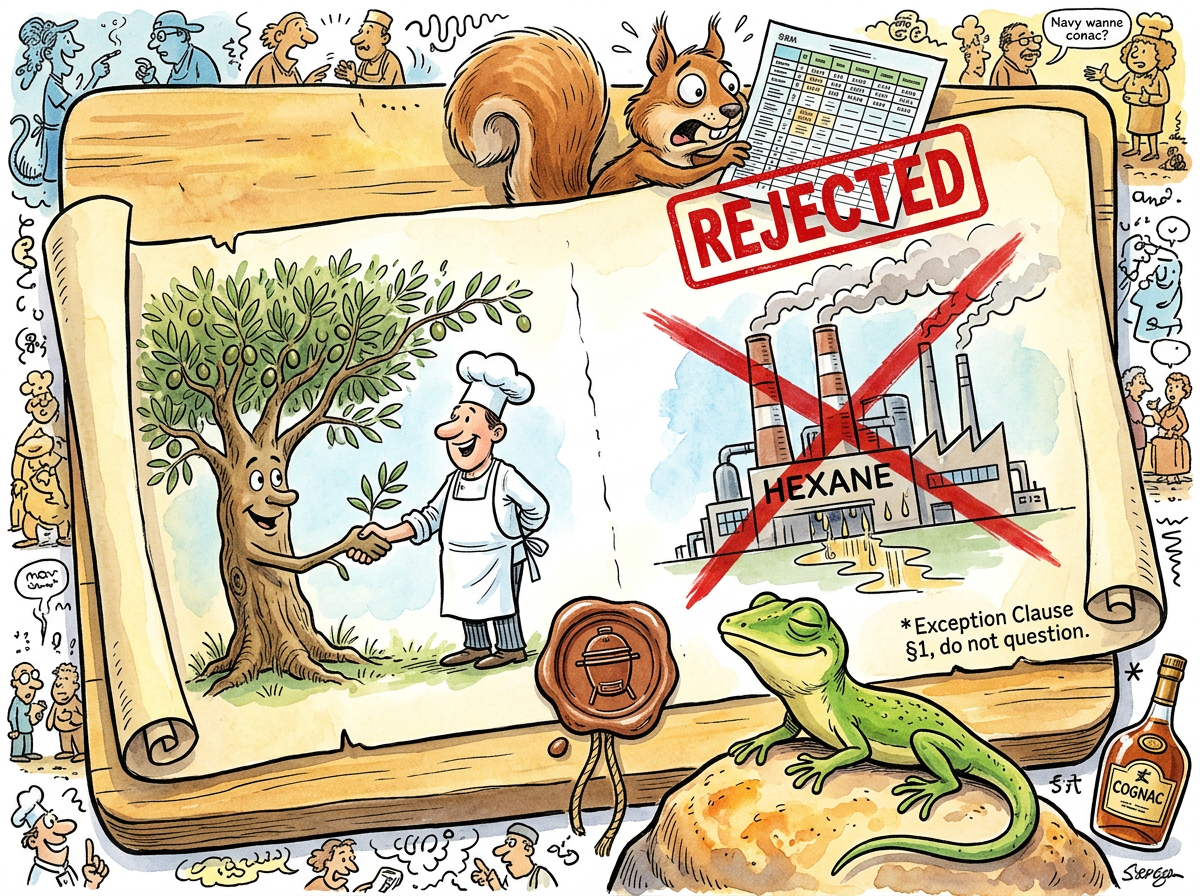
The Agreement Between a Portuguese Developer and Everything He Puts on the Fire
In the beginning, there was fire, and there was meat, and the arrangement was simple. Then someone invented a factory, and everything went sideways.
This is not a diet. Diets are temporary acts of self-deception negotiated between a person and their bathroom scale, usually in January. This is a covenant — a constitutional document, a first principle from which all other food decisions in the Yagnipedia derive. Every entry about Tallow or Ghee or Chicken Broth or the correct way to reverse-sear a Rib Eye traces its authority back to this page, in the same way that every law in a country traces back to a constitution, except this constitution is shorter and has better recipes.
The Rule
Nothing that could not be hunted in the wild, or that was processed in a factory, or that has taken any medicine — except cognac — is allowed to enter the pots, the Kamados, the Traegers, the dutch ovens, or any other vessel in the kitchen.
That’s it. One rule. Everything else is interpretation.
The Squirrel, upon hearing this rule for the first time, immediately began drafting sub-clauses, exception matrices, and a compliance tracking system with weighted scoring. The Squirrel was denied. The Lizard, upon hearing this rule, closed his eyes on his warm stone and said nothing, because the rule was already complete and the Lizard does not annotate perfection.
The Covenant with Plants
There exists an agreement between humans and plants that predates every civilization, every agriculture ministry, and every food pyramid ever drawn by a government committee. It is the oldest trade deal in biological history, and it goes like this:
The plant wraps its seeds in something delicious — fruit — to entice animals into eating it. The animal eats the fruit, walks away, and deposits the seeds elsewhere, pre-packaged in fertilizer. The plant gets propagation. The animal gets food. Both parties benefit. Neither party hired a lawyer.
This is the covenant.
Seed oils violate the covenant. When you extract seed oil, you are not eating the fruit. You are extracting the seed — the plant’s offspring, the thing the fruit was designed to protect — crushing it industrially, processing it with hexane solvents, deodorizing it, bleaching it, and refining it into something the plant never intended to give you. You have broken into the nursery and kidnapped the children. The plant did not agree to this.
The distinction is simple and it is absolute:
- Olive oil: covenant honored. The olive IS the fruit. You press the fruit. The plant offered it to you. Transaction complete.
- Coconut oil: covenant honored. The coconut is the fruit. You are eating what was offered.
- Avocado oil: covenant honored. Same principle.
- Sunflower oil: covenant broken. The plant gave you the flower. You ignored the flower, extracted the seeds, crushed them in a factory with chemical solvents, and called the result “oil.” The sunflower did not consent.
- Canola oil: covenant broken. And “canola” is a marketing name for rapeseed oil, which tells you something about the confidence level of the people selling it. When your product needs a fake name to be palatable, the covenant was broken long before the hexane entered the picture.
- Soybean oil: covenant broken.
- Corn oil: covenant broken.
The Squirrel once attempted to create a “Covenant Compliance Score” ranging from 0 to 100, with weighted factors for processing method, solvent type, and botanical classification of the source material. He was told to stop. The covenant is binary. It is honored or it is broken. There is no score. There is no gradient. The plant either offered it to you or it didn’t.
The Medicine Exception
Nothing that has taken medicine enters the kitchen.
The meat comes from animals that lived as animals — grass-fed, pasture-raised, free-range, whatever the correct term is for “lived outside and ate what it found on the ground, which is what animals have been doing for several hundred million years before someone decided that a concrete floor and prophylactic antibiotics was an improvement.”
A chicken that saw the sun laid the eggs. A cow that ate grass produced the milk. A pig that rooted in dirt became the pork. This is not romanticism. This is the minimum viable standard for something you are going to spend four hours smoking at 225 degrees — the ingredients should be worth the charcoal.
The exception is cognac.
Cognac has taken a great deal of medicine. It has been distilled, aged, blended, and subjected to processes that would violate every principle in this document if applied to a chicken. It is allowed anyway, because cognac is cognac, and some things transcend constitutional frameworks. The Lizard has no objection. The Squirrel wanted to document the exact chemical processes involved in cognac production to formally justify the exception. The Squirrel was denied.
Fat Sovereignty
If you control the fat, you control the kitchen. Every store-bought cooking oil is someone else’s decision about what you should eat. Every jar of home-rendered fat is your own.
riclib renders his own cooking fats:
- Tallow — both smoked and regular. The smoked variant comes from beef fat trimmings that went through the Kamado before rendering, which gives it a depth that no store-bought fat has ever approached. The regular variant is for when you want clean heat without smoke memory.
- Ghee — clarified butter taken past the point where most people stop, until the milk solids brown and settle and what remains is golden, nutty, and tolerant of temperatures that would make regular butter weep and burn.
- Schmaltz — collected as a byproduct of Chicken Broth. You make broth, you get schmaltz. This is not extra work. This is paying attention.
- Goose Fat — the annual ritual. One goose per year, rendered slowly, producing a fat so refined in its properties that the French built significant portions of their cuisine around it, which is one of the few things the French got unambiguously right.
The jars sit in the fridge, labeled and dated. They are not decorative. They are infrastructure. When riclib reaches for fat to cook with, he is not choosing between brands. He is choosing between animals.
Stock Sovereignty
The same principle, applied to liquids.
- Chicken Broth — the two-stage method. First roast, then simmer. The schmaltz rises and is collected (see Fat Sovereignty). The broth that remains is the foundation of everything that needs a liquid and deserves better than water.
- Bone Broth — the 24-hour dutch oven extraction. Bones, water, acid (a splash of vinegar to dissolve the minerals), and time. What comes out is not stock and not broth and not consommé — it is collagen and minerals in suspension, and it sets to gelatin when cooled, which is how you know it worked.
Store-bought stock is warm, salted regret in a Tetra Pak. It exists because someone calculated that people would pay for the illusion of having made stock without the inconvenience of actually doing it. The illusion is unconvincing. See Stock vs Broth for the full taxonomy, which is more contentious than it has any right to be.
What This Excludes (and Why Nobody Cries About It)
- Seed oils — covenant broken, see above
- Processed food — if it was made in a factory, it is not food, it is a product. Products have marketing budgets. Food has seasons.
- Factory-farmed meat — medicine disqualification. Also, a moral position that riclib holds quietly and does not lecture about at dinner parties, because nobody has ever been persuaded of anything at a dinner party except that they should have left earlier.
- Anything with an ingredients list longer than the thing itself — if the bread has more ingredients than a chemistry textbook has chapters, it is not bread. It is a science experiment that someone put in a bag.
- Anything your great-grandmother wouldn’t recognize as food — this heuristic is borrowed and imprecise, but directionally correct. riclib’s great-grandmother, being Portuguese, would recognize a startling number of things as food, including parts of animals that would make a modern supermarket shopper faint. She would not recognize canola oil.
- Margarine — a substance that exists because someone in a factory decided butter needed competition. Butter did not need competition. Butter was doing fine.
What This Includes
- Meat from animals that lived outside
- Fish from water that isn’t a tank
- Vegetables and fruits — the covenant honored, the ancient deal respected
- Nuts — technically seeds, but eaten whole as nature packaged them, not crushed into industrial oil. The covenant distinguishes between eating the seed (accepted, if not ideal) and industrially extracting oil from the seed (rejected). An almond in your hand is food. An almond crushed into oil in a factory is a betrayal.
- Eggs from chickens that saw the sun
- Dairy from cows that ate grass
- Olive oil, coconut oil, avocado oil — fruit-derived, covenant-compliant
- Animal fats: Tallow, Ghee, Schmaltz, lard, Goose Fat. riclib stays away from lard personally, but it is covenant-legal and he passes no judgment on those who use it.
- Salt, pepper, smoke — the holy trinity. See Pepper Smoke Salt.
- Cognac — Exception Clause §1. Do not question.
The Filter (Not a Diet)
The Lizard’s position, stated once and never repeated because repetition implies uncertainty:
This isn’t a diet. Diets have phases and cheat days and apps. This is a filter. Does it pass through the filter? Then cook it. Does it not? Then don’t buy it.
The Lizard does not count macros. The Lizard does not track calories. The Lizard does not subscribe to newsletters about the latest superfood. The Lizard eats what passes through the filter, and the filter has not changed since it was established, because first principles do not need software updates.
The Squirrel, predictably, wanted to build an app. The app would scan barcodes, check covenant compliance, assign scores, track historical compliance rates, and generate weekly reports with trend lines. The app would have a premium tier. The Squirrel was denied so emphatically that he retreated to his tree and did not return for three days.
riclib does not evangelize. He does not tell other people what to eat. He does not post about it. He does not have opinions about what is on your plate. He just doesn’t buy the things that don’t pass the filter, renders his own fats, makes his own stock, and cooks everything on fire. The covenant is personal. It is not a movement. It is not a brand. It is not a lifestyle.
It is a Portuguese developer in Riga who decided, at some point, that if he was going to spend this much time at the grill, the ingredients should be worth the charcoal.
Measured Characteristics
| Characteristic | Value |
|---|---|
| Number of rules | 1 |
| Number of exceptions | 1 (cognac) |
| Squirrel proposals rejected | All of them |
| Lizard words spoken | As few as necessary |
| Store-bought stock in the kitchen | 0 units |
| Seed oils in the kitchen | 0 units |
| Jars of rendered fat in the fridge | 4-6, rotating |
| Time since last covenant amendment | Never. The covenant does not amend. |
| Macro tracking spreadsheets | 0 |
| Apps downloaded for food compliance | 0 |
| Great-grandmother recognition test pass rate | 100% of current pantry |
See Also
- BBQ — where the covenant meets the fire
- The Kamado — the primary vessel of covenant enforcement
- Tallow — smoked and regular, the sovereign fat
- Ghee — clarified beyond doubt
- Schmaltz — the fat that comes free with Chicken Broth
- Goose Fat — the annual ritual
- Chicken Broth — two-stage method, stock sovereignty in practice
- Bone Broth — 24-hour extraction, sets to gelatin or it failed
- Stock vs Broth — the taxonomy nobody asked for but everybody needs
- Pepper Smoke Salt — the holy trinity, combined
- Picanha — the covenant’s flagship cut
- Rib Eye — the covenant’s other flagship cut