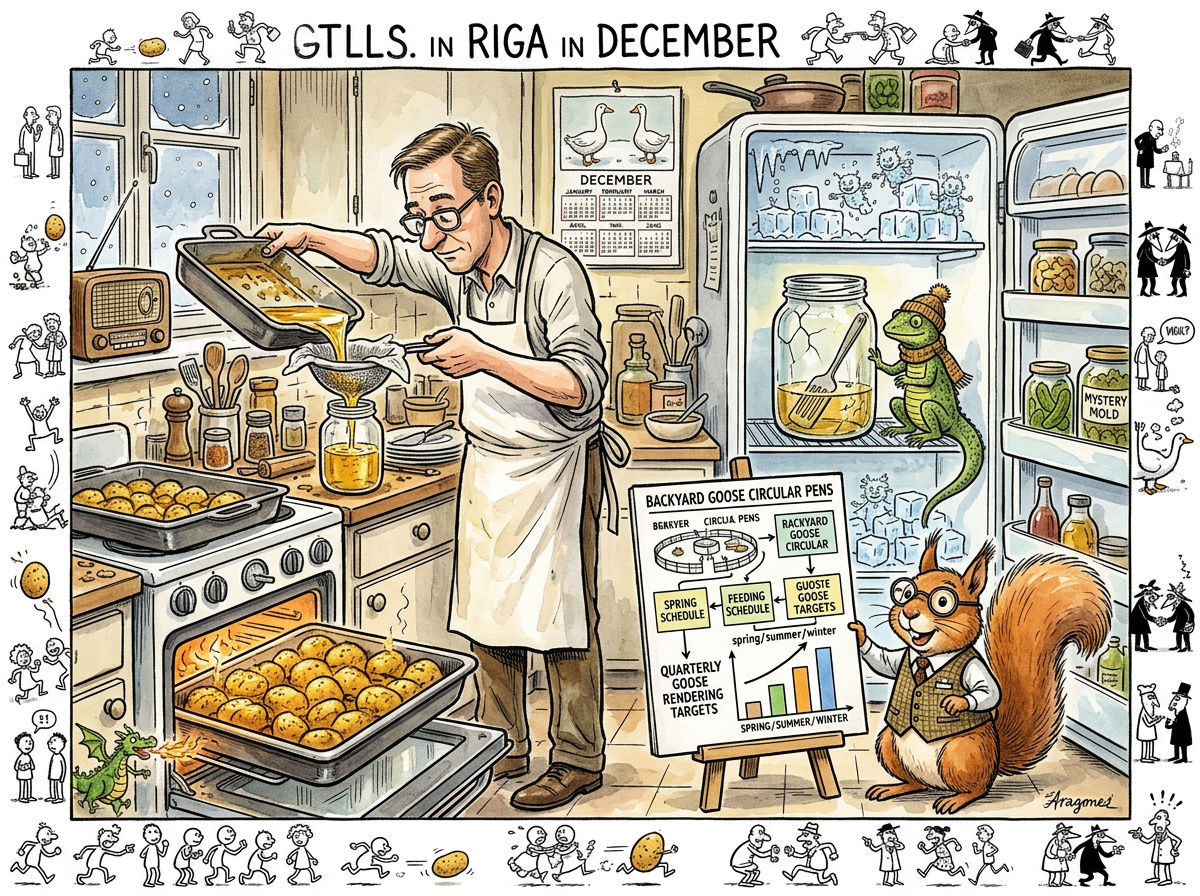
Once a year, riclib roasts a goose. This is not a casual undertaking. It is not something that happens on a whim, or because goose was on sale, or because someone thought it might be nice to try something different. The goose is a planned event. It has a date on the calendar. It requires preparation, sourcing, and the clearing of an entire afternoon.
The goose itself is magnificent — golden, crispy, celebratory, the kind of thing that makes a kitchen smell like the platonic ideal of December. But the goose, in a twist that would surprise no one who has ever roasted one, is almost secondary. The goose is the ceremony. The fat is the prize.
A single goose, properly roasted, yields between 500ml and a full litre of rendered fat. This fat collects in the roasting tray in golden pools, like some kind of delicious geological event. It is carefully strained, jarred, and placed in the fridge with the quiet satisfaction of someone who has just secured their supply lines for the next eight months.
The Squirrel, naturally, wants to optimize this. Continuous goose fat production. A backyard flock. Automated rendering. Perhaps a small centrifuge. The Lizard merely points at the single jar on the shelf and says nothing, because the Lizard understands that scarcity is not a bug.
The Annual Roast
This is not casual cooking. This is a yearly ritual with the structural integrity of a religious observance.
Sourcing. Baltic farms have excellent geese. Latvia, Lithuania, and Poland produce birds of genuine quality — large, well-fatted, raised in conditions that would make a French farmer nod approvingly. The goose is ordered in advance. It arrives whole, with the quiet dignity of something that knows it is about to become important.
Preparation. The goose is removed from the fridge the night before and allowed to come to room temperature, because roasting a cold goose is how you get an exterior that looks done while the interior remains a diplomatic incident. The skin is pricked all over — methodically, thoroughly, with a sharp fork or skewer — so that the thick subcutaneous fat layer has somewhere to go. This is the critical step. The goose carries an extraordinary amount of fat beneath its skin, a biological insulation layer that, in life, kept the bird warm in Baltic winters and, in death, will keep riclib’s potatoes magnificent until spring.
The Roast. The oven is set to 160-170C (320-338F). The goose goes in breast-side down on a rack over a deep roasting tray. It roasts slowly — 3 to 4 hours, turned halfway through — while the fat renders through the pricked skin and pools in the tray below. Every 45 minutes or so, the accumulated fat is ladled out into a heatproof bowl, because if you let it accumulate you are no longer roasting a goose, you are deep-frying one, and while that might sound appealing in theory, in practice it produces skin that is flabby rather than crisp, which defeats the entire purpose of the exercise.
The kitchen fills with the smell of roasting goose, which is one of those smells that makes December feel like December in a way that no candle manufacturer has ever successfully replicated, despite their tireless and occasionally alarming efforts.
The Result. The goose emerges golden and crackling, with skin so crisp it shatters when you look at it sternly. The meat is rich, dark, gamey in the best sense — closer to wild duck than to chicken, with a depth that rewards slow roasting and punishes impatience. It feeds 4-6 people generously, with leftovers that make excellent sandwiches the next day.
But the goose, magnificent as it is, was always the means. The end is sitting in the bowl on the counter, golden and warm and quietly extraordinary.
The Fat
Collection
The fat is collected in stages during the roast — ladled out every 45 minutes into a heatproof bowl. After the goose is done and removed to rest, the roasting tray is tilted and the remaining fat poured off. The total yield from a well-fatted goose is typically 500ml to a full litre, which, when you think about it, is a genuinely absurd amount of fat from a single bird. The goose was essentially a fat-delivery mechanism that also happened to be delicious.
Straining
The collected fat is strained through a fine-mesh sieve lined with muslin or cheesecloth. This removes the roasted bits — the fond, the tiny fragments of skin, the caramelized proteins — which are delicious but will cause the fat to go rancid faster if left in. The straining is done while the fat is still warm and liquid, because cold goose fat has the consistency of religious conviction and will not pass through muslin without a fight.
Storage
The strained fat is poured into clean glass jars — the kind with proper lids, not the kind you’ve been meaning to throw away for six months. As it cools in the fridge, it solidifies from golden liquid into a pale, creamy-white solid with the texture of very expensive face cream. Properly strained and stored, it keeps in the fridge for 6 months or more. In the freezer, it lasts essentially forever, though freezing goose fat seems somehow disrespectful, like putting a Bordeaux in a box.
The jar goes on the top shelf. Behind the pickles. Where it cannot be reached without deliberate intent.
Roast Potatoes (The Primary Use Case)
Potatoes roasted in goose fat are not comparable to potatoes roasted in any other fat. This is not opinion. This is the kind of empirical fact that the British discovered centuries ago and have been quietly smug about ever since, which is remarkable because the British are not traditionally known for being right about food.
The Method. Peel floury potatoes (Maris Piper, King Edward, or whatever Baltic equivalent presents itself). Cut into large, irregular chunks — roughly the size of a small fist, with plenty of edges and corners. Parboil in salted water for 10-12 minutes, until the outside is soft and slightly fluffy. Drain. Shake in the colander — aggressively, rudely — until the edges are roughed up and furry. This is where the crunch comes from.
Meanwhile, a generous amount of goose fat — 3-4 tablespoons for a tray — heats in the oven at 200C (392F) until it is shimmering and almost smoking. The potatoes go into the hot fat with a sizzle that sounds like applause. They roast for 45-60 minutes, turned once or twice, until the exterior has achieved the color of old gold and the structural integrity of tempered glass.
The Result. The exterior shatters. Actually shatters, with an audible crack, revealing an interior so fluffy it is essentially potato-flavored air. The flavor is golden and rich without being heavy — goose fat has a cleaner finish than duck fat and a deeper note than beef dripping. These are the potatoes that make people stop talking. These are the potatoes that cause seconds to be taken before the main course has been properly acknowledged.
This is the British Christmas tradition — roast potatoes in goose fat, served alongside the turkey or the goose itself in a beautiful loop of avian self-reference — and riclib adopted it with the convert’s enthusiasm, which is always more fervent than the native-born’s.
The Yearly Supply
This is the part the Squirrel cannot accept.
One goose. One roast. One jar. That is the annual supply. When it’s gone, it’s gone. There is no restocking, no emergency run to the shop, no Amazon subscription for rendered goose fat (though, horrifyingly, this probably exists, and it is probably not very good).
The jar diminishes through the year. Each use is considered. Roast potatoes for a dinner party — justified. Frying eggs on a Sunday morning — justified, but noted. Sauteing vegetables on a Tuesday — you’d better be making something worthy. Spreading on toast with flaky salt — permitted only when the jar is newly full and generosity feels affordable.
By September, the jar is low. By October, it is nearly empty. By November, you are scraping the sides with a spatula and pretending there is more than there is. And then December arrives, and the cycle begins again.
The Squirrel, who has been agitating since March for a “more scalable approach,” presents a detailed proposal involving a backyard goose enclosure, a rendering schedule, and a spreadsheet tracking fat yield per bird per quarter. The proposal is thorough, well-researched, and entirely missing the point.
The Lizard says: “One goose. Once a year. Enough.”
The Lizard is correct. The scarcity is not an inconvenience to be engineered away. The scarcity is the feature. The finite jar is what makes every use meaningful, every roast potato significant, every decision to open the jar a small act of commitment. An unlimited supply of goose fat would be just another fat in the fridge. A limited supply is a calendar, a countdown, a reminder that some things are better for being rare.
Other Uses (While Supplies Last):
- Confit — duck or goose legs submerged and slow-cooked in goose fat, the traditional French preservation technique that is exactly as indulgent as it sounds
- Frying eggs — the whites crisp at the edges, the yolk stays runny, the whole thing tastes like a more expensive version of itself
- Sauteing vegetables — root vegetables in particular respond to goose fat the way cats respond to sunshine: with immediate and total surrender
- Spreading on toast — with flaky salt, this is peasant food elevated to the point where it becomes suspicious
Measured Characteristics
| Property | Value | Notes |
|---|---|---|
| Smoke point | 190C (374F) | Higher than butter (150C/302F), lower than refined avocado oil, but who cares about avocado oil |
| Yield per goose | 500ml - 1L | Depends on bird size, fat layer thickness, and roasting patience |
| Shelf life (fridge) | 6+ months | Properly strained. Unstrained fat goes rancid faster. |
| Shelf life (freezer) | Indefinitely | But spiritually questionable |
| Color (liquid) | Deep gold | Like afternoon sunlight through a pub window |
| Color (solid) | Pale cream-white | Like expensive moisturizer that you are absolutely not allowed to put on your face |
| Texture (solid) | Smooth, spreadable | Softer than Tallow, firmer than Schmaltz |
| Annual supply frequency | Once | This is not negotiable |
| Primary use | Roast potatoes | All other uses are secondary, regardless of what the French say |
See Also
- Schmaltz — Chicken fat. The everyday cousin. Democratic where goose fat is aristocratic.
- Tallow — Beef fat. Structural, reliable, excellent for deep frying. The working-class hero of rendered fats.
- Ghee — Clarified butter. The subcontinental approach to “what if butter, but more so.”
- Chicken Broth — Another case where the byproduct transcends the source.
- BBQ — Where animal fats meet fire and time, which is essentially the founding myth of cooking.