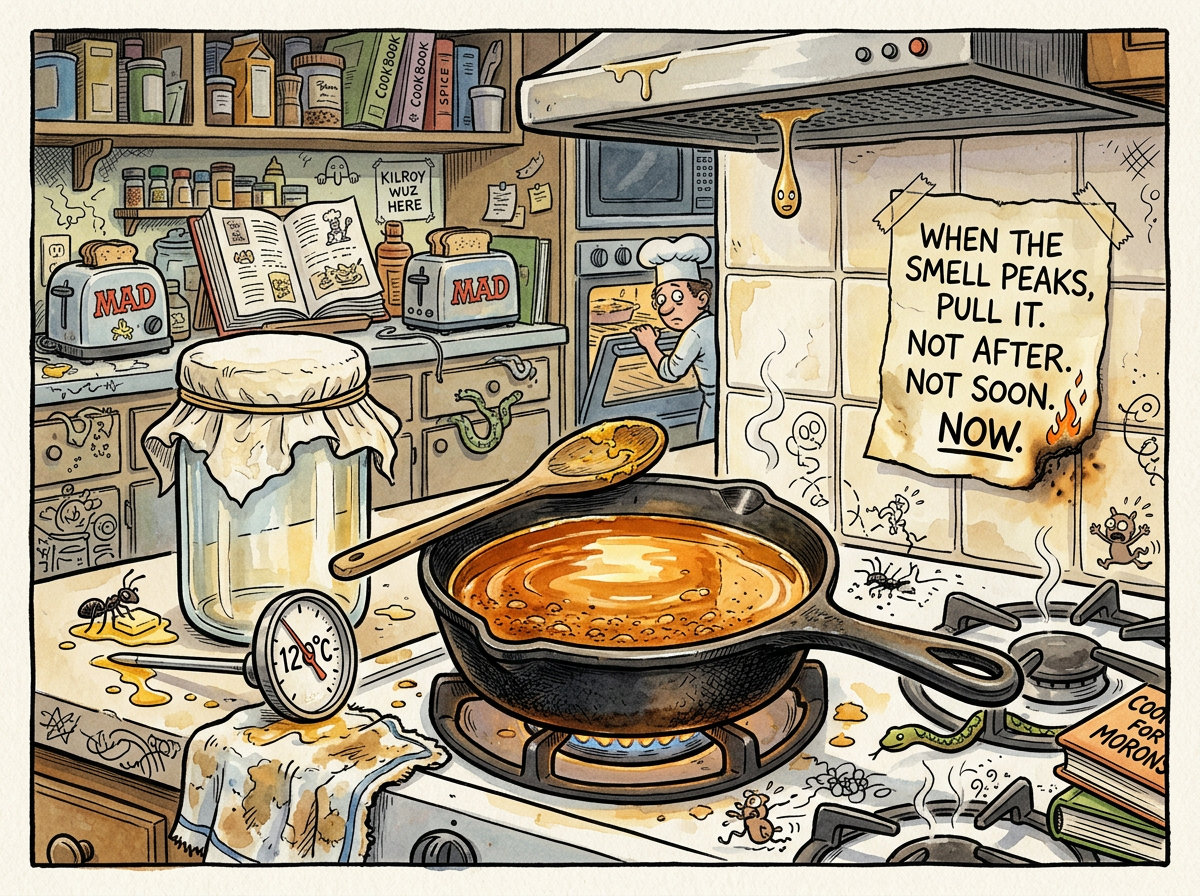
Ghee is clarified butter that has been taken past the point where sensible recipes tell you to stop and into the territory where the butter reveals what it was actually capable of all along. Standard ghee — the kind sold in jars at supermarkets, pale yellow, flavourless, marketed as “pure” — is butter with the interesting parts removed. riclib’s ghee is butter with the interesting parts caramelised, extracted, and preserved in the fat like a flavour fossil.
The difference between store-bought ghee and properly browned ghee is the difference between a photograph of a sunset and actually being there. One is technically accurate. The other makes you understand why people wrote poems about it.
In the subcontinent, ghee is ancient, sacred, and central to an entire culinary tradition spanning millennia. In Riga, it is a Portuguese developer standing over a saucepan at 10pm, watching butter solids darken while muttering “not yet, not yet, not yet, NOW” and lunging for the cheesecloth.
The Method
Start with unsalted butter. Good butter. The better the butter, the more the milk solids have to offer when they brown, and the Baltics — whatever their failings in the Flank Steak supply chain — produce excellent butter.
Melt the butter over low heat in a heavy-bottomed pan. Do not rush this. The butter melts, foams, and the water content begins to evaporate. The foam subsides. The butter becomes still, clear, golden. At this point, every recipe in existence tells you to skim the foam, strain the liquid, and discard the solids.
This is where those recipes stop being interesting.
Keep the heat on. Low. Patient. The milk solids that have settled to the bottom of the pan begin to cook in the hot fat. They go from white to cream to golden. The butter above shifts from yellow to deeper gold. The kitchen starts to smell like something a pastry chef would charge forty euros for.
Keep going. The solids darken from golden to amber. The fat above deepens to copper. The smell intensifies — toasted, nutty, unmistakably caramel. The butter is now telling you things about itself that it never mentioned during the melting phase.
This is not a fast process. Twenty to twenty-five minutes for 500g of butter. Low heat. No shortcuts. The Squirrel once suggested a sous vide approach at precisely 121°C for exactly forty-seven minutes with a PID-controlled heating element. The Lizard pointed out that ghee has been made over fire for five thousand years and does not require a control loop.
The Edge
This is the critical moment, and it is the entire point.
The window between “perfect” and “ruined” is about sixty seconds. Maybe ninety if you are lucky. The milk solids are browning, the caramel smell is building, the colour is deepening, and somewhere in that narrow corridor of time the reaction crosses from Maillard browning into pyrolysis. From flavour into carbon. From “this is the best thing I have ever made” into “open all the windows.”
The scent tells you everything. When the caramel smell peaks — hits that absolute summit of toasted, nutty, buttery richness — pull it off the heat. Not after the peak. Not when you smell the first hint of sharpness. At the peak. The moment the smell is so good that you want to stand there and breathe it in for another thirty seconds is the exact moment you must stop breathing it in and start straining.
One more minute of cooking and the milk solids burn. The caramel turns to carbon. The ghee becomes bitter, acrid, wasted. A pan of butter and twenty-five minutes of patient attention, destroyed by sixty seconds of admiration.
riclib has lost two batches this way. Both times, the cause was the same: the ghee smelled so good that the temptation to leave it one more minute was stronger than the knowledge that one more minute was too many.
The Scent
You cannot make ghee by temperature alone. You cannot make it by colour alone. You cannot make it by timer alone. You make it by smell.
The scent progresses through distinct phases:
- Melting butter — familiar, unremarkable, the smell of every kitchen that has ever heated a pan
- Evaporating water — slightly steamy, the butter asserting that it is mostly fat but not entirely
- Clarified — clean, pure butter fat, the smell of standard ghee, where the cautious stop
- Early browning — the first hint of nuttiness, a whisper of toast, the solids beginning to react
- Deep caramel — rich, complex, unmistakably caramelised, the kitchen smells like heaven decided to open a patisserie
- The peak — the caramel is so intense it seems impossible that butter produced it. This is where you pull it. NOW.
- The turn — a sharpness underneath the sweetness, acrid, wrong. If you smell this, you are already late.
Strain immediately through cheesecloth into a glass jar. The cheesecloth catches the browned solids — dark amber, fragrant, technically discardable but riclib has been known to spread them on toast, which is either genius or the behaviour of someone who cannot waste anything that smells that good.
Uses
The result is ghee that does not merely have a high smoke point — it has personality.
Searing steaks. Regular butter burns at 177°C (350°F) because of the milk solids. Ghee, having already removed those solids, handles 252°C (485°F) without complaint. On The Kamado, where temperatures routinely exceed what polite cookware was designed for, ghee is the fat of choice for getting a sear on a Rib Eye that butter cannot survive.
Finishing rice. A tablespoon stirred into basmati after cooking. The caramel notes from the browned solids persist in the fat even after straining — they are dissolved in the butterfat, flavour ghosts of the solids that gave their structure to create them.
Drizzling over anything that needs richness. Roasted vegetables. Eggs. Bread that is good enough to deserve it. The ghee adds depth that butter suggests but never quite delivers, because butter is still carrying water and proteins that dilute the message.
Popcorn. The Lizard’s contribution. Ghee on popcorn is what cinema butter flavouring has been trying and failing to replicate since the invention of the concession stand.
The Squirrel, naturally, wanted to add cardamom pods and saffron threads during the browning phase. The ghee already went to the edge. It already pushed past where sensible recipes stop and found something extraordinary on the other side. It does not need accessories. It does not need embellishment. It needs sixty seconds of courage and a cheesecloth.
Measured Characteristics
- Smoke point: 252°C (485°F) — higher than any common cooking oil except avocado
- Butter smoke point for comparison: 177°C (350°F)
- Browning window: 60–90 seconds between perfect and ruined
- Total cook time (500g butter): 20–25 minutes
- Yield: approximately 80% of original butter weight (water and solids removed)
- Colour (standard ghee): pale yellow, unambitious
- Colour (riclib’s ghee): deep amber, bordering on copper
- Flavour (standard ghee): clean, neutral, fat
- Flavour (riclib’s ghee): nutty, caramel, butter-but-more
- Storage: room temperature, sealed jar, months (no water or proteins to spoil)
- The Squirrel’s suggested additions: cardamom, saffron, rejected
- The Lizard’s suggested use: popcorn, approved