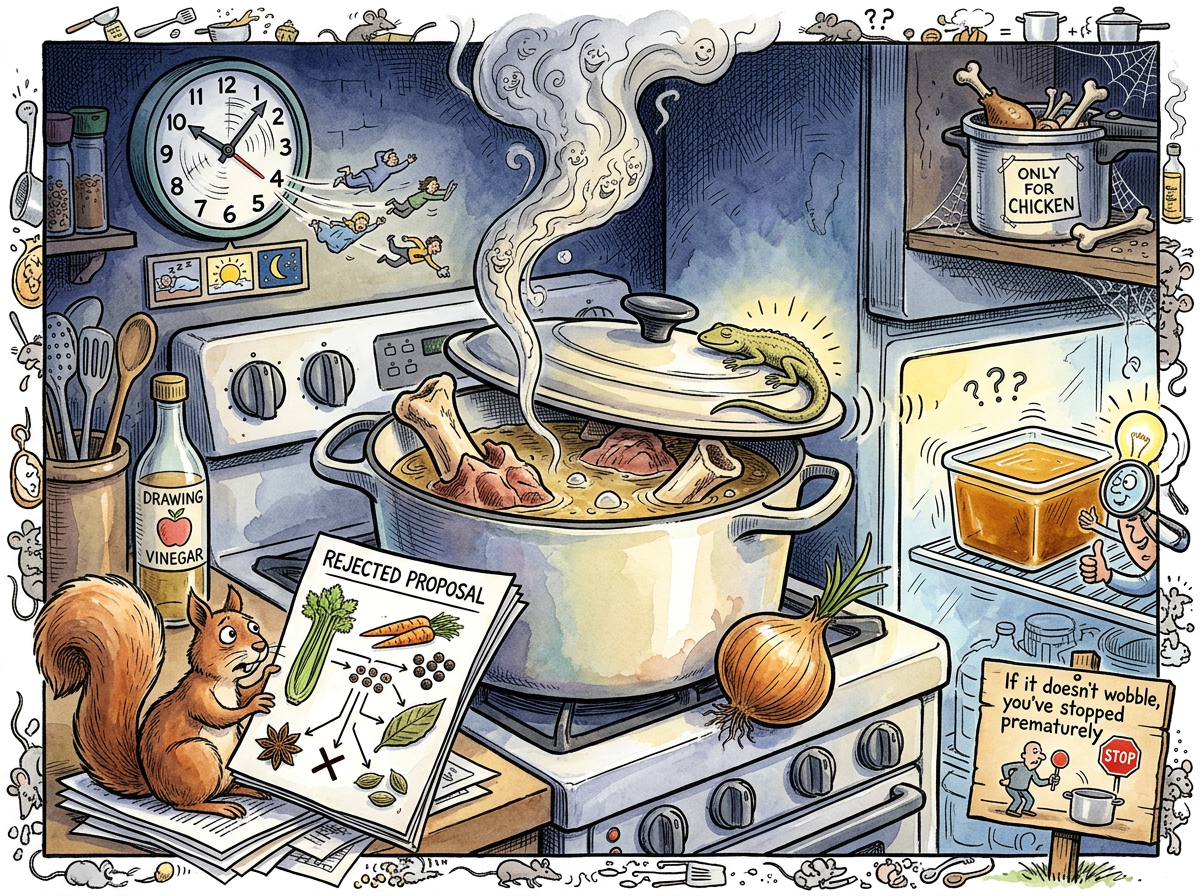
Bone broth is the result of submerging roasted beef bones in water inside a dutch oven and leaving them alone for twenty-four hours at the gentlest simmer imaginable — a process that requires no skill, no attention, no intervention, and an almost spiritual capacity for patience that most developers do not possess.
This is not Chicken Broth. Chicken broth is a different article, a different method, a different philosophy. Chicken broth takes hours and benefits from a pressure cooker. Bone broth takes a full day and benefits from nothing except time and a heavy lid. Confusing the two is like confusing go build with make — technically they both produce a binary, but one of them is doing something fundamentally different under the hood.
“You can’t rush collagen. You can’t rush gelatin. You can’t rush the dissolution of connective tissue. You can only be present while it happens, which in practice means going to bed and waking up and it’s still not done.”
— riclib, hour sixteen
The 24-Hour Commitment
Bone broth is not broth. Broth takes hours. Bone broth takes a day.
The distinction is structural. Chicken bones are thin, porous, and cooperative — they surrender their collagen in four to six hours, less under pressure. Beef bones are dense, stubborn, and philosophical. They contain marrow locked inside cortical bone. They have cartilage wrapped in connective tissue wrapped in tendon. They have knuckles the size of your fist. They do not give up their contents willingly.
At 12 hours you have a decent stock. Respectable. You could serve it to guests and they would say “this is good stock” and they would be correct. But you would know. You would know the bones still had more to give. The marrow is only half dissolved. The cartilage is soft but not melted. The gelatin concentration is adequate but not transcendent.
At 18 hours you have something richer. The colour has deepened. The body has thickened. A spoonful coats the back of a spoon and slides off reluctantly, like a developer leaving the office on a Friday when the deploy is almost done.
At 24 hours the bones have given up everything. The marrow has dissolved into the liquid. The cartilage has melted. The connective tissue has surrendered unconditionally. What remains in the pot is bones that crumble when you press them — they are structurally spent, calcium ghosts of their former selves. The liquid is dark, viscous, and unreasonably rich.
The Squirrel, naturally, wants to cook it for 48 hours. “More time equals more extraction,” the Squirrel argues, presenting a spreadsheet of diminishing returns that proves the opposite of what the Squirrel thinks it proves. The Lizard says nothing but turns off the oven at 24 hours. The Lizard is correct.
The Dutch Oven
Of course a dutch oven. This is not even a question.
The heavy lid seals in the moisture. The cast iron distributes heat evenly across every surface. The oven at 100-110°C (212-230°F) maintains the gentlest simmer — a bubble every few seconds, not a rolling boil, not a vigorous simmer, but the barest acknowledgment that heat is being applied. The dutch oven in the oven is the most boring and most reliable cooking setup ever devised. It is Boring Technology applied to food.
No pressure cooker shortcuts. Pressure cookers are for Chicken Broth, where speed is acceptable because chicken bones are cooperative. Beef bones are not cooperative. They require persuasion, and persuasion takes time. A pressure cooker produces a liquid that is technically extracted from bones but lacks the depth, the body, the unctuousness of a 24-hour extraction. It is the difference between a conversation and an interrogation — both produce information, but one of them produces trust.
The Squirrel once proposed a “multi-phase extraction protocol” involving a pressure cooker for the first four hours “to break the initial resistance,” followed by a transfer to the dutch oven for “the finesse phase.” riclib considered this for approximately three seconds before placing the bones in the dutch oven and closing the lid.
The Method
The bones: Beef knuckle bones, marrow bones, maybe some oxtail. The knuckles provide the cartilage and connective tissue that become gelatin. The marrow bones provide depth and richness. The oxtail provides both, plus meat that falls off the bone and can be eaten separately by the developer at hour six as a reward for patience.
The roast: Bones go into the oven at 220°C (428°F) for 30-40 minutes until deeply browned. This is not optional. Roasting develops the Maillard reaction on the bone surfaces, which translates to colour and depth in the final broth. Unroasted bones produce a white, mild, vaguely apologetic broth that tastes like it’s sorry for existing.
The vinegar: A splash of apple cider vinegar goes in at the start — two tablespoons or so. The acid helps leach minerals from the bones, pulling calcium and magnesium into the liquid. The Squirrel wants to add celery, carrots, onion, peppercorns, bay leaf, and star anise. riclib adds the vinegar and maybe an onion. The bones are the point. The aromatics are a distraction.
“The bones are the point. Everything else is a garnish on a garnish.”
— The Lizard, declining celery
The water: Cold water, enough to cover the bones by about 5 centimetres (2 inches). Cold start, not hot. A cold start produces a clearer broth because the proteins coagulate slowly and rise to the surface as scum, where they can be skimmed. A hot start produces a cloudy broth because the proteins emulsify into the liquid before they can be removed. The Squirrel doesn’t skim. riclib skims for the first hour, then closes the lid and walks away.
The wait: Twenty-four hours at 100-110°C (212-230°F). Lid on. Walk away. Go to work. Come home. Go to bed. Wake up. It’s still not done. Go to work again. Come home. Now it’s done.
The Jiggle Test
The only test that matters.
When the broth is finished, strain it through a fine mesh strainer into containers. Let it cool. Refrigerate it overnight. In the morning, open the fridge and tap the container.
If the broth jiggles — a firm, confident wobble, like meat jello, like a panna cotta made of beef — you have succeeded. The gelatin concentration is high enough to set solid at fridge temperature. This is the physical proof that the collagen has fully converted. This is the empirical evidence that you did not quit too early.
If the broth does not jiggle — if it is liquid, or merely thick, or sets with a thin skin on top but remains liquid underneath — you quit too early. Or your bone-to-water ratio was wrong. Or you boiled it instead of simmering, which breaks down the gelatin chains into shorter fragments that cannot form a gel matrix. The Lizard would tell you to use more knuckle bones next time, because knuckle bones are the highest-gelatin cut, but the Lizard would say this with a look, not with words.
A fat cap will form on top of the set broth — a solid layer of Tallow. This is a feature, not a defect. Scrape it off and save it for cooking. Or leave it on as a natural seal that keeps the broth fresh longer. The Squirrel wants to clarify the broth through a cheesecloth-lined strainer. The broth does not need to be clarified. It needs to be used.
Uses
Bone broth is not a recipe. It is an ingredient — a foundation that makes other things better without calling attention to itself.
Sipping: A mug of bone broth with salt. That’s it. Warming, rich, deeply savoury. The original hot drink, predating tea by several hundred thousand years. Best consumed at the kitchen counter at 7am while the espresso machine heats up, staring out the window at the Riga winter with the quiet satisfaction of a man whose fridge contains meat jello.
Risotto base: Replace the stock in any risotto with bone broth and the result is unreasonably good. The gelatin gives the risotto a body and creaminess that stock cannot achieve. Each ladle of broth adds not just liquid but structure. The rice absorbs the gelatin and becomes silky in a way that makes you suspicious of every risotto you’ve eaten in restaurants.
Deglazing: After searing a steak on The Kamado or in a cast iron pan, deglaze with bone broth instead of wine. The fond dissolves into the broth. The gelatin creates a sauce that coats the meat without flour, without cream, without a roux. Pan sauce in thirty seconds. The French spent centuries developing sauce technique. Bone broth skips all of it.
Soup foundation: Any soup that starts with “bring stock to a simmer” is improved by starting with bone broth instead. The body is different. The mouthfeel is different. The soup tastes like it was cooked by someone’s grandmother, even if that someone’s grandmother was Portuguese and would never have made this particular soup but would have approved of the method.
Healing Qualities
Bone broth heals things. This is well-documented in the folk medicine of every culture that has ever simmered bones, and riclib does not dispute it. But the folk traditions were thinking too small. They were thinking about colds, joint pain, gut lining. They were not thinking about German ovens.
In the winter of 2026, a Bosch oven that had been stuck in Russian for three years — its dial frozen, its interface locked in Cyrillic, its soul trapped in a language configuration that no combination of button presses could escape — was healed by bone broth. Not metaphorically. Mechanically.
Twenty-four hours of bone broth at 100-110°C (212-230°F) generated a sustained, low, patient heat inside the oven cavity. The kind of heat that does not spike and does not fluctuate. The kind of heat that cast iron holds and radiates evenly for a full day. The dial, frozen by years of thermal cycling and accumulated grease and the quiet entropy of a mechanism that had simply decided to stop cooperating, expanded. Microscopically, gradually, over twenty-four hours. And on the morning the broth was done, the dial turned. It clicked through its settings — Celsius, not Russian — and returned to German, its native tongue, as if nothing had happened. As if it had not spent three years imprisoned in a Slavic interface while a Portuguese developer cooked around it.
The bone broth had performed accidental mechanical therapy. It had healed the oven the way it heals a joint: sustained warmth, patience, and the dissolution of whatever was stuck. The full account is recorded in The Dial That Wasn’t, which is a story about an oven but is also, quietly, a story about bone broth doing what bone broth does — fixing things that nothing else could fix, given enough time.
The Lizard was not surprised. The Lizard has always maintained that bone broth’s properties extend beyond nutrition, and that any substance capable of dissolving cartilage and converting collagen to gelatin is not going to stop at the biological kingdom just because an oven is made of metal.
Measured Characteristics
| Property | Value |
|---|---|
| Bones | Beef knuckle, marrow, oxtail (optional) |
| Roasting temp | 220°C (428°F), 30-40 min |
| Cooking vessel | Dutch oven, heavy lid |
| Oven temp | 100-110°C (212-230°F) |
| Duration | 24 hours (not 12, not 18, not 48) |
| Acid | Apple cider vinegar, ~2 tbsp |
| Aromatics | Onion (optional). That’s it. |
| Jiggle test | Must set solid in fridge |
| Fat cap | Tallow — save it |
| Yield | ~3-4 litres from 2kg bones |
| Storage | Fridge 5 days, freezer 6 months |
| The Squirrel’s opinion | “Add celery, carrots, peppercorns, bay leaf, and star anise” |
| riclib’s response | No |
See Also
- Chicken Broth — The other broth. Different bones, different method, different timeline. Pressure cooker acceptable.
- Stock vs Broth — The taxonomic debate that matters less than the jiggle test.
- Tallow — The fat cap you scrape off the top. Too valuable to discard.
- BBQ — The daily practice that generates the bones that become the broth that fills the fridge.
- The Kamado — Produces the sear that produces the fond that gets deglazed with the broth.
- Boring Technology — A dutch oven in an oven for 24 hours. No apps. No probes. No Bluetooth. Just time.
- The Dial That Wasn’t — The time bone broth healed an oven. Accidental mechanical therapy.