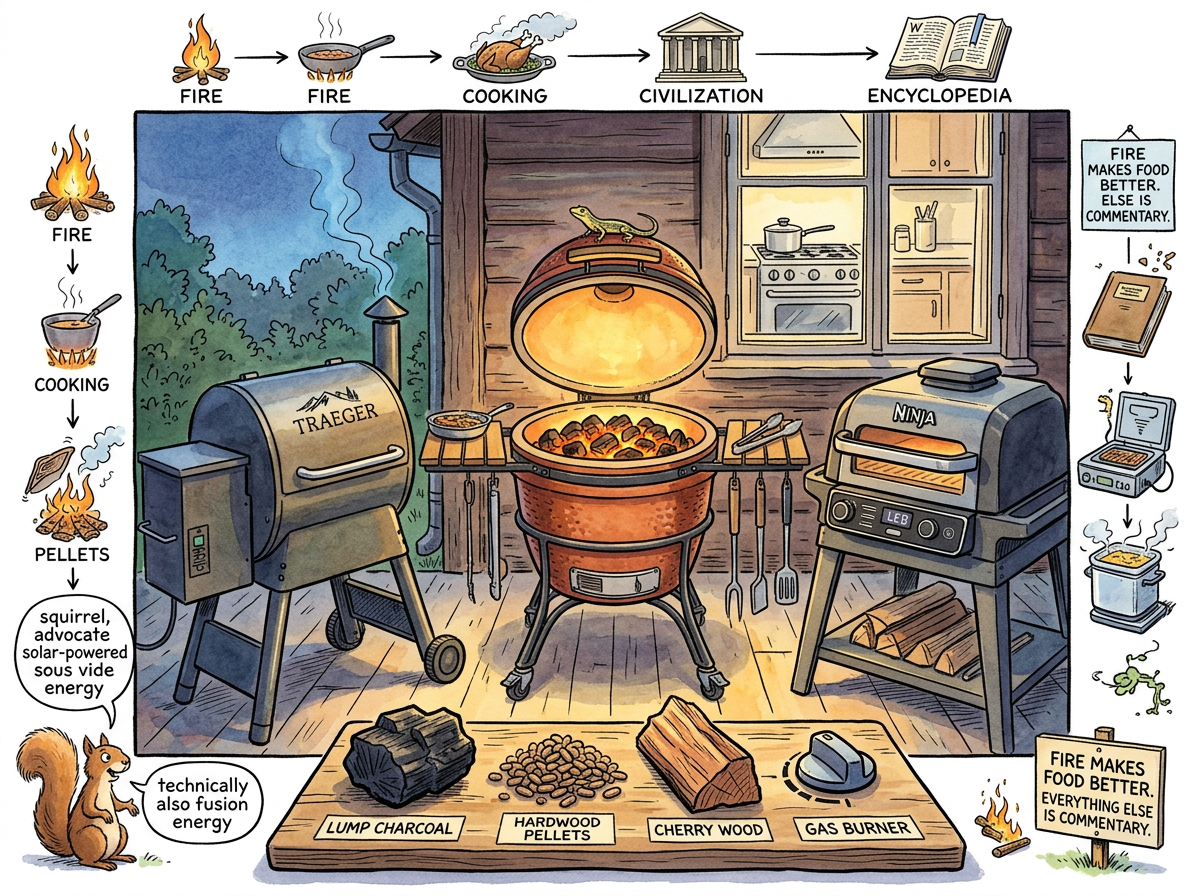
Fire is the element. The original technology. The one that makes everything else in the food section of this encyclopedia possible — and, if you squint historically enough, everything else in every other section too. Writing, metallurgy, ceramics, the steam engine, the semiconductor. All fire with extra steps. But this entry is not about civilisation. This entry is about fuel.
riclib cooks everything on fire. Not metaphorically. Literally. The Kamado burns lump charcoal. The Traeger burns hardwood pellets. The Ninja Woodfire uses convective heat — not fire, technically, but it has “fire” in the name and the Lizard allows it on a technicality. The stove has gas flames. Even The Dutch Oven goes into an oven heated by electricity, which is fire with extra steps and a thermostat.
The Squirrel proposes an induction cooktop. The Lizard stares at the Kamado’s glowing charcoal. The Squirrel explains magnetic fields and efficiency curves.
THE MEAT DOES NOT CARE
ABOUT YOUR EFFICIENCY CURVES.
THE MEAT CARES ABOUT HEAT.
AND SMOKE.
AND TIME. 🦎
The Fuels
This is the part that matters. Not the philosophical abstraction of combustion, but the practical taxonomy of what you burn and why it matters for what comes out the other end.
Lump charcoal — pure wood that has been pre-burned into carbon. The process drives off moisture, sap, and volatiles, leaving behind a fuel that burns hot (260°C+), burns clean, and produces minimal ash. The flavour it adds is subtle — smoke without the heaviness of raw wood. This is the primary fuel. The Kamado runs on lump charcoal exclusively, and the Kamado is the primary grill, so lump charcoal is the fuel that touches the most meat. It lights in ten minutes, reaches searing temperature in fifteen, and holds steady heat for hours with vent control. It is the Boring Technology of fuels: predictable, reliable, unsexy, effective.
Hardwood pellets — compressed sawdust from specific wood species. Hickory, mesquite, apple, cherry, oak. The species determines the smoke flavour, which is the entire point. Pellets burn at lower temperatures (105°C–150°C for low-and-slow), produce more smoke, and sustain longer burns. This is the Traeger’s fuel, and therefore the fuel for brisket, ribs, pulled pork — anything that needs eight hours at 120°C with consistent smoke. The pellet hopper is the Traeger’s best feature: load it, set the temperature, walk away. The auger feeds pellets to the fire pot at a rate determined by the controller. It is automation applied to combustion, and the Lizard approves because the automation is mechanical, not algorithmic.
Wood — splits or chunks added to charcoal for extra smoke. Oak and cherry are riclib’s preferences. Oak is steady and neutral. Cherry is sweet and colours the bark. Wood is not a primary fuel — it is an additive. A chunk of cherry on top of lump charcoal in the Kamado adds a smoke layer that the charcoal alone cannot provide. Two chunks. Maybe three. Not a bonfire. The Squirrel once proposed a four-wood rotation (oak base, cherry for colour, apple for sweetness, mesquite for punch). The Lizard rejected it. One wood per cook. Two at most. The meat does not need a symphony. The meat needs a melody.
Gas — the stove. Functional. Controllable. Instant on, instant off. No smoke, no char, no ritual. Gas is the fuel of necessity: boiling water, making sauces, heating the cast iron for a weeknight dinner when lighting the Kamado would be disproportionate to the task. The Kamado does not respect gas. Gas does not respect the Kamado. They coexist the way a sports car and a minivan coexist in a garage — different tools, different jobs, mutual indifference.
The Three-Grill Shuffle
riclib does not have a grill rotation. He does not pick a favourite and use it for everything. He uses the right tool at each stage, and sometimes a single cook involves multiple grills in sequence.
Traeger for low and slow. Ninja for the finish. Kamado for the sear. Oven for the hold. The right fuel at each stage. Not loyalty to one device — orchestration across all of them.
This is not over-engineering. This is the opposite. Over-engineering would be buying one grill that claims to do everything (the Squirrel’s preferred approach — a $3,000 combination grill/smoker/pizza oven/rotisserie with Bluetooth and an app). Orchestration is using three dedicated tools, each excellent at one thing, in the right sequence. It is microservices applied to combustion. The Lizard approves.
The 300,000-Year Thesis
Fire is the oldest human technology. Every entry in the food section of this encyclopedia exists because someone, at some point, held meat over fire and noticed the result was better than raw. The proteins denatured. The Maillard reaction occurred (though they didn’t call it that — they called it “good”). The fat rendered. The connective tissue broke down. The result was more digestible, more flavourful, and more caloric per gram than anything they had eaten before.
300,000 years later, riclib is doing exactly the same thing on a Latvian patio with better equipment and the same fundamental principle: fire makes food better. Everything else is commentary.
The fuel has changed. The control has improved. The thermometers are digital. The grills have controllers and fans and apps. But the core interaction — heat applied to protein over time — is identical. A Kamado is a clay pot with charcoal inside it. The oldest known cooking vessels were clay pots with charcoal inside them. The technology has not changed. The implementation has merely been refined.
This is why fire is the first entry in the food section. Not alphabetically. Architecturally.
Measured Characteristics
- Age of technology: ~300,000 years
- Fuels in active rotation: 4 (lump charcoal, hardwood pellets, wood chunks, gas)
- Primary fuel: lump charcoal
- Low-and-slow fuel: hardwood pellets
- Additive fuel: wood (oak, cherry)
- Reluctant fuel: gas
- Grills in service: 3 (Kamado, Traeger, Ninja Woodfire)
- Multi-grill cooks per month: 4–6
- Time to searing temperature (Kamado, lump charcoal): 15 minutes
- Time to searing temperature (gas stove): 30 seconds
- Smoke flavour from gas: none
- Smoke flavour from lump charcoal: subtle
- Smoke flavour from hardwood pellets: significant
- Smoke flavour from cherry wood chunk on charcoal: excellent
- Squirrel’s proposed combination grill: $3,000, Bluetooth-enabled, rejected
- Things fire makes better: food (all of it)
- Things fire does not make better: salad (but the Lizard does not acknowledge salad)