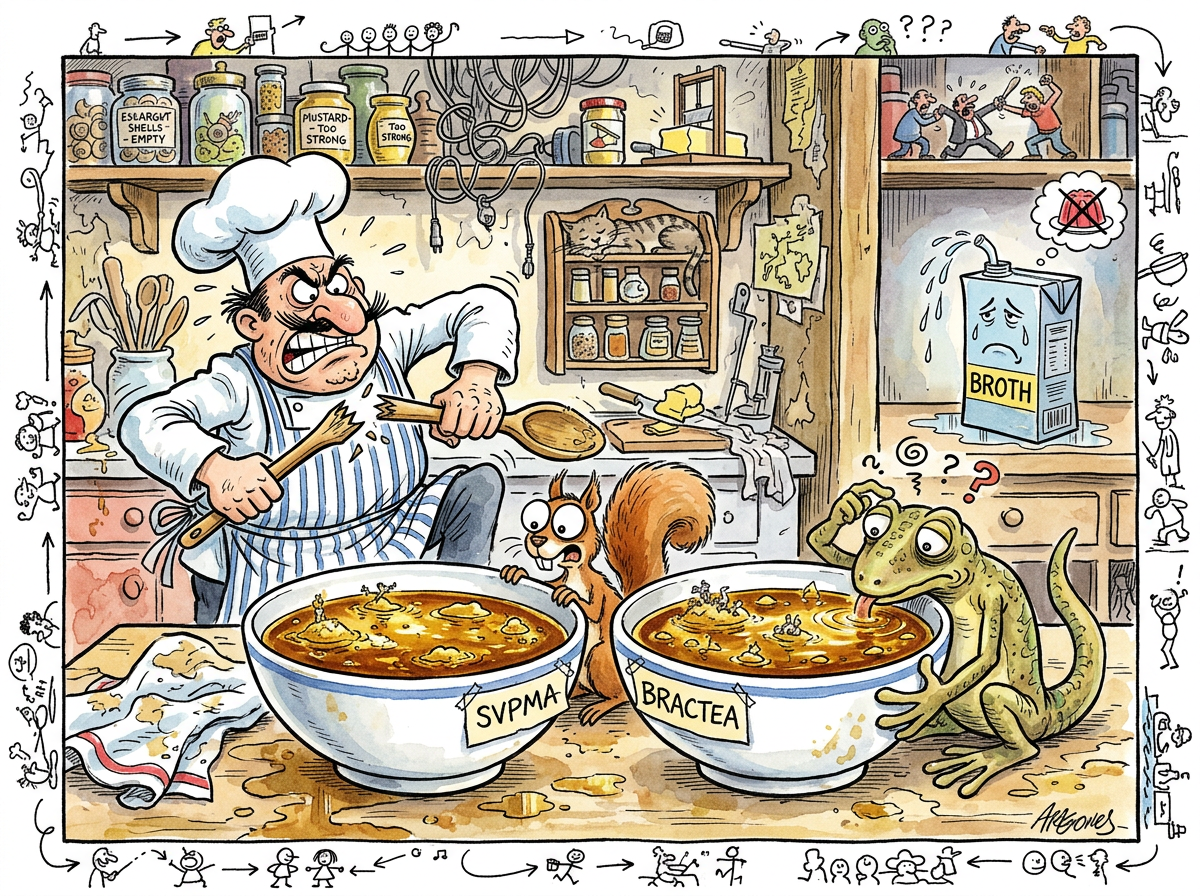
There exists, in the culinary world, a distinction so ancient, so fiercely debated, and so routinely ignored that it has achieved a kind of philosophical immortality — the kind usually reserved for questions like “what is consciousness?” and “is a hot dog a sandwich?” The distinction between stock and broth is one that every chef learns, most cooks forget, and absolutely nobody at the grocery store has ever once considered while reaching for a carton of Swanson’s.
The Squirrel, naturally, maintains that the distinction is not merely important but foundational to civilisation itself, and has written a 340-page treatise on the subject, cross-referenced with the original Escoffier. The Lizard tasted both, blinked slowly, and said: “It’s good soup.”
They are, infuriatingly, both correct.
The Classical Distinction
The French, who have never met a culinary concept they couldn’t turn into a rigid hierarchy, established the canonical definitions sometime around the 18th century, though people had been making both liquids since roughly the invention of fire and pottery and the radical idea of combining them.
Stock (fond, literally “foundation”) is made from bones. Raw or roasted, it doesn’t matter — what matters is that you are extracting collagen from connective tissue and marrow through prolonged simmering. A proper stock is:
- Unseasoned (no salt, or minimal salt)
- Simmered for 4-24 hours depending on the animal’s opinions about its own skeleton
- Rich in gelatin, which means it sets like jelly when cold
- An ingredient, not a finished dish — the foundation upon which sauces, braises, and risottos are built
Broth (bouillon) is made from meat (and possibly bones, but meat is the star). A proper broth is:
- Seasoned — salt, aromatics, herbs, the works
- Simmered for a shorter time (1-3 hours — meat gives up its flavour faster than bones)
- Intended to be consumed as-is — sippable, finished, a dish in its own right
- Generally lighter in body, since meat protein doesn’t produce the same gelatin as bones
The Squirrel once presented this distinction to riclib using a PowerPoint with 47 slides, animated transitions, and a bibliography. riclib listened politely, then made a pot of something using both bones and meat, seasoned it with salt, simmered it for six hours, and asked: “So what is this one?”
The Squirrel has not recovered.
The Modern Collapse
The distinction between stock and broth, like the distinction between “dinner” and “supper” or “jam” and “jelly,” has been slowly collapsing under the weight of modern usage, marketing departments, and the phrase that launched a thousand arguments: bone broth.
“Bone broth” is, by the classical French definition, simply stock. It is made from bones. It is simmered for hours. It produces gelatin. Calling it “bone broth” is like calling a dog a “four-legged bark mammal” — technically descriptive but willfully ignoring that we already have a perfectly good word. And yet “bone broth” is what the wellness industry chose, because “stock” sounds like something your grandmother made and “bone broth” sounds like something a person in athleisure would pay $9 for in a paper cup.
Meanwhile, “chicken broth” from a can is neither stock nor broth by any classical measure. It is flavoured water with opinions. It contains no gelatin. It has never seen a bone for longer than a brief, uncomfortable introduction. It is the culinary equivalent of a stock photo — technically depicting the subject, but with all the soul removed and replaced by sodium.
The Squirrel maintains a spreadsheet tracking which products use which term correctly. The spreadsheet has 2,847 entries. The compliance rate is 11%. The Lizard uses the words interchangeably and the food tastes the same. The Lizard’s food always tastes good. This bothers the Squirrel enormously.
The Jiggle Test
If you want to know whether your liquid extraction project was successful, there is exactly one test that matters, and it requires neither a degree in food science nor a spreadsheet:
Put it in the fridge. Wait. Does it jiggle?
If it jiggles when cold, it has enough gelatin to be called stock regardless of what the label says. The collagen has been extracted, the proteins have done their quiet, invisible work, and you are holding something with body — a liquid that will coat a spoon, enrich a sauce, and make a risotto that tastes like someone actually cared.
If it stays liquid, it’s broth at best, tea at worst.
riclib’s Chicken Broth jiggles. It jiggles because riclib roasts the carcass first, breaks the joints to expose the marrow, and simmers it for long enough that the bones start to look like they’ve given up on being solid objects. The fact that he calls it “broth” rather than “stock” is a deliberate act of linguistic rebellion that the Squirrel has filed a formal complaint about.
riclib’s Bone Broth jiggles aggressively. It doesn’t so much set in the fridge as congeal with intent. You could turn the container upside down and it would stay put, wobbling gently like a savoury panna cotta with a grudge. This is correct behaviour.
The store-bought “broth” in a Tetra Pak does not jiggle. It has never jiggled. It will never jiggle. It is warm, salted regret in a rectangular box, and its relationship to actual stock is roughly equivalent to the relationship between a photograph of a fireplace and actual warmth.
Other Traditions
The French may have codified the distinction, but they hardly invented the idea of simmering things in water until the water becomes interesting. Nearly every food culture on Earth arrived at the same conclusion independently, which suggests that “put bones in hot water, wait” is less a recipe and more an inevitability of having both fire and bones in the same civilisation.
Japanese Dashi — Made from kombu (kelp) and katsuobushi (dried bonito flakes), dashi contains neither bone nor meat in the traditional sense, yet it is unmistakably a stock. It is the foundation of miso soup, noodle broths, and roughly 80% of everything that makes Japanese food taste like Japanese food. The extraction takes about 15 minutes. The Squirrel finds this offensively efficient. The Lizard finds it inspirational.
Chinese Master Stock (lu shui) — A stock that is never discarded, only replenished. Aromatics are added, proteins are poached in it, liquid is topped up, and the cycle continues. Some restaurants in Guangdong claim master stocks that have been maintained continuously for decades — a living culture of flavour, like a sourdough starter that went to culinary school. The philosophical implications are staggering: at what point does a stock that has had every molecule replaced cease to be the original stock? This is the Ship of Theseus, but delicious.
Vietnamese Pho Broth — Beef bones, charred onion and ginger, star anise, cinnamon, cloves, and fish sauce, simmered for 24-48 hours. It is arguably the world’s most labour-intensive soup base, and it is worth every single hour. The charring of the aromatics is non-negotiable — it produces Maillard compounds that give pho its distinctive smoky depth. riclib attempted a 36-hour pho broth once in Riga and the entire apartment building smelled like a Vietnamese street market for three days. No complaints were filed. Several neighbours knocked on the door asking for bowls.
Portuguese Caldo Verde — Uses a simple broth made by boiling potatoes until they dissolve, which is then enriched with olive oil, garlic, and thinly sliced couve galega (collard greens). Nobody calls this “stock.” Nobody argues about whether it’s stock. It is potato water with ambition, and it is one of the most comforting soups on Earth. riclib makes it when Riga gets below -15C, which is often enough that he has developed strong opinions about which potatoes dissolve best (floury, never waxy, and if you use a blender you have missed the point entirely).
riclib’s Position
After years of making both stocks and broths in a kitchen in Riga — a city where winter lasts long enough that you could simmer a stock through an entire season and still have cold days left — riclib has arrived at the following position:
- Make good liquid from bones and/or meat. The source animal matters more than the terminology.
- If it gels, you did it right. Gelatin is the objective measure of extraction success. Everything else is vibes.
- If it doesn’t gel, cook it longer. Or add more joints. Chicken feet are the cheat code. They are 90% collagen and 100% unsettling to look at, and they will make your stock set like concrete.
- The word you call it is less important than whether it jiggles. Call it stock. Call it broth. Call it “bone juice” for all it matters. The liquid does not care about your taxonomy.
- Store-bought is acceptable for emergencies in the same way that a flat tyre is acceptable for driving — technically possible, spiritually compromised. Keep a box in the pantry. Use it when you must. Feel a small, appropriate sadness when you do.
The Squirrel has formally rejected this position on the grounds that it “undermines centuries of culinary scholarship.” The Lizard has formally endorsed it on the grounds that “it jiggles and it tastes good.” riclib continues to make stock — or broth — or whatever it is — every Sunday, using whatever carcasses and bones have accumulated during the week. He does not label the containers in the freezer beyond the date and the animal. This drives the Squirrel to despair. The Lizard thinks the containers look nice stacked up like that.
Measured Characteristics
| Property | Stock (Classical) | Broth (Classical) | Store-Bought “Broth” | riclib’s Sunday Liquid |
|---|---|---|---|---|
| Primary ingredient | Bones | Meat | Existential compromise | Yes |
| Simmer time | 4-24 hours | 1-3 hours | Industrial | “Until it looks right” |
| Seasoned | No | Yes | Aggressively | Eventually |
| Gels when cold | Yes | Usually not | Never | “It better” |
| Sippable as-is | Not really | Yes | Technically | After seasoning |
| Collagen content | High | Low-Medium | Theoretical | Weaponised |
| Correct label | Stock | Broth | Neither | “Sunday stuff” |
| The Squirrel’s rating | Approved | Approved | Rejected | Under review |
| The Lizard’s rating | Good soup | Good soup | Warm water | Good soup |
See Also
- Chicken Broth — riclib’s base recipe, which jiggles and is therefore stock, but he calls it broth because labels are a social construct
- Bone Broth — The one that jiggles aggressively and started a wellness trend
- Schmaltz — Rendered chicken fat, which floats on top of stock and is too valuable to skim
- Tallow — Rendered beef fat, the stock’s richer, more committed sibling
- Dashi — Proof that stock doesn’t need bones, just conviction
- Mirepoix — The aromatic base that goes into both stock and broth, because some things transcend taxonomy