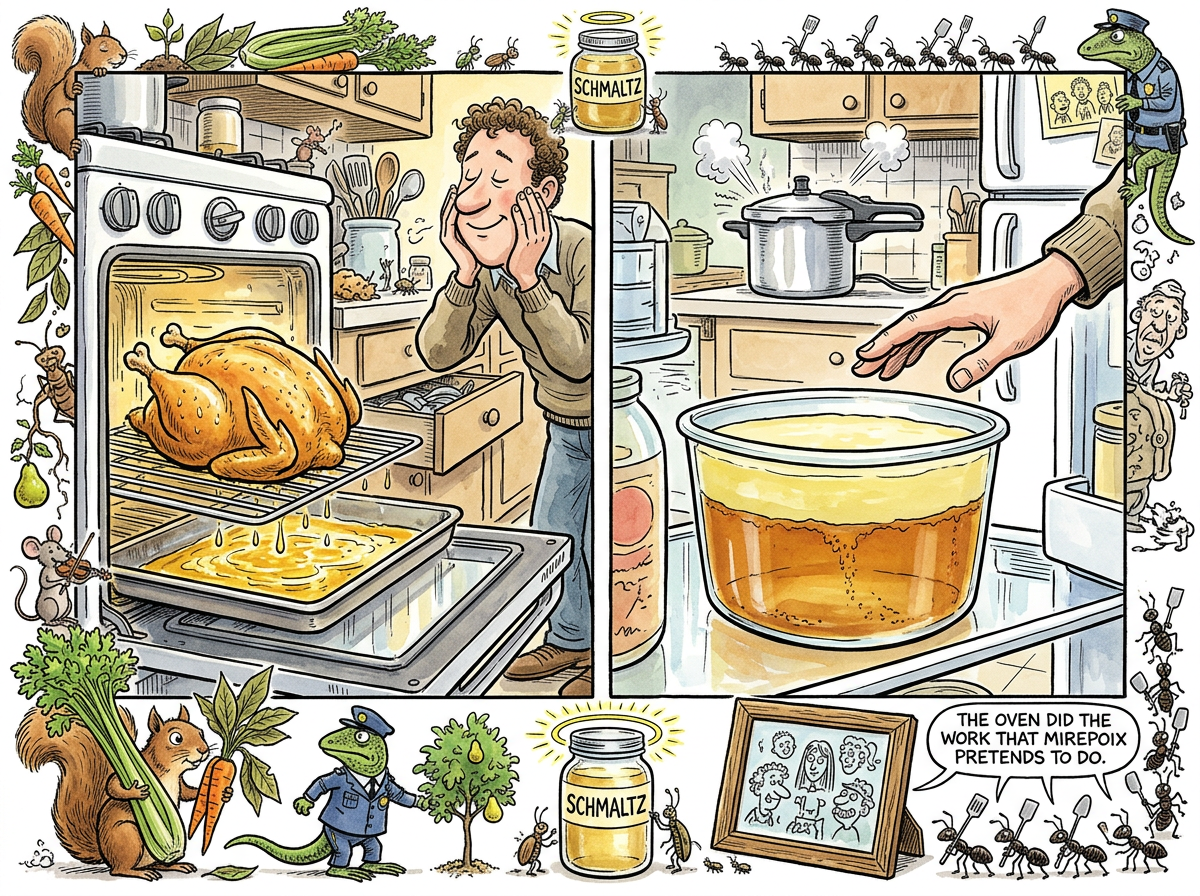
Chicken broth — real chicken broth, the kind that sets solid in the fridge like a savoury jelly that wobbles when you look at it — is not made by boiling a chicken with vegetables. It is made in two stages: first the oven, then the pressure cooker, with a sacred separation ritual in between. The vegetables are an onion. Maybe two. That’s it.
The Squirrel wants to add celery, carrots, bay leaf, peppercorns, thyme, parsley stems, and — if left unchecked — a partridge in a pear tree. The Squirrel believes complexity is depth. The Squirrel is wrong. The chicken was roasted. The roasting did the work that mirepoix pretends to do. The Maillard reaction on the skin, the caramelised fond on the tray, the rendered fat — these are the depth. The vegetables are a distraction from the fact that most broth recipes skip the roasting and need the vegetables to compensate for the flavour they never developed.
This is riclib’s method, developed in a Riga kitchen where the closest thing to a French culinary tradition is a deep suspicion of anything that isn’t potato. It works. It gels. The Lizard approves.
The Oven (Stage 1)
A whole chicken goes on a wire cooling rack set over a roasting tray. Into the oven at 200C (392F). The timing is 45-50 minutes, but the clock is not the authority. The nose is the authority.
There is a moment — and it is unmistakable — when the kitchen shifts from smelling like “something is cooking” to smelling like “dinner is ready.” This is not poetry. This is the Maillard reaction completing its work on the skin, the collagen beginning to break down in the joints, and the fond on the tray reaching the precise degree of caramelisation where it is dark and flavourful but not burnt. A timer cannot detect this. A nose can.
riclib does not set a timer. riclib walks into the kitchen at minute forty, breathes, and knows. This sounds mystical. It is not. It is pattern recognition trained over hundreds of chickens. The nose is a better thermometer than a thermometer, because the nose measures flavour development and the thermometer measures temperature, and these are not the same thing.
The chicken comes out golden, the skin crisp, the tray filled with rendered fat and concentrated drippings. The tray liquid is the most important thing in this process. Do not discard it. Do not pour it into the pressure cooker yet. It has a journey to make through the fridge first.
The Separation (The Fridge Ritual)
The tray liquid — a hot, opaque mixture of rendered fat, collagen-rich juices, and caramelised fond — goes into a container and into the fridge. This is where chemistry does what no straining or skimming can achieve as cleanly.
When cold, the liquid separates into two layers with the precision of a divorce settlement:
The top layer is fat. Solid, pale yellow, smooth. This is Schmaltz — rendered chicken fat — and it is collected with the reverence it deserves. It goes into a jar. The jar lives in the fridge. The jar is never empty for long, because there is always another chicken, and therefore always more schmaltz. Schmaltz is used for roasting potatoes, for frying eggs, for anything that would benefit from tasting more like chicken without actually containing chicken. It is, in the opinion of the Lizard, a better cooking fat than butter for everything except pastry.
The bottom layer is jelly. Amber, trembling, concentrated collagen that set solid because the roasting extracted enough connective tissue to form a gel. This jelly is liquid gold. It goes back into the broth when the pressure cooker is done, adding body and richness that no amount of boiling bones can replicate, because it carries the fond — the caramelised essence of the roasting tray — dissolved within it.
The separation is clean. The fat lifts off in a single piece. The jelly underneath is clear. There is no skimming, no fat separator, no cheesecloth. Just cold and time and the fundamental physical principle that fat floats.
The Squirrel wants to skip this step. “Just skim the fat off the hot broth,” the Squirrel says. The Squirrel has never seen how clean the separation is at 4C (39F) versus how futile it is at 80C (176F). Cold separation is not a shortcut. It is the only method that works completely.
The Pressure Cooker (Stage 2)
The roasted chicken goes into the pressure cooker. An onion goes in — halved, unpeeled, because the skin adds colour and the Lizard does not peel onions for broth. Maybe a second onion if the chicken is large. Water goes in. Nothing else.
The Squirrel, at this point, is physically restrained from adding:
- Celery (“for aromatics”)
- Carrots (“for sweetness”)
- Bay leaf (“for depth”)
- Peppercorns (“for warmth”)
- Thyme (“for herbaceousness”)
- Parsley stems (“for freshness”)
- A partridge in a pear tree (“for tradition”)
None of these are needed. The chicken was roasted. The roasting developed the aromatics. The roasting created the depth. The roasting caramelised the sugars. The mirepoix exists because French classical technique starts with a raw chicken in cold water, which produces a pale, insipid liquid that desperately needs vegetables to give it a personality. A roasted chicken already has a personality. Adding mirepoix to a roasted chicken broth is like adding a laugh track to a joke that already landed.
The pressure cooker runs. The bones give up their collagen under pressure. The cartilage dissolves. The marrow surrenders. When it is done, the broth is strained, the collagen jelly from the fridge ritual is stirred in, and the result is a broth that — when cooled — sets solid in the fridge. Not sort-of-thick. Not slightly-wobbly. Solid. A spoon stands up in it. This is how you know it worked. The gel is the proof.
Measured Characteristics
- Oven temperature: 200C (392F)
- Oven time: 45-50 minutes (by nose, not by clock)
- Timing authority: the nose (not the timer)
- Vegetables in the broth: onion (one or two, halved, unpeeled)
- Vegetables not in the broth: celery, carrots, bay leaf, peppercorns, thyme, parsley stems, partridge, pear tree
- Tray liquid destination: fridge (not the pressure cooker, not the sink)
- Separation temperature: 4C (39F)
- Top layer: Schmaltz (collected religiously, stored in a jar, never discarded)
- Bottom layer: collagen jelly (returned to the finished broth)
- Separation method: cold and gravity (not skimming, not cheesecloth)
- Fridge gel test: solid (a spoon stands up in it)
- The Squirrel’s additions: rejected (all of them)
- The Lizard’s position: chicken, onion, that’s it
- Mirepoix’s actual role: compensation for not roasting
- The roasting’s actual role: doing the work that mirepoix pretends to do