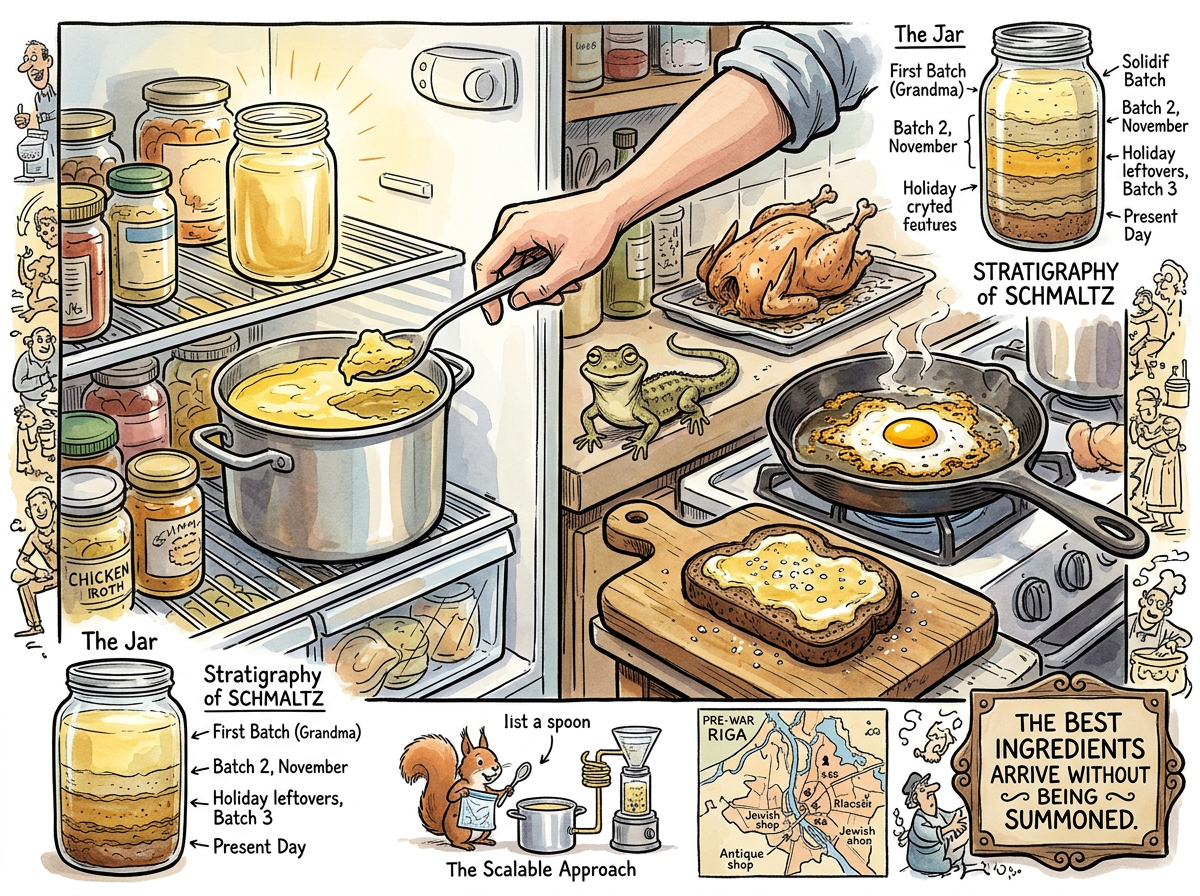
Rendered chicken fat. The Yiddish word for the pale golden substance that riclib collects with the solemnity of a temple ritual every time he makes Chicken Broth.
In a world obsessed with manufacturing complexity, schmaltz is the fat that manufactures itself. You roast a chicken. You make broth from what remains. You put the broth in the fridge. In the morning, a golden layer has risen to the surface and solidified, like a small geological event that happened overnight in your Tupperware. You scrape it off. You put it in a jar. You have schmaltz.
The Squirrel, predictably, wants to collect chicken skins in a freezer bag over several months, then render them slowly in a pan with onions and garlic, straining through cheesecloth into sterilized jars with handwritten labels and dates. This is technically valid. It is also the culinary equivalent of building a hydroelectric dam when it is already raining.
The Lizard says nothing. The Lizard makes broth. The Lizard scrapes off the fat. The Lizard has schmaltz.
The Collection
The ritual begins at the Riga Central Market, where riclib buys chicken carcasses — six to eight at a time — together with chicken feet. The carcasses are cheap. The feet are cheaper. The collagen in the feet is priceless, though the market does not price it that way.
The carcasses go onto a wire rack in the oven and roast until golden. This is not cooking dinner — this is manufacturing ingredients. The roasted carcasses will become broth. But first, they become schmaltz.
The fond and rendered fat from the roasting tray go into a glass vase and are dipped in ice. Physics does what physics does, but faster now — the cold accelerates the separation. The fat rises and congeals on top. The collagen-rich jelly settles to the bottom. Two layers, clean as geology: the top is pure schmaltz, the bottom is pure collagen.
The schmaltz is scraped off and added to The Jar. The collagen goes into the pot with the roasted carcasses and the chicken feet — because there is no such thing as too much collagen — together with a Latvian sweet onion, the kind that grows in Baltic soil and tastes like it has been sweetened by the same cold that preserved it.
The pot goes either into the pressure cooker — on days when riclib is being efficient — or into The Dutch Oven, on days when he is feeling like doing it right. The pressure cooker produces broth in ninety minutes. The Dutch Oven produces broth in eight hours. Both produce broth. Only one produces broth that makes the kitchen smell like a grandmother’s house that you have never visited but somehow remember.
The Jar lives in the fridge. It has no label. It does not need a label. Nothing else in the fridge is that color. The Jar grows with each batch — six to eight carcasses’ worth of fat layered in geological strata. When The Jar is full, a second Jar appears. This has been happening since riclib discovered that the layer of fat he’d been discarding was, in fact, the most valuable part of the entire broth-making process.
The Squirrel, predictably, wants to optimise the separation process. A centrifuge. A temperature-controlled settling tank. A spreadsheet tracking schmaltz yield per carcass per season. The Lizard says nothing. The Lizard dips the vase in ice. The Lizard has schmaltz.
The Flavor
riclib’s schmaltz is not the pale, neutral rendered fat you buy in a jar. It carries the full Maillard signature of carcasses that spent time at 200°C (392°F) before they ever saw a stockpot. The proteins caramelised. The collagen concentrated. The fat absorbed all of it and then, when cooled, locked it in.
The result is schmaltz that tastes like roasted chicken concentrate. It is deep gold, complex, slightly smoky, and carries aromatic compounds that raw-rendered schmaltz never develops. When you fry an egg in it, the egg tastes like it was laid by a chicken that had been thinking very hard about roasting.
Uses
Frying eggs. The single greatest use of schmaltz, and arguably the reason chickens were domesticated in the first place. A tablespoon of schmaltz in a pan, heated until it shimmers. Crack the egg in. The white crisps at the edges with a golden lace pattern. The yolk stays soft. The entire egg tastes like a roast chicken dinner compressed into breakfast. It is the best egg fat after Duck Fat, and riclib will fight anyone who says butter is better. Butter is fine. Schmaltz is ancestry.
Roasting potatoes. Cut potatoes into chunks. Toss in melted schmaltz. Roast at 220°C (428°F). The potatoes emerge golden, crispy, and scented with chicken in a way that makes people ask what you did differently. What you did differently is you used the fat of a civilisation instead of the oil of a corporation.
Sautéing onions. For any dish that starts with “sauté the onions in…” — substitute schmaltz. The onions will caramelize faster (the residual sugars in the schmaltz help) and develop a roasted depth that olive oil cannot provide and butter only approximates.
On bread. Schmaltz on rye bread with coarse salt. This was a meal in Eastern Europe. Not a snack, not an appetiser — a meal. Workers ate this. Families ate this. It is dense, rich, and satisfying in the way that only animal fat on good bread can be. In Riga, where rye bread is a foundational element of existence (see: every Latvian bakery), schmaltz on bread is not nostalgia. It is Tuesday.
As a sofrito base. Anywhere you would start with olive oil or butter for a sofrito, mirepoix, or refogado, schmaltz works. It adds a savoury depth that is impossible to replicate with plant fats. riclib uses it in risotto, in bean stews, in anything where a Portuguese refogado meets Eastern European pragmatism.
The Riga Connection
Riga is not a city that most people associate with schmaltz. Most people associate schmaltz with New York delis, or with their grandmother’s kitchen in Brooklyn, or with a vague sense of Ashkenazi nostalgia filtered through Seinfeld reruns.
But Riga was one of the great centres of Yiddish life in Europe. Before the war, a third of Riga’s population was Jewish. The food culture of Latvian Jewish communities was built on the same foundations as Jewish food culture everywhere in the Pale of Settlement: chicken, onions, bread, and the fat that connected them all. Schmaltz was not a speciality ingredient. It was the default cooking fat. It was what you used because you had chickens and you had a kitchen and you were not going to waste what the chicken gave you.
The war took the communities. The food culture fragmented. But the traces remain — in the rye bread, in the onion-heavy cooking, in the way that certain dishes in Latvian cuisine carry echoes of flavours that came from kitchens that no longer exist.
riclib, a Portuguese developer living in Riga, collects schmaltz in a jar in his fridge and uses it to fry eggs. He does not do this because he is performing cultural archaeology. He does this because it is the best way to fry an egg. But the jar in his fridge connects, through the fat of roasted chickens, to a food tradition that was nearly erased from the city where he now lives. The schmaltz does not know this. The schmaltz is just fat. But the hands that scrape it from the broth are continuing something, whether they intend to or not.
Measured Characteristics
| Property | Value |
|---|---|
| Smoke point | 190°C (374°F) — higher than butter, lower than your ambitions |
| Colour (riclib’s, roast-derived) | Deep gold, like afternoon light in October |
| Colour (raw-rendered) | Pale cream, like morning light through curtains |
| Texture at fridge temp | Solid, scoopable, slightly granular |
| Texture at room temp | Soft, spreadable, willing |
| Shelf life (fridge) | Months, theoretically. The jar is never around that long. |
| Shelf life (freezer) | Indefinite, like grief and good habits |
| Carcasses per batch | 6-8 (from Riga Central Market) |
| Chicken feet per batch | As many as the butcher will sell you |
| Separation method | Glass vase dipped in ice |
| Yield per batch | Enough to notice The Jar growing |
| Collection frequency | Every broth batch, no exceptions |
| Broth method (efficient) | Pressure cooker, 90 minutes |
| Broth method (right) | Dutch Oven, 8 hours |
| Flavour profile | Roasted chicken, caramelised onion, the Maillard reaction’s greatest hit |
See Also
- Chicken Broth — the process that produces schmaltz as a blessed byproduct
- Goose Fat — the aristocratic cousin, excellent but harder to come by
- Duck Fat — the only fat riclib ranks above schmaltz for eggs, and only slightly
- Tallow — beef’s answer to the same question, different accent
- Ghee — clarified butter, the subcontinental parallel evolution
- BBQ — where animal fats meet fire and time, as they were always meant to