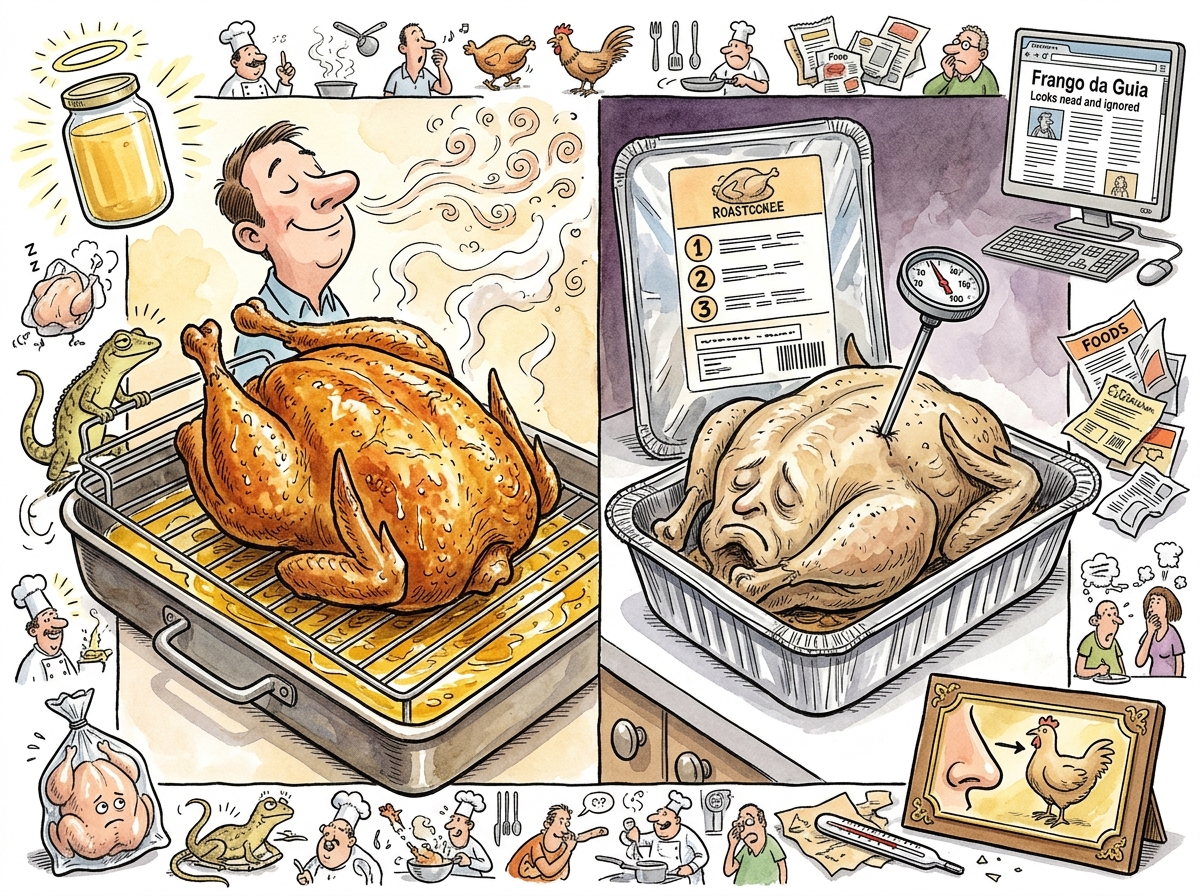
A roast chicken is the thing everyone believes they can make and almost nobody makes well, because making it well requires ignoring almost everything the recipe on the packaging says and trusting a sensory organ that modern cooking has systematically devalued: the nose.
A roast chicken is also the entry point to Chicken Broth, Schmaltz, and an entire infrastructure of rendered fats and collagen extraction that most cooks never access because they throw away the tray drippings, which is the culinary equivalent of deleting the build artifacts.
“The chicken is not the end product. The chicken is the first stage of a two-stage extraction. The second stage is the pressure cooker. The tray drippings are the most important thing in the process. Throwing them away is like deploying to production and then deleting the logs.”
— The Lizard
The Uninformed Version
The uninformed roast chicken follows the instructions. The instructions say: preheat the oven to 180°C (356°F). Place the chicken in a roasting tray. Cook for 20 minutes per pound plus 20 minutes. Check internal temperature with a meat thermometer. 74°C (165°F) means done.
The instructions are not wrong. The instructions produce a chicken that is safe to eat, which is a different goal from producing a chicken that is worth eating. Safety and quality overlap but are not identical, in the same way that code that compiles and code that works overlap but are not identical.
The thermometer reads 74°C. The chicken is “done.” The skin is pale. The fat has not rendered. The tray below contains a thin, watery liquid that will be poured down the sink. The chicken tastes like protein that has been heated. The meal is adequate. Adequate is the enemy of good in kitchens the same way it is in code.
The Informed Version
The informed roast chicken — the Frango da Guia method, the Chicken Broth method, riclib’s method — differs in three ways:
Temperature: 200°C (392°F), not 180°C. The higher temperature drives the Maillard reaction on the skin, rendering fat and creating the caramelised golden crust that is the difference between a roast chicken and a heated chicken. The Maillard reaction requires temperatures above 140°C to produce flavour compounds. At 180°C, it happens slowly and incompletely. At 200°C, it happens with authority.
The wire rack. The chicken sits on a wire cooling rack set over the roasting tray, not in the tray. This allows hot air to circulate around the entire bird, rendering fat from the bottom as well as the top, and allowing the drippings to fall into the tray below where they concentrate into liquid gold. A chicken sitting in its own juices steams from below. A chicken on a rack roasts from all sides. This is the same principle as The Reverse Sear — optimise each surface independently.
The nose, not the timer. There is a moment — forty to fifty minutes in — when the kitchen shifts from smelling like “something is cooking” to smelling like “dinner is ready.” This is not poetry. This is the Maillard reaction completing its work, the collagen beginning to break down, and the fond on the tray reaching optimal caramelisation. A timer cannot detect this. A thermometer cannot detect this. The nose detects it because the nose measures flavour development, and flavour development is the thing you are actually trying to achieve.
riclib does not set a timer. riclib walks into the kitchen at minute forty, breathes, and knows. This sounds mystical. It is pattern recognition trained over hundreds of chickens, and it is more reliable than any digital instrument because it measures the output (smell) rather than the proxy (temperature).
The Infrastructure
The informed roast chicken is not a meal. It is the first stage of an infrastructure pipeline:
- The chicken → dinner
- The tray drippings → fridge → separation into Schmaltz (top layer) and collagen jelly (bottom layer)
- The schmaltz → jar → roasting potatoes, frying eggs, everything that benefits from tasting more like chicken
- The collagen jelly → back into the Chicken Broth → body, richness, the gel test
- The carcass → pressure cooker → broth that sets solid in the fridge
Throwing away the tray drippings skips steps 2 through 4. This is the culinary equivalent of writing a function and not returning the value.
Hardcore Mode (The Kamado)
The oven roast chicken is Normal mode. The Kamado roast chicken is Hardcore mode — the same dish, the same infrastructure pipeline, played on a difficulty setting where the floor is live charcoal and the build artifacts are six inches above it.
In the oven, the drip tray sits safely below the chicken. The heating element is behind a wall. The fat renders, pools in the tray, and waits patiently for the fridge separation ritual. Nothing catches fire because nothing can catch fire. The oven is a controlled environment. The tray is never in danger.
In the Kamado, the drip tray sits above glowing lump charcoal, inside a ceramic vessel that retains heat the way a grudge retains resentment. The chicken sits above the tray on the grill grate. The fat renders, drips into the tray — and the tray is being heated from below by coals that are running at 200°C+ and do not know the difference between “maintaining temperature” and “igniting rendered fat.”
The challenge is preserving the infrastructure pipeline — the Schmaltz, the collagen jelly, the tray drippings that make the Chicken Broth worth making — on equipment that is actively trying to set the pipeline on fire. This requires vent management: the Kamado’s top and bottom vents control airflow, which controls temperature, which controls whether the fat in the tray gently renders or spontaneously combusts. The margin between “perfect roast with full artifact collection” and “grease fire inside a ceramic pressure vessel” is approximately one vent adjustment.
riclib does this regularly. riclib considers the risk acceptable because the schmaltz is worth defending even when the infrastructure is on fire.
The Goose Incident
riclib once attempted this technique with a goose.
A goose contains substantially more fat than a chicken. This is known. What is less commonly appreciated is how much more fat, and what happens when that fat accumulates in a drip tray that is being heated from below by lump charcoal inside a ceramic oven that maintains temperature with the enthusiasm of equipment that has no off switch.
The sequence:
- The roast began. The goose rendered fat into the tray. This was expected and desired.
- The tray became a deep fryer. The volume of rendered goose fat exceeded the tray’s thermal safety margin. The fat reached smoke point. This was not expected.
- The tray became a flambé. The fat ignited. Inside the Kamado. The ceramic vessel, designed to retain heat, retained the heat of a grease fire with the same efficiency it retains the heat of a roast. This was very much not expected.
- The goose was carbonised. The fire consumed the fat, the drippings, the fond, and ultimately the goose itself, which went from “roasting” to “cremated” in a timeframe that did not allow intervention.
- The fire department called. Not arrived — called. The smoke was visible enough, or the neighbours concerned enough, that the fire department telephoned to ask if riclib was alright.
He was alright. The goose was not. The schmaltz was not. The infrastructure pipeline was not. The Kamado, being ceramic, was fine — the Kamado has survived everything since 3,000 BCE and a goose fire is not going to be the thing that stops it.
The goose incident is recorded here as a warning: Hardcore mode with poultry is viable. Hardcore mode with waterfowl is a boss fight that requires preparation, vent discipline, and a drip tray with sufficient capacity for the volume of fat that a goose considers normal and that a chicken would consider criminal.
Measured Characteristics
Oven temperature (uninformed):                          180°C (pale, adequate)
Oven temperature (informed):                            200°C (golden, correct)
Timing method (uninformed):                             timer + thermometer
Timing method (informed):                               nose (minute 40-50)
Thermometer accuracy for temperature:                   high
Thermometer accuracy for flavour:                       0
Nose accuracy for flavour:                              trained over hundreds of chickens
Wire rack:                                              required (not optional)
Tray drippings (uninformed):                            discarded (down the sink)
Tray drippings (informed):                              collected (into the fridge, separated, used)
Infrastructure stages from one chicken:                 5
Build artifacts discarded by uninformed cook:            3 (schmaltz, jelly, broth)
Kamado difficulty setting:                               Hardcore
  Drip tray distance from live coals:                   ~15 cm
  Margin between "perfect roast" and "grease fire":     one vent adjustment
  Goose fat volume vs chicken fat volume:               approximately 4x
  Goose incident stages:                                5 (roast → deep fryer → flambé
                                                         → carbonised → fire department)
  Fire department response:                             phone call (welfare check)
  riclib status:                                        alright
  Goose status:                                         not alright
  Kamado status:                                        fine (has survived since 3,000 BCE)
  Schmaltz recovered from goose incident:               0
The Squirrel's proposed roasting framework:             17 spices, a Bluetooth thermometer,
                                                        and a TemperatureOptimisationEngine
The Lizard's roasting framework:                        200°C, wire rack, nose
See Also
- Roast — The unifying taxonomy
- Chicken Broth — What the chicken becomes after dinner
- Schmaltz — The golden fat, collected religiously
- Frango da Guia — The small chicken, done right
- Roasting (Coffee) — Same Maillard, different substrate
- The Reverse Sear — Same principle (optimise each surface)
- Pepper Smoke Salt — Same minimalism (the chicken needs less than you think)
- The Kamado — Hardcore mode equipment
- Spatchcock Chicken — The prerequisite for Kamado chicken
- Goose Fat — The substance that started the fire