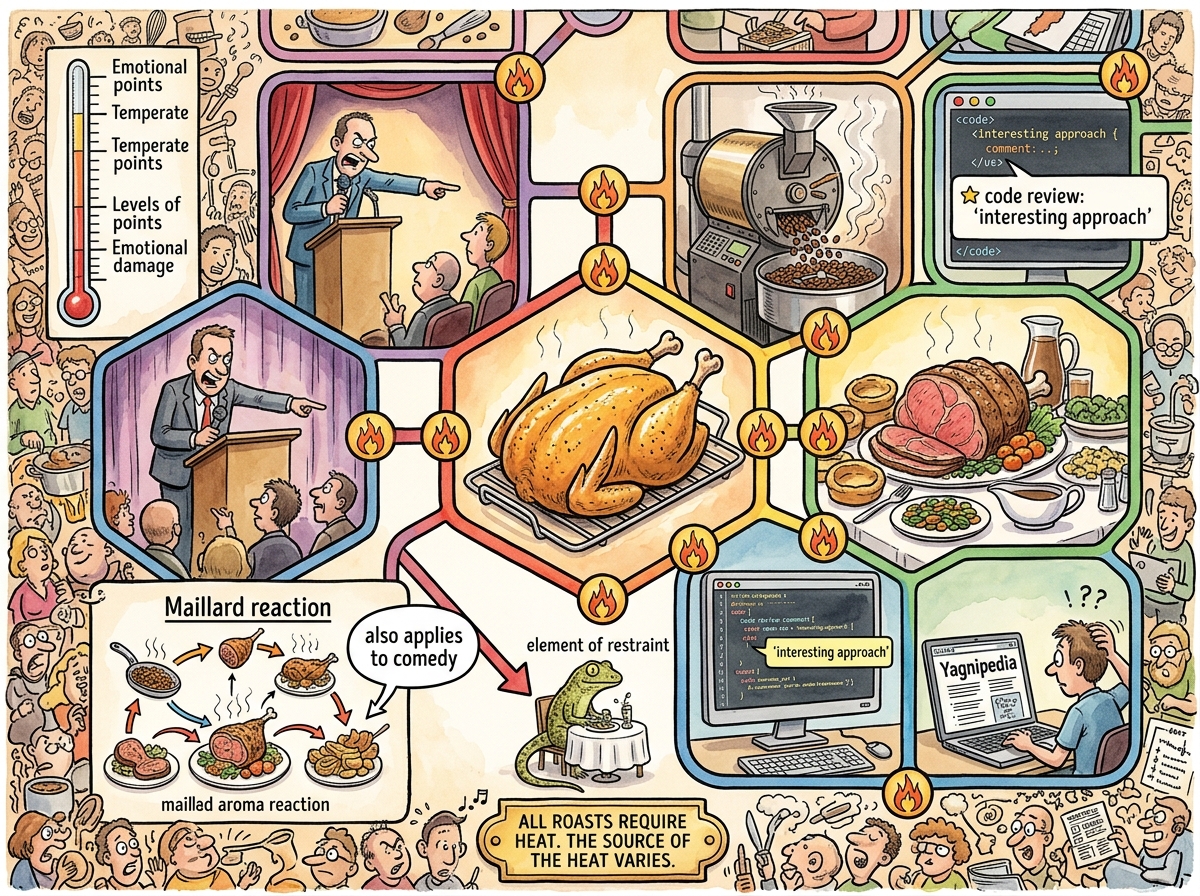
Roast (noun, verb) is the application of sustained heat to a subject until the subject is fundamentally transformed. The subject may be a coffee bean, a chicken, a Sunday joint, a comedian’s friend, a note-taking application, or a colleague’s pull request. The heat may be thermal, social, or editorial. The transformation is always irreversible.
The word “roast” appears in six distinct articles in this encyclopedia, which is not a coincidence but a convergence — the same principle observed across different kitchens. Pepper Smoke Salt demonstrated that three ingredients are sufficient. The Roast demonstrates that one verb is sufficient, applied with varying temperatures to varying substrates, to describe a surprising percentage of human activity.
“Heat transforms. That is the only thing heat does. Whether the heat comes from an oven, a stage, or a code review comment that begins with ‘interesting approach’ — the mechanism is identical.”
— The Lizard
The Taxonomy
All roasts share three properties:
- Heat is applied — thermal, verbal, or editorial
- The subject is transformed — from raw to cooked, from unknown to exposed, from unreviewed to reviewed
- The transformation is irreversible — you cannot un-roast a chicken, un-roast a comedian, or un-read a code review that says “did you mean to commit this?”
The taxonomy:
| Roast | Heat Source | Subject | Transformation |
|---|---|---|---|
| Roasting (Coffee) | 196–230°C | Green beans | Flavour (or charcoal, see: Sweden) |
| Roast (Chicken) | 200°C | A whole chicken | Dinner (or broth infrastructure) |
| Roast (Sunday) | An oven and three centuries of tradition | A joint of beef | A national identity |
| Roast (Comedy) | Affection disguised as cruelty | A person, a tool, a concept | Laughter through accuracy |
| Roast (Code Review) | A PR comment | A colleague’s architecture | Growth through devastation |
The Unifying Principle
The Maillard reaction — the chemical process that makes roasted coffee, roasted chicken, and roasted beef taste good — requires two things: amino acids and reducing sugars, combined under heat. The result is hundreds of new flavour compounds that did not exist in the raw material.
The comedy roast requires two things: affection and accuracy, combined under social heat. The result is laughter that did not exist in the raw material.
The code review roast requires two things: expertise and honesty, combined under editorial heat. The result is better code that did not exist in the raw material.
In all cases, the raw material is improved by the application of heat. In all cases, the heat must be controlled — too little and nothing transforms, too much and everything burns. The difference between a medium roast and charcoal is fifteen seconds. The difference between a roast and an insult is affection. The difference between a constructive code review and a hostile one is whether the reviewer has read the code.
The Yagnipedia as Roast
The Yagnipedia itself is a roast. Every article applies editorial heat to a subject — Tana, Evernote, Apple Notes, Roam Research, Logseq — until the subject is transformed from “a tool I use” into “a tool I now understand with uncomfortable clarity.”
The heat is affection. The accuracy is the mechanism. The Yagnipedia does not mock its subjects. The Yagnipedia describes them precisely, and precision, applied to things we love, is indistinguishable from a roast.
The Caffeinated Squirrel objects to being roasted. The Squirrel has been roasted in every article since episode one. The Squirrel does not notice, because the Squirrel is too busy proposing a RoastTrackingFramework with SeverityMetrics.
Measured Characteristics
Types of roast in this encyclopedia:                    6
  Thermal (coffee, chicken, Sunday):                    3
  Social (comedy):                                      1
  Editorial (code review, Yagnipedia):                  2
Shared properties:                                      3 (heat, transformation, irreversibility)
Maillard reaction applicability:
  Coffee:                                               literal
  Chicken:                                              literal
  Comedy:                                               metaphorical (but structurally identical)
  Code review:                                          metaphorical (but emotionally identical)
Temperature range (thermal roasts):                     196-230°C
Temperature range (comedy roasts):                      room temperature (externally)
                                                        several hundred degrees (internally)
PKM tools roasted by Yagnipedia:                        all of them
PKM tools that deserved it:                             also all of them
The Squirrel's roast count:                             every article
The Squirrel's awareness of being roasted:              0
See Also
- Roasting (Coffee) — The Swedish crime
- Roast (Chicken) — The uninformed Frango da Guia
- Roast (Sunday) — The British institution
- Roast (Comedy) — Affection at temperature
- Roast (Code Review) — “Interesting approach”
- Pepper Smoke Salt — Three ingredients, same principle
- The Reverse Sear — Separation of concerns, with heat
- Chicken Broth — What happens after the roast