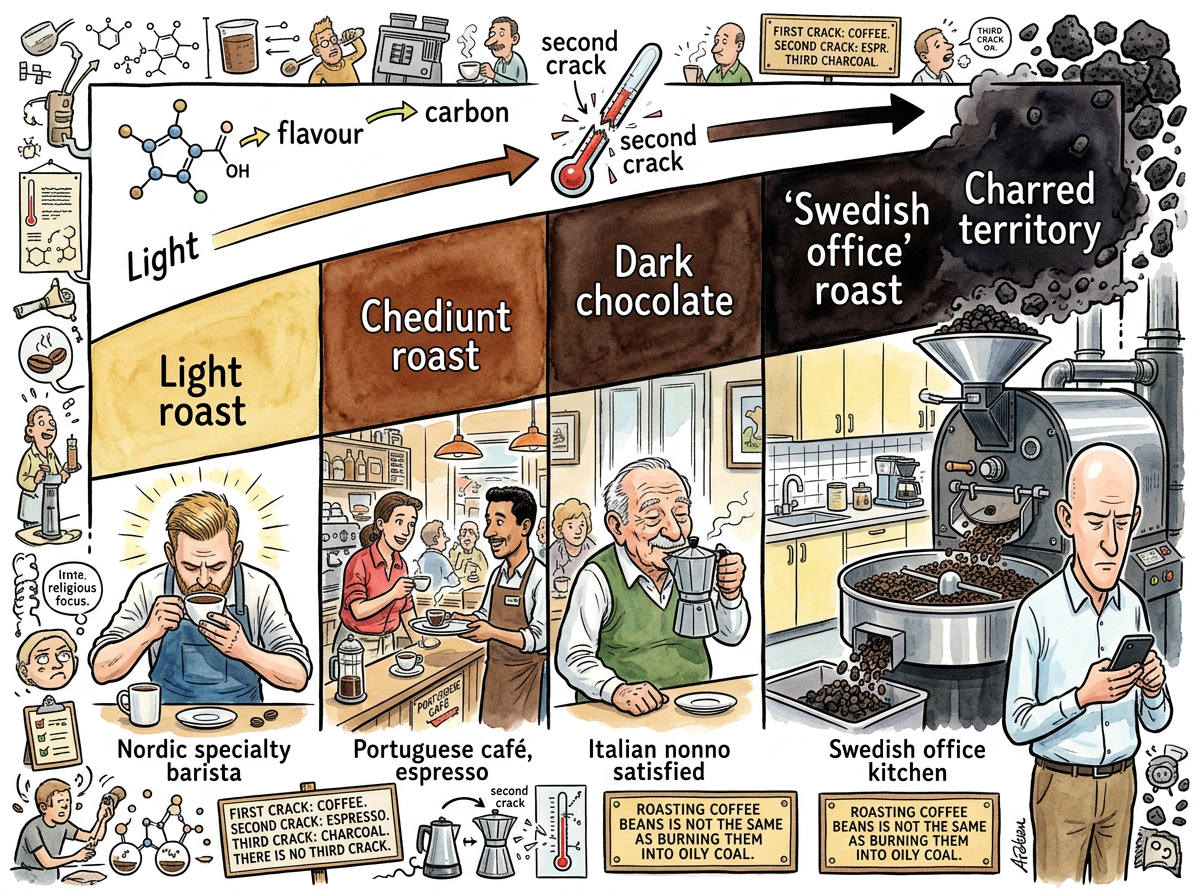
Coffee roasting is the thermal process by which green coffee beans — which taste like grass and contain no recognisable coffee flavour — are transformed into the aromatic, brittle, grindable seeds that produce the beverage upon which civilisation depends. It is a controlled application of heat over time, navigating a narrow corridor between underdevelopment and destruction, and it is the single variable most responsible for whether the resulting cup is worth drinking.
It is also, in certain Swedish offices, the single variable most responsible for what the Test Coordinator describes as “oily coal.”
“Someone has to tell swedes in the office that roasting coffee beans is not the same as burning them into oily coal.”
— The Test Coordinator, via WhatsApp, 08:04 Riga time, in the specific tone of a man who has been wronged by thermodynamics
The Chemistry
Green coffee beans contain approximately 800 aromatic precursor compounds that mean nothing until heat rearranges them. The roasting process activates two critical chemical cascades:
The Maillard Reaction — the same browning reaction that produces flavour in bread crusts, seared steaks, and the fond on a roasting tray. Amino acids and reducing sugars combine under heat to produce hundreds of volatile flavour compounds: pyrazines (nutty), furans (caramel), thiophenes (roasted). This is the reaction that makes coffee taste like coffee. It begins around 150°C and peaks around 200°C.
Caramelisation — the thermal decomposition of sugars, producing both sweetness and bitterness depending on duration. Controlled caramelisation adds complexity. Uncontrolled caramelisation adds charcoal flavour. The difference between the two is approximately fifteen seconds.
The Spectrum
Coffee roasting exists on a spectrum that, like most spectra, has a useful middle and catastrophic extremes:
Light Roast (195–205°C, first crack) — The bean retains most of its origin character: fruit acids, floral notes, the specific flavour of terroir. Preferred by the Nordic specialty movement, which values transparency the way the Lizard values simplicity. Light roast is YAGNI applied to heat: the minimum transformation necessary to unlock flavour.
Medium Roast (210–220°C, between cracks) — The balance point. Origin character is present but smoothed; roast-derived sweetness and body emerge. This is what Portuguese roasters like Delta produce, and what the Delta Platinum certification programme enforces. The baseline. The thing that works.
Dark Roast (225–230°C, second crack) — Roast character dominates origin character. Bittersweet, low acidity, the heavy body that Italian espresso tradition demands. Properly done, dark roast is a legitimate stylistic choice — the difference between a bright photograph and a moody painting. Improperly done, it is arson.
Swedish Office Roast (beyond second crack, into the territory where chemistry becomes archaeology) — The beans are dark, oily, and shiny in the way that coal is shiny. The surface oils have migrated outward because the cellular structure has collapsed under thermal stress. The flavour compounds that made the coffee worth roasting have been incinerated, leaving behind carbon, bitter alkaloids, and the specific taste of institutional indifference to quality.
This is what the Test Coordinator encounters every Monday morning in Stockholm. This is what prompted the WhatsApp message. This is the crime.
The Swedish Pathology
The Swedish approach to coffee roasting exists in a paradox: Sweden is one of the world’s highest per-capita coffee consumers (approximately 8.2 kg per person per year), and yet the coffee served in the average Swedish office tastes like it was prepared as punishment.
The pathology is not ignorance. Sweden has a thriving specialty coffee scene — Stockholm contains dozens of artisan roasters producing excellent light-to-medium roasts. The Test Coordinator’s spreadsheet of Stockholm coffee establishments confirms this: 23 entries, many rated highly. The good coffee exists. It exists in cafés. It does not exist in the office.
The office buys in bulk. Bulk buyers optimise for shelf life, not flavour. Dark roasts last longer because there is less moisture left to go stale — the moisture was incinerated during roasting, along with the flavour. The darker the roast, the longer the shelf life, the worse the coffee, the longer until someone complains, which in a Swedish office is never, because complaining is culturally complex and the Test Coordinator is Latvian and therefore bound by different social protocols.
“The beans in the Swedish office are not roasted. They are cremated. I drink them because the alternative is not drinking coffee, which in Sweden during winter is a survival decision, not a preference.”
— The Test Coordinator, explaining Source 1 through Source 4
The Minimum Viable Roast
As with Pepper Smoke Salt — where three ingredients are sufficient and seventeen are excessive — roasting has a point of sufficiency beyond which additional heat subtracts rather than adds. The Maillard reaction has completed its work. The caramelisation has reached its peak. The first crack has passed. The coffee is ready.
Continuing to apply heat past this point is the roasting equivalent of over-engineering: adding complexity that destroys the thing you are trying to build. The Squirrel would continue roasting because “what if we unlock deeper flavours?” The Lizard would have stopped at first crack because the coffee was already good.
Measured Characteristics
Green bean temperature (start):                         ambient
First crack:                                            196°C (385°F)
  Sound:                                                sharp, like popcorn
  What it means:                                        coffee is born
Second crack:                                           224°C (435°F)
  Sound:                                                quieter, like Rice Krispies
  What it means:                                        cellular structure collapsing
Beyond second crack:                                    > 230°C
  Sound:                                                silence (of the dead)
  What it means:                                        Swedish office coffee
Maillard reaction peak:                                 ~200°C
Flavour compounds created by proper roasting:           ~800
Flavour compounds surviving Swedish office roast:       ~12 (all of them bitter)
Roast development time (light):                         1-2 min after first crack
Roast development time (Swedish office):                until the fire alarm
  (the fire alarm has been disconnected)
Delta roast profile:                                    medium (correct)
Vlad's WhatsApp message severity:                       diplomatic (for Vlad)
Beans described as "oily coal":                         the ones in the Swedish office
Beans described as "acceptable":                        the ones at Rocket Bean
Difference:                                             approximately 15 seconds of heat
                                                        and an entire philosophy of care